Hieromartyr
Michael Platonov
A hieromartyr of the Russian Church, commemorated in the Orthodox calendar.
- Feast
- September 27old style October 10
- Reposed
- 191920th century
- Order
- Martyrs
Life
Holy Hieromartyr Michael Platonov, a priest, was born in 1868 into a deacon's family in Nizhny Novgorod province. On passing into the fifth class of the Nizhny Novgorod seminary he was removed from it at his parents' request. From 1890 to 1894 he was a teacher. On 20 October 1894 he was ordained a deacon and on 19 June 1897 a priest, and served at the church of the village of Uvarovo, Knyaginin district, where he was teacher of the literacy school. On 4 December 1902 he received the epigonation for his work in popular education, and in 1907 the skufia.
From 1907 he served in the Saratov diocese under the holy hieromartyr Hermogenes (Dolganev), Bishop of Saratov, with whom he had good relations. On 9 September he was appointed observer of parish schools and literacy schools of the Khvalynsk district. He was also entrusted with the leadership of missionary readings and conversations in the Kazan cathedral of Khvalynsk, with Old Believers. In March 1910 he was appointed head of the Podlesnoe missionary school, and in September 1911 head and religion teacher of the two-class girls' teachers' school; he received the kamilavka. On 14 September 1912 he was appointed priest at the Protection church in the village of Bolshoi Melik, Balashov district, and on 16 January 1913 moved to Saratov, to the church of Saint Seraphim of Sarov, where he was religion teacher at the Seraphim school and the orphanage. From 1914 he gave lectures on spiritual and moral subjects. In the summer of 1916 he was elected plenipotentiary for the building of the memorial church in honour of the heroes of the First World War, at the brotherhood cemetery of Saratov. On 28 March 1916 he received a golden pectoral cross. He was a member of the "Union of Saint Michael the Archangel", was present at the pilgrimage to the newly appeared holy objects, the wonderworking icons of the Spanish Mother of God and of the great martyr Panteleimon in the village of Korneevka, and witnessed ten healings there.
After the February revolution of 1917 he founded the Orthodox society "For the Faith", which was turned before the elections to the Constituent Assembly into the electoral bloc "For Faith and Order", with the aim of restoring an Orthodox monarchy. With his wife Valentina Sergeevna he had four children; his son Vasily received the rank of deacon and served in the Saratov diocese after the Great Patriotic War.
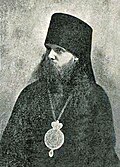
At the beginning of August 1918 the news reached Saratov of the killing by the Bolsheviks, in the night of 17 July 1918, of the family of the last Russian emperor. On 4 August the rector of the church of Saint Seraphim, the priest Michael Platonov, offered a prayerful commemoration of the slain Anointed of God and spoke a word on the persecution of the faith. Many present at the service could not hold back their tears. On 21 August there appeared in the Izvestia of the Saratov Soviet an article, "The Sermon of the 'Holy Father'", which ended with a call to the provincial Cheka to take note of "this outrage" and take the proper measures. The article had its effect: on 24 August Father Michael was arrested. At the search two copies of the printed collection of his sermons, "For Faith and Order", were taken and attached to the case as material evidence of his counter-revolutionary character. In answer, the diocesan council headed by Archpriest Alexis Khitrov, with the blessing of His Grace Germanus (Kosolapov), Bishop of Volsk, ordered the services at the church of Saint Seraphim to cease and called the parishioners to demand the release of their rector.
In September 1918 Trotsky came to Saratov, and gave the chairman of the provincial executive committee, V. P. Antonov-Saratovsky, the order to "undermine the influence of the Church". He ordered the arrest of Bishop Germanus and the whole diocesan council and a show trial. After the show trial in the Great Hall of the Saratov Conservatory on 6 October 1918, Bishop Germanus was sentenced to fifteen years' deprivation of liberty with forced labour, and the priest Michael Platonov to the highest penalty. After appeal, by the verdict of the revolutionary tribunal of 9 January 1919, the bishop was again sentenced for the same act to fifteen years of forced labour, and the priest Michael Platonov to twenty years in prison with public works.
But the new martyrs were not destined to leave the dungeons of the Cheka: after the attempt on Lenin and the advance of Denikin's troops, by decision of the Saratov provincial Cheka of 8 October 1919, they were condemned to death as "implacable enemies of the workers' and peasants' power". According to tradition, when the prisoners learned of the coming shooting, the clergy headed by Bishop Germanus performed within the walls of the Saratov prison the funeral service for themselves and their lay fellow prisoners. The priest Michael Platonov was killed with the bishop, with Archpriest Andrew Shansky (former secretary of the chancery of the holy hieromartyr Hermogenes, Bishop of Saratov) and ten laymen, in the night of 10 October 1919, on the edge of the Resurrection cemetery of Saratov. He was glorified in the year 2006. He is commemorated on 10 October, the day of his death, in the new style, with the Synaxis of the New Martyrs and Confessors of the Russian Church (a movable day) and, on 12 September, with the Synaxis of the Saints of Saratov (a movable day).
Commemorated the same day September 27
 Anthim the IberianHieromartyr · Metropolitan of Ungro-WallachiaSep 27
 John MarkApostle · Companion of Paul and BarnabasSep 27
 Sigebert of East AngliaRight-Believing · King of East AngliaSep 27
 Sabbatius of SolovkiVenerable · Co-founder of Solovki MonasterySep 27
 Zenas the LawyerApostle · Apostle of the SeventySep 27
 Caius of MilanSaint · Bishop of MilanSep 27
 Peter of KrutitsyHieromartyr · Metropolitan of KrutitsySep 27
- Flavian of AntiochSaint · Patriarch of AntiochSep 27
 Callistratus of CarthageMartyrSep 27
 Aquilina of ZagliveriNew MartyrSep 27
 Herman KosolapovHieromartyr · Bishop of VolskSep 27
- AdheritusSaintSep 27