Hieromartyr
Michael Votyakov of Chistopol
Cleric of Chistopol, martyred for the faith of Christ in 1931.
Life
Holy Hieromartyr Michael Votyakov of Chistopol, an archpriest, was born on 5 November 1881 in the village of Votyakovo, Chistopol district of Kazan province, to the peasants Timothy Alexandrovich and Xenia Efimovna Votyakov. In 1899 he finished the parish school at Savrushi and received a certificate of knowledge and right to teach choral singing. In 1899-1901 and 1903 he attended pedagogical courses for teachers in Kazan, in 1901 he passed the examination for teacher in a parish school before the commission at the Chistopol clerical school, in 1903 the examination for reader, and in the same year he entered as reader the church of Saint Nicholas in the village of Zhukotino. On 10 December 1906 he was ordained a deacon for the Entry-into-Jerusalem church of the Mother of God-Sergievsk convent in Tsarevokokshaisk, having been all this time a teacher in various parish schools. In 1911 he passed the examination for the rank of priest, and in 1914 he was ordained a priest for the Protection church in the village of Kumya, Kozmodemyansk district.
In this church, in 1917, Father Michael's temptations began. The churchwarden, with some companions, accused him of extorting money for services and of neglecting his duties. Bishop Anatoly (Grisyuk) of Chistopol, who governed the Kazan diocese, ordered an inquiry, which did not prove the accusations, but the peasants nevertheless signed a decision to remove the priest from the parish. On 1 November 1917 some parishioners begged Bishop Anatoly to contest this decision, showing that the inquiry had been one-sided and that the decision had been signed by only ten householders of one hundred and ninety. The bishop agreed, and Father Michael remained at that church, but relations with the parishioners stayed tense, so in 1919 he was moved to the church of Saints Constantine and Helen in the village of Kulakovo, Kozmodemyansk district. The parish was poor and in the civil war and famine grew poorer still, and the situation of the priest, who by then had a large family, became desperate. In 1921 the parishioners of the village of Krasny Yar asked for him, but by the time the petition reached Bishop Joasaph (Udalov), who then governed the Kazan diocese, another priest had been appointed there. In 1923 the church at Kulakovo was closed by the authorities, and Father Michael was appointed to the Protection church in the village of Sarsasy, where he was raised to archpriest.
In 1929 he was arrested on a charge of agitation against grain levies, but after a few months was released for lack of proof. In 1930 he was sent to serve at the Trinity church in the village of Chistopolskie Vyselki, in place of the priest who had died there. On 20 April 1931 the chairman and secretary of the village council of Chistopolskie Vyselki drew up an act in which they wrote that "the priest Michael Votyakov at every service gives a 'sermon' in which he mentions the collective farms; by the talk of the women, who praise the addresses... he begins his sermon with the life of some saint and ends with: see what we have come to now. Almost always during the 'sermon' Votyakov brings those in church to tears." The village council considered that Votyakov carried on anti-Soviet work in the church, agitated against the collective-farm movement and had to be isolated, in connection with the spring sowing campaign and collectivization.
On 22 April 1931 Father Michael and eleven peasants were arrested and held at Chistopol. The next day the investigator began to question witnesses. A member of the village council said that he had not noticed anti-Soviet agitation in the priest: he had met him once over the sale of straw, and on the road the priest told him that life was bad now, that formerly there was everything and now, under Soviet power, there was nothing, and asked whether he was a collective farmer; when told no, the priest said it was better not to go in. The chairman of the council said that the priest, in his sermons, spoke of the founding of collective farms and asked parishioners to help him pay the taxes, otherwise the church would be closed and there would be no one to serve. A woman worker from a Moscow factory, sent to the village with other townspeople to drive the peasants into the collective farm, said that at the meetings about collectivization the women behaved without restraint and spoke against the collective farm, all connected with religion; until Michael Votyakov was taken no one joined the collective farm, and after he was taken the mass began to enrol, thirty or forty applications a day.
On 28 April the arrested peasants were charged that they had "asked that the priest be helped to pay taxes... insistently demanded at the meeting the opening of the church, saying that we want no collective farm, nor Soviet power, but give us the church, for we want to pray". The next day the investigator questioned Archpriest Michael. Of all the charges he admitted only that he had indeed appealed to the church council to help him pay part of the tax, but the church council refused. "To the population I did not turn with such a request," said Father Michael; "from the faithful I received some food, but not money..." Of talk about the collective farms he said that he always warned them not to begin such conversations; the talk was of a purely religious character. On 30 April the inquiry was ended, and all the arrested were charged that "being hostile to Soviet power and forming a counter-revolutionary grouping, they carried on systematic agitation and spread provocative rumours aimed at weakening Soviet power and wrecking its measures, using for this the religious prejudices of the masses".
On 12 June 1931 the OGPU troika sentenced the priest and some of the peasants to death. Archpriest Michael Votyakov and the peasants were shot on 18 June 1931 and buried in an unknown common grave. He is commemorated on 18 June, the day of his death, in the new style, with the Synaxis of the New Martyrs and Confessors of the Russian Church (a movable day) and, on 17 October, with the Synaxis of the Saints of Kazan.
Commemorated the same day June 5
 Boniface of MainzHieromartyr · Apostle of the GermansJun 5
 Dorotheus of GazaVenerable · Abbot near GazaJun 5
 Igor of ChernigovPassion-Bearer · Grand Prince of KievJun 5
 Luke of SimferopolSaint · Archbishop of CrimeaJun 5
 Dorotheus of TyreHieromartyr · Bishop of TyreJun 5
 Constantine I of KievSaint · Metropolitan of KievJun 5
- EobanHieromartyr · Bishop, companion of Saint BonifaceJun 5
 John of ValaamVenerable · Schema-abbot at New ValamoJun 5
 Jonah and VassianHoly VenerablesJun 5
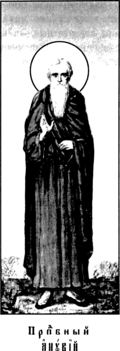 Anoub of ScetisVenerable · Desert Father of ScetisJun 5
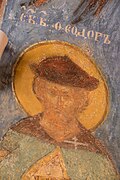 Theodore YaroslavichRight-Believing · Prince of NovgorodJun 5
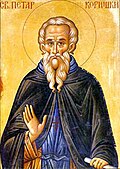 Peter of KorišaVenerable · HermitJun 5