Venerable Martyr
Mstislava Fokina
Nun martyred for the faith of Christ in 1938, during the Soviet persecution.
- Feast
- February 25old style March 10
- Reposed
- 193820th century
- Order
- Martyrs
Life
Venerable Martyr Mstislava Fokina, a nun, was born in 1895 in the village of Maloe Uvarovo, Kolomna district of Moscow province, to Semyon Fokin, a worker at the Kolomna works, and was named Maria at Baptism. Her father had a parcel of land in the village, which, not being occupied with farming, he leased out. Maria finished the village school and from 1908 worked at a silk-twisting factory in Kolomna. In 1913 she had to leave work because her mother fell gravely ill and she nursed her. After her parents' death she remained at first with her brothers, but since they were members of the Communist Party and unbelievers, wishing to serve the Lord wholly, in 1921 she left them and settled in Kolomna, by the church belonging to the Kolomna men's monastery. There she lived until 1930.
On 15 April 1930, in a church in the town of Izhevsk, Maria was tonsured a nun with the name Mstislava and returned to Kolomna, continuing her obedience at the church. Learning from pilgrims that at the Theologian monastery near Ryazan the monks still lived and monastic life was not yet destroyed, in December 1930 she went to the Theologian monastery and settled beside it, in the village of Poshchipovo, and, despite the persecution, was perfectly happy to have found a place where a prayerful monastic life could be lived. The godless authorities were then pursuing with merciless consistency their aim: the destruction in Russia of all beginnings of Christian church life. On 31 May 1931 the monks of the Theologian monastery, and the nuns and laity gathered around the monastery, were arrested, in all forty people, among them the nun Mstislava. All were held in the prison at Ryazan.
At the interrogation the nun Mstislava said, "I declare boldly that the authorities oppress religion; freedom was granted, but it turns out the opposite: monasteries and churches are closed." The investigator asked her who had tonsured her, but she, not wishing to name the priest, said she did not know his name; and to the question why she had done it, she answered that she entered the monastery for the salvation of her soul, "to give myself wholly to the service of God, in Whom I believe, renouncing this world, and no persuasion and no persecution will kill in me my faith in God". On 3 September 1931 the OGPU troika sentenced her to three years in a labour camp, and she was sent by transport to the disposal of the Directorate of the Solovki camps of the OGPU, at Svir station. Serving the whole term at forced labour in Svirlag, in 1934 she returned to Kolomna. As one returned from prison she was forbidden to live here and no one would take her on to work on the strength of the camp certificate, so that she obtained a new passport, as if she had lost her papers, and then began to live in the town, serving at the Protection church. Churches were being closed everywhere, and in 1936 she was forced to take a job as a storekeeper at a gramophone factory in Kolomna.
In the second half of 1937 the authorities began to arrest the priests and monks who remained free, and on 24 February 1938 the nun Mstislava was arrested and held in the prison at Kolomna. The investigator told her that during her stay in Kolomna she had carried on counter-revolutionary agitation, despite her previous conviction. She answered that she did not deny the conviction of 1931 for counter-revolutionary activity, but that in Kolomna she had carried on no agitation among those around her. Extracts from the testimony of witnesses were read to her, which the nun rejected one after another. On 2 March 1938 the NKVD troika sentenced her to death, and she was taken to the Taganka prison in Moscow. The nun Mstislava (Fokina) was shot on 10 March 1938 and buried in the unknown common grave at the Butovo range near Moscow. She is commemorated on 10 March, the day of her death, in the new style (a movable day), with the Synaxis of the New Martyrs of Butovo (a movable day) and with the Synaxis of the Saints of Moscow, on 5 September (a movable day).
Commemorated the same day February 25
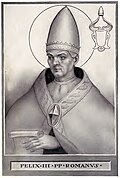 Felix III of RomeSaint · Bishop of RomeFeb 25
 Æthelberht of KentRight-Believing · King of KentFeb 25
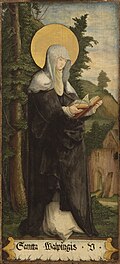 WalburgaVenerable · Abbess of HeidenheimFeb 25
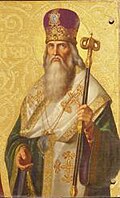 Tarasios of ConstantinopleSaint · Patriarch of ConstantinopleFeb 25
 ConstantinaRight-Believing · Daughter of Constantine the GreatFeb 25
 Donatus of ZadarSaint · Bishop of ZadarFeb 25
 Alexander of RomeMartyr · Roman soldierFeb 25
 Reginos of SkopelosHieromartyr · Bishop of SkopelosFeb 25
 Gennady RebezaVenerable Martyr · Abbot of Bizyukov MonasteryFeb 25
 John LabaVenerable Martyr · MonkFeb 25
 Leo KorobchukHieromartyrFeb 25
- Asclepius of SyriaVenerable · Syrian hermitFeb 25