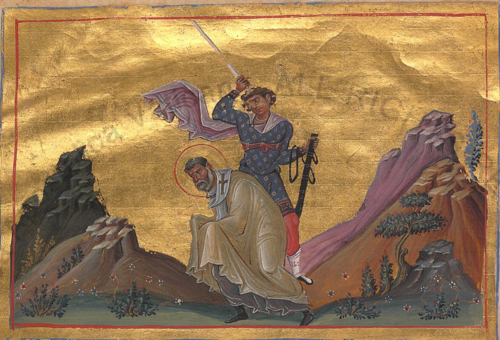
Hieromartyr
Reginos of Skopelos
Bishop of Skopelos
Bishop tortured to death in 362, patron of the island of Skopelos, where part of his relics are kept.
- Feast
- February 25old style March 10
- Reposed
- 3624th century
- Place
- Livadeia
- Order
- Martyrs
Life
Saint Reginos (Riginos), Hieromartyr, bishop of Skopelos, is the protector and patron saint of the island of Skopelos in Greece. According to tradition, he was a bishop who was tortured and killed in the year 362, in the time of the emperor Julian the Apostate. His day, 25 February, is a public holiday on the island. Part of his relics are kept in Skopelos, and most are at Nicosia, in Cyprus.
Beginnings
Reginos was Greek by birth. He was born at Livadeia, in Boeotia, toward the end of the third or the beginning of the fourth century, to pious parents of good deeds, who gave him both worldly and spiritual education. A relative of the family was Bishop Achillios of Larissa, later a saint, known for his works of mercy, and the Russian and Serbian sources call him his uncle. After his first schooling at his birthplace, Reginos studied philosophy, rhetoric and theology, the sciences of the time.
At Nicaea
In 325 the emperor Constantine the Great gathered the First Ecumenical Council at Nicaea in Bithynia, to restore peace in the church affairs of the empire. Reginos had the good fortune to be present and follow the proceedings, accompanying the bishops Achillios of Larissa and Diodoros of Trikka. The council lasted from 20 May to 25 July and was decisive for Reginos, both in experience and in the knowledge he gained. At that council the teaching of Arius was condemned, and Arianism was judged heresy.
At Skopelos
In the fourth century the Orthodox faith on the island of Skopelos was shaken by the errors of heretics and the fury of idolaters. Bishop Achillios decided to send Reginos there, to help strengthen the faith. According to the Russian source, in the time of Constantine's sons, with the Arian Constantius at Constantinople and the Orthodox Constans at Rome, tension between supporters and opponents of the Council of Nicaea continued, and Reginos came to the island to strengthen the local people spiritually, and they asked him to be their bishop. He drew them out of the darkness of heresies and worked in charity. For his piety and pure life he was ordained deacon, then priest, and when the bishop of Skopelos fell asleep, Reginos received the rank of bishop.
In 343 (according to the Greek source, in 347) he was summoned and took part in the Council of Sardica (now Sofia), at which, says the Greek source, 300 Orthodox bishops of the Western Church and 76 Arian bishops of the East assembled. Bishop Reginos distinguished himself and, with proofs from Holy Scripture, overcame the followers of Arius, who left before the end of the proceedings. He returned to Skopelos, where he was received with joy by his flock.
Julian's persecution and martyrdom
In the time of the emperor Julian the Apostate the peace of the Church was again disturbed and fierce persecutions began against Christians. Among the first seized was Bishop Reginos, whose fame had reached Constantinople. The pagan eparch of Greece came to the island and tried, with promises and threats, to make him renounce his faith in Christ. Seeing his steadfastness, he ordered him tortured and imprisoned. On 25 February 362 he was brought for the last time before the eparch. According to the Russian source, to the demand to renounce Christ the saint answered by silence; he was led to the stadium, a place of public executions, where he was tormented with terrible sufferings. According to the Greek source, at the official's command the executioners blinded him and then dragged him to the place called "Old Bridge", where they beheaded him with a sword. At night the inhabitants secretly took their bishop's body and buried it on a nearby hill, beside a spring and an ancient temple in Doric style, at the place where his tomb was later built.
After his sacrifice, Bishop Reginos was numbered among the saints of the Orthodox Church and recognized as protector of Skopelos.
The relics
According to the Greek source, in 1068 a William the Good of Sicily, who made raids on the islands of the Aegean and gathered relics of saints, is said to have taken the relics of Saint Reginos from Skopelos and carried them to Cyprus (the year given does not fit the reign of a king William the Good, and the sources do not clarify this). Later, again by the Greek tradition, in 1740, through the care of the island's council, Hadji Konstantinos was sent to Cyprus, and brought back some parts of them. The Russian and Serbian sources say that only in the nineteenth century did the inhabitants manage to find some particles, which Captain Hadji Konstantinos brought to the island; first they stayed in the church of Saint John the Baptist, then were moved to the cathedral of the Nativity of Christ, near the port. Most of the relics are kept at the church of the Archangel Michael in Nicosia, in Cyprus.
Veneration
At the place where the people of Skopelos buried him a monastery bearing his name was built. The present church was built in the 1960s, and in the monastery courtyard is the saint's sarcophagus. At the start of the twenty-first century thousands of Christians from nearby islands came there each year, on 25 February, to venerate him. The place at Old Bridge, where he is believed to have been beheaded, is called "Agios Riginakis", and there is a small shrine there which the faithful look after, and a prayer is held on the feast day. On the feast day, a holiday on the island, there is a procession with the holy relics and the saint's icon from his monastery to the cathedral of the Nativity of Christ, where they are kept. The names Reginos and, for women, Regina, are very common on Skopelos, for the inhabitants baptize their children with the name of their protector.
One of the first to write about him was the monk and scholar of Skopelos Kaisarios Dapontes (1713 to 1784), who also composed a service to Saint Reginos and a eulogy in which he asks the saint to guard his city and people. The service was reprinted in 1902 by the "Committee of Saint Reginos" of Skopelos and is performed at the vigil and on the feast day.
Commemorated the same day February 25
 Felix III of RomeSaint · Bishop of RomeFeb 25
 Æthelberht of KentRight-Believing · King of KentFeb 25
 WalburgaVenerable · Abbess of HeidenheimFeb 25
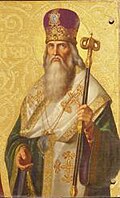 Tarasios of ConstantinopleSaint · Patriarch of ConstantinopleFeb 25
 ConstantinaRight-Believing · Daughter of Constantine the GreatFeb 25
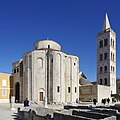 Donatus of ZadarSaint · Bishop of ZadarFeb 25
 Alexander of RomeMartyr · Roman soldierFeb 25
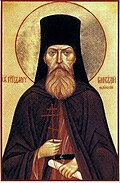 Gennady RebezaVenerable Martyr · Abbot of Bizyukov MonasteryFeb 25
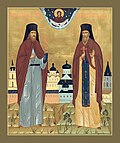 John LabaVenerable Martyr · MonkFeb 25
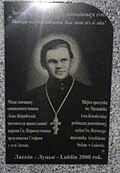 Leo KorobchukHieromartyrFeb 25
- Asclepius of SyriaVenerable · Syrian hermitFeb 25
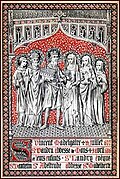 Aldetrudis of MaubeugeVenerable · Abbess of MaubeugeFeb 25