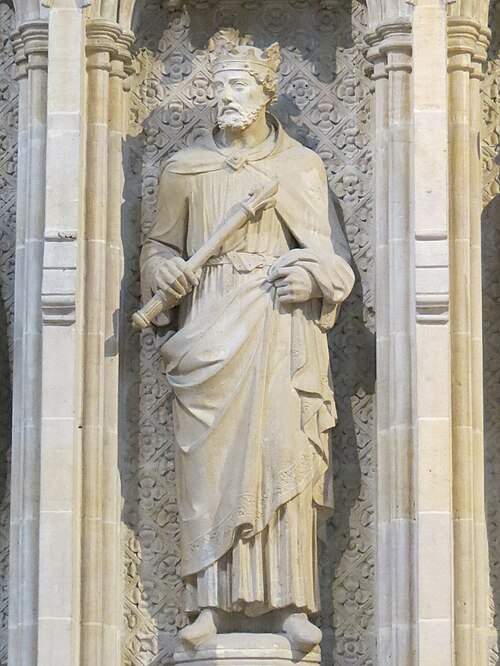
Right-Believing
Æthelberht of Kent
King of Kent
King of Kent, the first Christian Anglo-Saxon king, baptized through the mission of Augustine of Canterbury.
- Feast
- February 25old style March 10
- Reposed
- 6167th century
Life
Saint Ethelbert (Æthelberht), King of Kent, was the first Anglo-Saxon king to receive Christianity, through the mission of Saint Augustine of Canterbury, sent by Pope Gregory the Great. He is honoured as a saint of the undivided Church. He reposed on 24 February 616, and the Orthodox commemoration is on 25 February.
His reign
Ethelbert was the son of King Eormenric and reigned in Kent, in south-eastern England, from about 589 or 590 until his death. The sources are uncertain about his years: Bede says he reigned fifty-six years, but historians think he was born about 560 and came to the throne about 589. He was a powerful king. Bede counts him the third of the rulers who held sway over the other Anglo-Saxon kingdoms south of the River Humber, and the Anglo-Saxon Chronicle gives him the title bretwalda, "ruler of Britain."
He married, probably before he became king, Bertha, the Christian daughter of Charibert I, king of the Franks at Paris. The marriage tied Ethelbert to the strongest state of the West. Bertha came to Kent with a bishop, Liudhard, and kept her faith, so the king knew Christianity before the mission arrived.
The mission of Augustine
In 596 Pope Gregory the Great sent Augustine, prior of the monastery of Saint Andrew in Rome, with nearly forty monks. In 597 they landed on the Isle of Thanet in Kent. According to Bede, the king received them in the open air, fearing they might use magic against him. He listened with goodwill but was not converted at once. He allowed them to settle in Canterbury and to preach.
It is not known when he was baptized. An old tradition places his baptism early in the summer of the year Augustine arrived, 597, and by 601 Pope Gregory was writing to him as a Christian king. By his example and support thousands were baptized. Bede says he compelled no one to become Christian, but showed more affection to those who were baptized. Through him his nephew Saberht, king of the East Saxons, was also won to the faith. Ethelbert gave the missionaries land at Canterbury, where the church and the monastery of Saints Peter and Paul, later Saint Augustine's, were founded.
The laws
Some time after the mission arrived, perhaps in 602 or 603, Ethelbert issued a code of laws in ninety sections, the earliest code written in any Germanic language and among the first texts written in Old English. Its first article speaks of the compensation due for the property of a bishop and of the clergy. The laws set fines for wrongdoing according to the rank of the injured person. The only early manuscript is the Textus Roffensis, of the twelfth century.
Repose
Ethelbert died on 24 February 616. According to Bede, he was buried in the chapel of Saint Martin in the church of the monastery of Saints Peter and Paul at Canterbury, beside Queen Bertha. His son and successor Eadbald was not a Christian, turned away from the faith for a time and the missionaries were driven out, but he later returned to it. The Orthodox calendar that keeps the saints of the West from before the schism commemorates Ethelbert on 25 February. The Roman Catholic Church keeps his memory on 24 February.
Commemorated the same day February 25
 Felix III of RomeSaint · Bishop of RomeFeb 25
 WalburgaVenerable · Abbess of HeidenheimFeb 25
 Tarasios of ConstantinopleSaint · Patriarch of ConstantinopleFeb 25
 ConstantinaRight-Believing · Daughter of Constantine the GreatFeb 25
 Donatus of ZadarSaint · Bishop of ZadarFeb 25
 Alexander of RomeMartyr · Roman soldierFeb 25
 Reginos of SkopelosHieromartyr · Bishop of SkopelosFeb 25
 Gennady RebezaVenerable Martyr · Abbot of Bizyukov MonasteryFeb 25
 John LabaVenerable Martyr · MonkFeb 25
 Leo KorobchukHieromartyrFeb 25
- Asclepius of SyriaVenerable · Syrian hermitFeb 25
 Aldetrudis of MaubeugeVenerable · Abbess of MaubeugeFeb 25