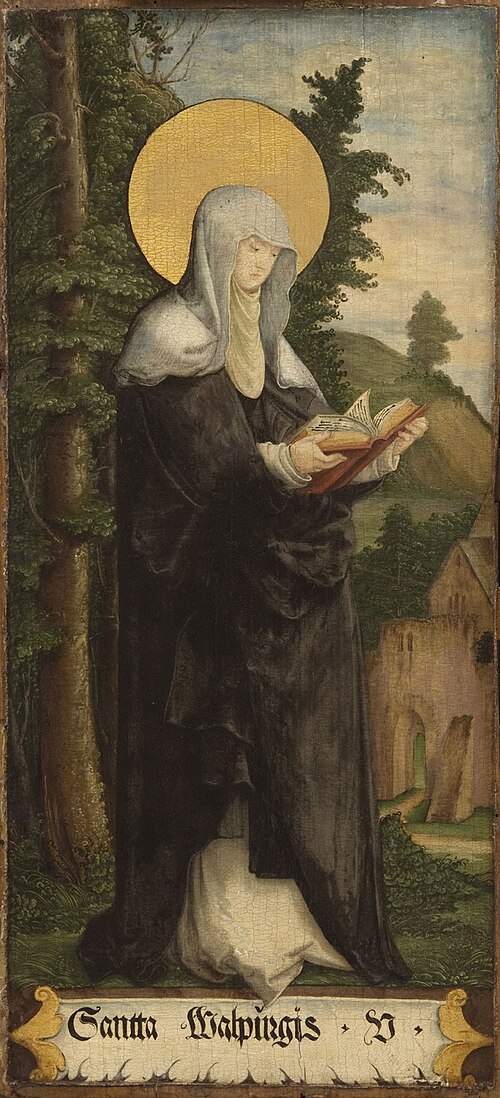
Venerable
Walburga
Abbess of Heidenheim
Anglo-Saxon missionary to the Frankish empire, abbess of the monastery at Heidenheim.
- Feast
- February 25old style March 10
- Reposed
- 7798th century
- Order
- Venerables
Life
Saint Walburga (Walpurga) was an Anglo-Saxon missionary in the Frankish lands and abbess of the double monastery of Heidenheim. She lived in the eighth century and is commemorated on 25 February. Venerated in the Catholic Church, she is also regarded as a local saint in the Berlin and German diocese of the Russian Orthodox Church. The day of her canonization, 1 May, gave its name to “Walpurgis Night”.
Family and youth
She was born around 710 in Dumnonia (modern Devon), in the southwest of England, in a distinguished family, daughter of Richard the Pilgrim and Wuna of Wessex, and sister of Willibald and Winibald. In 721 Richard set out on pilgrimage to Rome with his two sons, entrusting Walburga, then eleven, to the abbess of the double monastery of Wimborne in Dorset. After a year she learned that her father had died at Lucca. Her brothers buried their father and went on to Rome, where they fell gravely ill. Willibald then set out for the Holy Land, and after some seven years returned to Italy and became a monk at Monte Cassino; Winibald stayed at Rome. Meanwhile Walburga remained at Wimborne, where she was educated and became a nun. The nuns there were skilled at copying and decorating manuscripts and at embroidery. She spent twenty-six years in this community.
Mission in Germany
In 737 her uncle Boniface, in Rome, called his nephews to help him in the mission in Germany. Winibald arrived in Thuringia in 740 and, ordained priest, was given charge of seven churches; Willibald, ordained by Boniface in 741, began work around Eichstätt and became its first bishop. Walburga crossed the Channel and landed perhaps near Antwerp, with the nun Hugeburc, who would write the lives of Willibald and Winibald, and with relatives, among them Lioba. Tradition says that during the crossing a terrible storm broke out and Walburga knelt and prayed, and the storm calmed; for this she is regarded as patron of sailors.
She came to the double monastery of Heidenheim am Hahnenkamm, founded by Winibald. After his death, in 761, she took over the monastery’s leadership as abbess, and was one of the most important women of European Christianity of her time. Boniface was among the first to see in women full missionaries. Her biographer, Wolfhard of Herrieden, tells of other miracles of hers: the calming of mad dogs that had attacked her and the saving of a child from hunger with three ears of grain. The healing of a dying girl and of a woman near death in childbirth are also attributed to her.
Death and veneration
She died on 25 February 777 or 779 (the sources do not agree, some give 780), after receiving the last communion from her brother Willibald, and was buried at Heidenheim. She was canonized on 1 May, probably in 870, by Pope Adrian II, on the initiative of Bishop Otgar of Eichstätt, who found her relics and moved them to the church of the Holy Cross. At Eichstätt her bones were placed in a niche in the rock from which an oil began to drip, called “Walburga’s oil”, regarded as healing, especially from October to February, which drew pilgrims. Her veneration grew in the eleventh century, when Anno II of Cologne carried part of the relics to Berg (today Walberberg) in 1069. The night of 30 April to 1 May is called “Walpurgis Night”. She is patron against sickness and epidemics, of the sick, of women in childbirth and of farmers. An asteroid bears her name, and the fortified church of Cisnădie (Heltau) in Transylvania had, until the Reformation, her dedication.
Commemorated the same day February 25
 Felix III of RomeSaint · Bishop of RomeFeb 25
 Æthelberht of KentRight-Believing · King of KentFeb 25
 Tarasios of ConstantinopleSaint · Patriarch of ConstantinopleFeb 25
 ConstantinaRight-Believing · Daughter of Constantine the GreatFeb 25
 Donatus of ZadarSaint · Bishop of ZadarFeb 25
 Alexander of RomeMartyr · Roman soldierFeb 25
 Reginos of SkopelosHieromartyr · Bishop of SkopelosFeb 25
 Gennady RebezaVenerable Martyr · Abbot of Bizyukov MonasteryFeb 25
 John LabaVenerable Martyr · MonkFeb 25
 Leo KorobchukHieromartyrFeb 25
- Asclepius of SyriaVenerable · Syrian hermitFeb 25
 Aldetrudis of MaubeugeVenerable · Abbess of MaubeugeFeb 25