Hieromartyr
Nicholas Tokhtuev
Cleric martyred for the faith of Christ.
Life
Holy Hieromartyr Nicholas Tokhtuev was a protodeacon at Kungur, in the Urals, with a wonderful bass voice, and died in a camp on 17 May 1943.
Family and childhood
He was born on 9 May 1903 in the Bym works of the Osa district of the Perm province, in a peasant family. The Tokhtuev line came from baptised Tatars, settled there in the first half of the eighteenth century, blacksmiths from father to son, famed for their skill. The sin of drink was widespread among the craftsmen, and Nicholas's grandfather, up to fifty a wonderful smith, lost his health and soon died. His father, Basil Nikolaevich, made a vow to God in childhood not to drink a drop, and kept it all his life. His mother, Maria Matveevna, a devout and well-read person, raised Basil in a religious spirit. Basil was elected volost elder four times, an energetic and just man, and in 1906 he was elected to the first State Duma by the Osa district; after three months the Duma was dissolved and he returned home, then was a member of the district administration, in charge of schools, libraries and hospitals; dozens of schools were built under his direction. Nicholas's mother, Maria Matveevna, was a woman of deep faith, a harsh word was never heard from her, she laboured all day with joy, prayed at night on her knees, reading the Psalter, and received with love the pilgrims who came to the Belogorsk monastery, nine kilometres away. The Belogorsk Monastery of Saint Nicholas, founded in 1897 by Archimandrite Barlaam, became a centre of enlightenment of the Urals; the faith of his parents, the nearby monastery and the services there formed the young Nicholas. In 1916 he finished the two-class school in Bym and the following year entered the school for psalm-readers at the bishop's house in Perm.
The protodeacon
After finishing the school, in 1919, he was named reader at the church of the Holy Trinity in the village of Ashapa; on 14 May 1922 he was ordained deacon for the same church, in 1923 he was sent to the church of Saints Peter and Paul in Uinskoye, in 1924 to the church of Saint Nicholas in Kylasovo. Then a beautiful and powerful bass opened in him, such as no deacon of Kungur and Perm had, and on 26 January 1925 Bishop Arcadius (Ershov) of Kungur called him to the Dormition Cathedral of Kungur. The bishop came to love him for his simplicity, kindness and freedom from possessions. In 1925, on the Sunday of Orthodoxy, he was raised to protodeacon and received the double orarion.
The OGPU watched the clergy all the time, arresting some, forcing others to collaborate and others to leave the ministry. In 1931 he was asked, under threat of arrest, to sign a pledge as informer, and he gave it, but did not collaborate. In the same year his father was deprived of electoral rights as a former deputy of the Duma, and the two sons, among them the protodeacon Nicholas, were sent, as sons of a "disenfranchised", to the rear militia, where conditions were like those in a camp; he worked at Yekaterinburg. In December 1932 an OGPU agent found, in the file "The Toilers", that some priests and laymen, discontented with the authorities, carried on anti-Soviet agitation, predicted the fall of the authorities, the end of the world and the Last Judgement and spread "holy letters". Twenty-seven persons were arrested. The protodeacon Nicholas was arrested on 19 January 1933 and imprisoned at Kungur in a basement cell for ten people, in which fifty were crammed, with damp, stifling air and tobacco stench, and some died. He stayed there half a year. At the interrogation he said that he was a convinced believer and believed in the coming of the antichrist, the second coming of Christ, the Last Judgement and the end of the world, but that he had not set or predicted dates and had not spread "holy letters"; that the existence of Soviet power was incompatible with religion and his convictions, since it preaches atheism. Of the pledge of 1931 he said that he had not fulfilled it and had even carried on anti-Soviet activity, and that he recognised the authorities only so far as they did not harm the faith. On 28 May 1933 the Special Council sentenced him to three years of exile in the Urals.
Sick with typhus in prison, he was released after the sentence to go freely to the place of exile, but the illness developed complications and until November he could not move. Recovered, on the advice of relatives he went to Moscow instead of exile and from the end of 1933 served in a church of the Kaluga diocese; in 1934 he moved to the church at Naro-Fominsk. The rector, the archpriest Sergius Pavlov, was an NKVD informer and demanded that he give false testimony; at his refusal, he threatened him with prison. The protodeacon left in 1935 for the church of the Protection at Petrovskoye, and in January 1938 for the church of Saints Cosmas and Damian at Bolshevo, where he took singing lessons from the leader of the Alexandrov ensemble, was invited into the ensemble and was offered a place at the Bolshoi Theatre.
Arrested again in 1940, he said at the interrogation that he had no close ties with the priests of Bolshevo, for fear that one of them might be an NKVD agent, and that he considers traitors those who help the authorities to expose the discontented: "I shall never be so, neither under Soviet power, nor under tsarist, nor under fascist." He said that in life on earth there are many injustices and that human life cannot end with earthly life, for Someone must judge and repay each according to his deeds, and that in newspapers and books they write wrongly about religion, while he believes everything written in Holy Scripture. On 2 September 1940 the Special Council sentenced him to eight years in a camp and he was sent to Sevzheldorlag, in Komi. He wrote his last letter to his family from the settlement of Kozhva, in early 1943. The protodeacon Nicholas Tokhtuev died in the camp on 17 May 1943 and was buried in an unknown place.
He is remembered on 17 May, on 11 February in the Synaxis of the Komi Saints, on 14 February (a movable day) in the Synaxis of the Saints of the Perm Metropolis, on 5 September (a movable day) in the Synaxis of the Saints of Moscow, and on 7 February (a movable day) in the Synaxis of the New Martyrs and Confessors, in the new style.
Commemorated the same day May 4
 MonicaFool-for-Christ · Mother of Augustine of HippoMay 4
 FlorianMartyr · of LauriacumMay 4
 Erasmus of FormiaHieromartyr · Bishop of FormiaMay 4
 Godehard of HildesheimSaint · Bishop of HildesheimMay 4
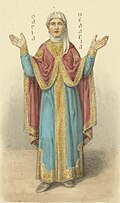 Pelagia of TarsusMartyrMay 4
 Sylvanus of GazaHieromartyr · Bishop of GazaMay 4
 Alvian of AneaHieromartyr · Bishop of AneaMay 4
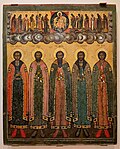 Alfanov Brothers of NovgorodHoly Venerables · Five monk brothers of NovgorodMay 4
 Trendafil KerelovNew Martyr · Priest of BatakMay 4
 Mavra of Mount CeahlăuVenerable · Schemanun of Mount CeahlăuMay 4
- New Martyrs of BatakHoly New MartyrsMay 4
- Nikephoros the SolitaryVenerable · Athonite monkMay 4