Martyr
Nina Kuznetsova
Christian woman martyred for the faith of Christ.
Life
Holy Martyr Nina Kuznetsova was an ascetic of the town of Lalsk, in the Vologda province, a laywoman with a life of prayer and hospitality to strangers, and she died in a camp in the Arkhangelsk region on 14 May 1938.
Her life
She was born on 28 December 1887 in the town of Lalsk in the Vologda province, in a pious family, that of Alexei Kuznetsov, a police sergeant, and Anna. She was their only child, loved beyond measure. Her parents dreamed of marrying her off, but from childhood Nina loved only prayer, monasteries and spiritual books. In Lalsk there were eight churches, though the town scarcely had a thousand inhabitants. Her father, seeing his daughter's attraction, judged it unwise to insist on the way of a family and stand in her way: he gave her a storeroom as a cell, in which he himself made shelves, and bought spiritual books for her at monasteries and church shops. So Nina gathered a rich library; she had no greater comfort than reading. She prayed much, knew many prayers by heart and read the Psalter from memory. In prayer and labour her soul grew in purity and virtues and strove toward perfection. Then she began to receive, according to the Gospel's command, strangers and people in need. Her parents accepted her path, and saw themselves that the time of persecution was coming.
In 1932 the authorities arrested Alexei and Anna, who were old and, unable to bear the hardships of prison, soon died. They meant to arrest Nina too, but on the day of her parents' arrest paralysis struck her, so they left her at home. All her life afterward she moved with difficulty and could hardly use her right hand; when she had to cross herself, she helped herself with the left. Because of her grave illness they left her the house and the property, which she disposed of as well as could be. The house was large, with a huge kitchen where up to twenty people could lie on the bench, and five on the stove, and a large room always full of people, mostly women whose husbands had been arrested and property taken. All came to Nina and found shelter and food.
After the closing of the Koryazhma Monastery at the start of the revolution, its brotherhood moved to Lalsk and a monastery of twelve monks was formed there. Under a church, in a former storeroom, they built a stove, cut two windows and divided it in two cells; they served in the cathedral of Lalsk and kept the monastic order. The abbot was Paul (Khotemov), of Zyryan stock. He learned to read from a benefactor teacher, and as a boy some women going on foot on pilgrimage to Kiev took him with them; the journey took a year and there, at the relics in the caves of the Lavra, he understood what the monastic way of salvation is. "I pray every day for the women who took me to Kiev", he said. Father Paul knew by heart over six hundred names which he remembered at the Liturgy, and came to church several hours early to perform the proskomedia. Asked what a monastery is, he answered: "A monastery is the seventeenth kathisma and sour cabbage every day." He fasted very strictly. After this monastery too was closed, some of the brothers, among them the abbots Paul and Niphon, found shelter in the house of the blessed Nina.
She kept her ascetic "rule" strictly. She slept four hours a day and at two in the night always rose to pray with the monks. She never drank tea or milk, ate no sugar or anything tasty; her food was only rusks soaked in water, though in her house the samovar never left the table and there were always guests. She never sat at the table, but in the corner, by the stove, on a log. She never slept in a bed, but lay in a corner of the house, under the washstand, pulling her blanket over her head. She was in church at every service, settled somewhere in the choir and seemed to sleep, but as soon as someone stumbled in the text, she said what followed, for she knew the service by heart. Father Paul, whose sight was poor, would open the altar door and ask her: "Nina, which section of the Apostle and the Gospel is read?" She answered and never erred.
Arrest and death
In November 1937 she was arrested, but no charges could be found. They kept her half a month in the Lalsk prison without asking her anything. Many people were forced to lie against the ascetic, but only one agreed, the deputy chairman of the Lalsk soviet, who said that Kuznetsova was an active churchwoman, who opposed the closing of churches and laboured ceaselessly for the opening of others: "In the summer of 1936, when the soviet wished to close the church in Lalsk, Kuznetsova organised a campaign which frustrated the measure, gathered signatures and held meetings of the faithful in her house. In August 1937 the soviet began to gather the signatures of residents who wanted the church closed, but Kuznetsova again gathered the faithful in her house and frustrated the measure. When the reader Melentyev was arrested, she at once began to intercede for him." In the middle of November 1937 she was charged and questioned. She said that in her house lived the priest Paul Fyodorovich Khotemov and that other believers came for church matters; she denied having said that "this power will not last long, war is coming and all will be as before". She did not admit guilt. The day after the interrogation she was sent to the prison at Kotlas. On 23 November 1937 an NKVD troika sentenced her to eight years in a labour camp. She was sent to a camp in the Arkhangelsk region, where she stayed briefly; on 14 May 1938 she died.
She is remembered on 14 May, on 21 October in the Synaxis of the Saints of Vyatka, on 1 November in the Synaxis of the Saints of the Archangelsk Metropolis, and on 7 February (a movable day) in the Synaxis of the New Martyrs and Confessors, in the new style.
Commemorated the same day May 1
 JeremiahProphet · The ProphetMay 1
 Tamar of GeorgiaRight-Believing · Queen of GeorgiaMay 1
 Sigismund of BurgundyPassion-Bearer · King of the BurgundiansMay 1
 Bertha of KentRight-Believing · Queen of KentMay 1
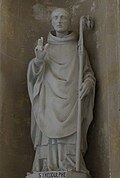 Theodulf of OrléansSaint · Bishop of OrléansMay 1
 Æthelred of MerciaRight-Believing · King of MerciaMay 1
 OrientiusSaint · Latin Christian poetMay 1
 Isidore of ChiosMartyrMay 1
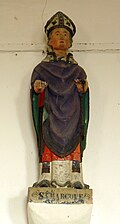 Marculf of NantusVenerable · Abbot in the CotentinMay 1
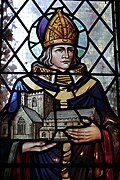 Asaph of LlanelwySaint · First Bishop of St AsaphMay 1
 AndeolusMartyr · Missionary in GaulMay 1
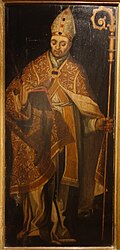 Torquatus of GuadixSaint · Bishop of GuadixMay 1