Venerable
Onuphrius of Katroma
Venerable monk, venerated in the Orthodox calendar.
- Feast
- June 12old style June 25
- Era
- unknown
- Order
- Venerables
Life
Holy Venerable Onuphrius of Katroma was the founder of a monastery at Katroma, in the Vologda region; it is not known when he lived and died.
From the written sources that remain it is seen that the Katroma monastery already existed at the beginning of the sixteenth century and that in 1532, when Prince Ivan Danilovich Penkov gave the monastery nineteen villages and hamlets, the venerable founder was no longer alive. Beyond this no other news of him has been preserved, though the place of his burial, the gravestone, was always known, his memory was honoured in the monastery and his name was entered in the calendar. The cause, without doubt, was the fires in the monastery, from which not even the deeds of land ownership escaped.
About thirty years passed, when the memory not only of the long-closed monastery but of the burned churches was bound to vanish from the memory of the people around, and suddenly the forgotten grave of the venerable founder began to draw worshippers from everywhere by the thousand. The name of Venerable Onuphrius passed from mouth to mouth, and his gravestone became a source of healings. About this the priest John Rzhanitsyn (father of Archbishop Alexis of Tver) wrote in his report to Bishop Stephen of Vologda, and in October of the same year the clergy of the Transfiguration church at Karachunovo, in whose parish the site of the Katroma monastery lay, submitted to him a report with records of wonderful healings at the venerable one's grave in July, August and September; twenty-six healings were recorded.
Bishop Stephen twice refused to permit the building of a chapel on the site of the burned churches, but the peasant Nikitin, without permission, put up the chapel. A correspondence with the governor began, and the diocesan authorities demanded that the chapel be destroyed and the place filled in. The chapel remained untouched, and the next year people gathered at the grave in still greater numbers. The peasant Nikitin declared to the bishop that he had put up the chapel by the command of Saint Nicholas and Venerable Onuphrius, who had appeared to him in a dream, and presented two lists of those healed by Venerable Onuphrius. By the ukaz of 25 September 1835 the Holy Synod decreed that the chapel not be destroyed, that services of supplication to Saint Nicholas be celebrated there, that the memorial service for Venerable Onuphrius not be forbidden, and entrusted this to the monastics of the Semigorodnaya Hermitage. When the site of the Katroma monastery passed to the Semigorodnaya Hermitage, on the place of the burned church of Saint Nicholas a larger wooden chapel was soon built, turned in 1867 into a church dedicated to the saint. In 1868, through the zeal of the hermitage's abbot, Archimandrite Nectarius, beside the wooden church a stone five-domed two-storey church was built, and in 1869, on 28 September, the holy table and antimension were moved into it, after the death of the builder, who found his grave beneath its vaults. In the monastery book, after the many wonderful healings of the years 1834-1836, the last recorded is that of 1873, written by the healed man himself.
He is remembered on 11 July (a movable day), in the Synaxis of the Saints of Vologda, in the new style.
Commemorated the same day June 12
 Leo III of RomeSaint · Bishop of RomeJun 12
 Onuphrius the GreatVenerable · Hermit of the ThebaidJun 12
 John TornikeVenerable · Georgian general, monk at IvironJun 12
 Anna of KashinRight-Believing · Princess of TverJun 12
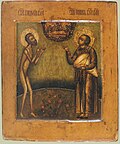 John of MoscowFool-for-Christ · Fool for ChristJun 12
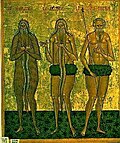 Peter the AthoniteVenerable · First hermit of Mount AthosJun 12
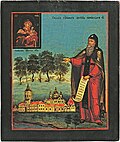 Arsenius of KonevetsVenerable · Founder of Konevets MonasteryJun 12
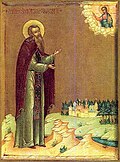 Stephen of KomelVenerable · Founder of Saint Nicholas MonasteryJun 12
- Auxentius of VologdaVenerableJun 12
- Onuphrius of MalskVenerableJun 12
- Onuphrius of VologdaVenerableJun 12
- Agatan of Disert AgatainSaintJun 12