Saint
Paulinus of York
First Bishop of York
Roman missionary sent by Pope Gregory the Great, first bishop of York, who died in 644.
- Feast
- October 10old style October 23
- Reposed
- 6447th century
- Place
- Rochester
- Order
- Hierarchs
Life
Saint Paulinus of York was a Roman monk, missionary to England and the first bishop of York. He belonged to the second group of missionaries sent in 601 by Pope Gregory the Great to bring the pagan Anglo-Saxons to Christianity, preached the Gospel in Northumbria, and died on 10 October 644 as bishop of Rochester. The Orthodox Church remembers him in the Synaxis of the Saints of Britain and Ireland.
The mission
Paulinus was a monk at Rome, according to some sources at the monastery of St Andrew, and probably of Italian birth. He left in 601 for England with Mellitus and others, in the second group sent by Gregory the Great to help Archbishop Augustine of Canterbury. The pope wished York to be the chief see of the northern provinces, which would shape Paulinus's later work. The group reached Kent in 604. Almost nothing is known of the next two decades.
On 21 July 625 (in some historians' view 626) he was consecrated bishop by Archbishop Justus of Canterbury. King Edwin of Northumbria asked for the hand of Æthelburg, sister of King Eadbald of Kent, and promised that she might remain a Christian and that her household would not be hindered in its faith. Paulinus went with her to Northumbria, to serve the queen and to try to bring the local people to the faith. Bede describes him as a tall man, slightly stooped, with black hair, a thin face and a thin hooked nose, of venerable and awe-inspiring appearance.
The baptism of King Edwin
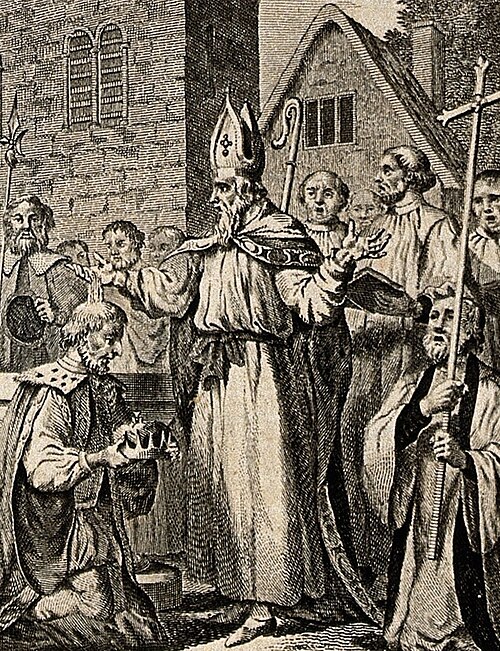
At Easter 626 the queen gave birth with difficulty to a daughter, Eanflæd, and Paulinus said she had come into the world through his prayers. Two days before, the king had escaped an assassination plotted by the king of Wessex. Edwin promised to become a Christian if he won in Wessex, but did not keep his word at once. According to Bede, he decided after Paulinus recalled a dream from the time of his exile at the court of King Rædwald of East Anglia and laid a hand on his head, the sign from the dream. It is unlikely, however, that a vision alone convinced him; the nobles seemed willing, and Pope Boniface V had written to the king urging him to be baptized.
Edwin and many of his people were baptized at York in 627. It is told that at the royal residence at Yeavering Paulinus baptized converts for thirty-six days. He also worked in Lindsey. He baptized the future Saint Hilda of Whitby. At York he built a church; Gregory the Great had planned York as England's second metropolitan see.
Withdrawal and end
After King Edwin's death in 633, Paulinus and Queen Æthelburg fled Northumbria. He left James the Deacon behind. He returned to Kent and became bishop of Rochester. He received from the pope the pallium of archbishop of York, but too late for it to take effect. He departed to the Lord on 10 October 644. He was numbered among the saints and is venerated in the Orthodox, Catholic and Anglican Churches.
Commemorated the same day October 10
 Victor of XantenMartyrOct 10
 Gereon of CologneMartyr · Martyr of CologneOct 10
 Ambrose of OptinaVenerable · Elder of Optina MonasteryOct 10
 Clarus of NantesSaint · First Bishop of NantesOct 10
 Cerbonius of PopuloniaSaint · Bishop of PopuloniaOct 10
 Eulampius and EulampiaHoly MartyrsOct 10
- Pinytus of KnossosSaint · Bishop of KnossosOct 10
 Innocent of PenzaSaint · Bishop of Penza and SaratovOct 10
 Martyrs of ZographouHoly Venerable Martyrs · Monks of Mount AthosOct 10
- Andrew of TotmaFool-for-Christ · Fool for ChristOct 10
 Methodius of PochaivVenerable · First abbot of Pochaiv MonasteryOct 10
- 200 MartyrsHoly MartyrsOct 10