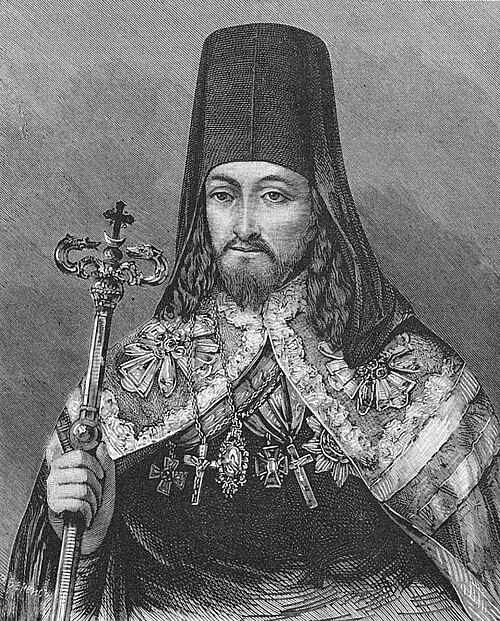
Saint
Innocent of Penza
Bishop of Penza and Saratov
Bishop of Penza and Saratov and rector of the Saint Petersburg seminary, canonized in 2000.
- Feast
- October 10old style October 23
- Reposed
- 181919th century
- Place
- Penza
- Order
- Hierarchs
Life
Saint Innocent (in the world Hilarion Dmitrievich Smirnov) was born on 30 May 1784 in the village of Pavlovo, near Moscow, and fell asleep at Penza on 10 October 1819. He was bishop of Penza and Saratov, rector of the Saint Petersburg seminary and a learned professor of church history. He was canonized in August 2000, at the Jubilee Council of Bishops of the Russian Orthodox Church, among the hierarchs, for veneration throughout the Church. He is remembered on 10 October on the old calendar.
Childhood and studies
He was the son of the sexton Dimitry Egorov of the church of the Resurrection at Pavlovo (now Pavlovsky Posad). From childhood he stood out for a gentle nature, so that when he entered the Perervino seminary in Moscow he was nicknamed Smirnov, that is "meek", for his meekness and blameless conduct. Finishing the seminary as the best pupil, Hilarion was moved to the seminary of the Trinity Lavra, where he continued his studies in the classes of history, philosophy, theology and foreign languages.
In 1805, before finishing the seminary, he was appointed teacher in the primary grammar class. Then he was entrusted with teaching poetry, being also a catechist. From 1809 he taught philosophy and was prefect of the seminary.
Monk and professor
On 13 October 1809, in the Trinity-Sergius Lavra, Metropolitan Platon tonsured him a monk with the name Innocent. The next day he was ordained hierodeacon and then hieromonk. On 6 August 1810 he was appointed abbot of the Saint Nicholas monastery at Ugresha, and on 14 October was moved to the Znamensky monastery in Moscow. On 22 January 1812 he was offered a place as professor of theology at the Saint Petersburg Theological Academy, and on 30 August was raised to archimandrite. In September 1813 he was appointed rector of the theological seminary in Saint Petersburg, professor of theology and member of the committee of spiritual censorship, remaining also a teacher of church history at the Academy.
As a teacher of church history he was remarkable: he did not follow the beaten track but, as far as he could, checked historical data against the sources. His tireless work produced the Outline of Church History from biblical times to the eighteenth century, published in 1817, which served for half a century as a textbook in church schools. His works Practical Theology, Attempt at an Explanation of the First Two Psalms and Explanation of the Creed were also important. In 1814 he was given the degree of doctor of theology. From 1813 to 1816 he was abbot of the Sergiev Hermitage, then of the Yuriev monastery. From 7 April 1817 he was a member of the Main Board of People's Schools and a member of the Russian Academy.
The bishop
He was an active opponent of the mysticism then in fashion, and when, as spiritual censor, he approved the printing of the book of Evstafy Stanevich, Lament at the Grave of an Infant, he was appointed, under the guise of a promotion, without election by the Synod, bishop at Orenburg, which was in fact an exile. At the Holy Synod's request, because of his weak health, the appointment was changed to Penza. On 2 March 1819 he was consecrated bishop of Penza and Saratov in the Kazan cathedral in Saint Petersburg. On 21 June 1819 he arrived at Penza. In August he went to Saratov and fell gravely ill. On 10 October he asked for the Mystery of Holy Unction and, after it, fell asleep. He was buried on 13 October 1819 in the cathedral of the Saviour in Penza (blown up in 1934, being rebuilt since 2011).
Relics and writings
From 2000 to 2021 his relics lay in the Dormition cathedral in Penza, and since 17 October 2021 they are in the rebuilt cathedral of the Saviour. He received the orders of Saint Vladimir, second class, and Saint Anna, second class. His writings, Sermons and Letters, were published in two parts, in 1821 and 1845. His textbook Church History (1807) was long used in the seminaries.
Commemorated the same day October 10
 Paulinus of YorkSaint · First Bishop of YorkOct 10
 Victor of XantenMartyrOct 10
 Gereon of CologneMartyr · Martyr of CologneOct 10
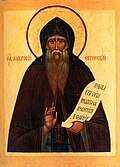 Ambrose of OptinaVenerable · Elder of Optina MonasteryOct 10
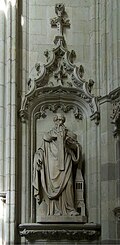 Clarus of NantesSaint · First Bishop of NantesOct 10
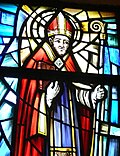 Cerbonius of PopuloniaSaint · Bishop of PopuloniaOct 10
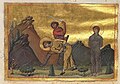 Eulampius and EulampiaHoly MartyrsOct 10
- Pinytus of KnossosSaint · Bishop of KnossosOct 10
 Martyrs of ZographouHoly Venerable Martyrs · Monks of Mount AthosOct 10
- Andrew of TotmaFool-for-Christ · Fool for ChristOct 10
 Methodius of PochaivVenerable · First abbot of Pochaiv MonasteryOct 10
- 200 MartyrsHoly MartyrsOct 10