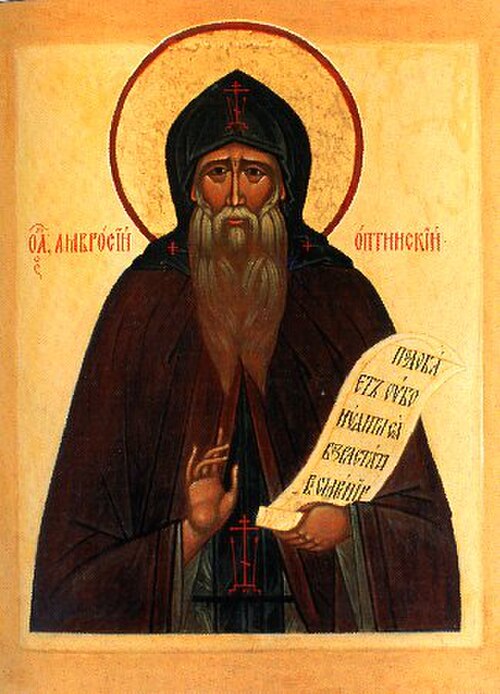
Venerable
Ambrose of Optina
Elder of Optina Monastery
Elder and hieroschemamonk at Optina, born Alexander Grenkov, who died in 1891; canonized in 1988.
- Feast
- October 10old style October 23
- Reposed
- 189119th century
- Place
- Kaluga Governorate
- Order
- Venerables
Life
Saint Ambrose of Optina, in the world Alexander Mikhailovich Grenkov, was an elder and hieroschemamonk at Optina Monastery, born in 1812 and fallen asleep in 1891. He was canonized by the Russian Church on 6 June 1988, at the Local Council. He served as spiritual guide to countless people, among them writers such as Dostoevsky and Tolstoy, and Dostoevsky had his image in mind for Elder Zosima in The Brothers Karamazov. He is commemorated on 10 October, the day of his repose, and on 27 June, the finding of his relics, and in the Synaxis of the Elders of Optina.
He was born on 5 December 1812 in the village of Bolshaya Lipovitsa in Tambov province, in the house of his grandfather, a priest, son of the sexton Mikhail Fyodorovich and Marfa Nikolayevna Grenkova. He was the sixth of eight children. At twelve he entered the clerical school in Tambov, then the seminary. In 1835, shortly before graduation, he fell gravely ill and vowed to become a monk if he recovered. He recovered but delayed the decision and became a tutor in a landowner's house and then at the clerical school in Lipetsk. During summer vacation he met a well-known elder, Hilarion of Troekurovo, who advised him: "Go to Optina and you will be experienced. You could go to Sarov too, but there are no more experienced elders there." Hilarion added: "They need you there." After this advice, in October 1839, he entered Optina Monastery in Kaluga province, which was then in its spiritual flowering. His first guide was Elder Leonid, then Elder Macarius, with whom he shared a cell. He was tonsured a monk in 1842 with the name Ambrose, in honour of Ambrose of Milan, and three years later was ordained hieromonk. On the way to Kaluga for ordination he caught cold, and from then on his health was so poor that he could hardly serve. Because of illness he lived for several years in semi-seclusion, which helped him master the Jesus Prayer and the stillness of the soul before God. He helped Macarius translate the Church Fathers, especially The Ladder of Divine Ascent by Saint John Climacus. He was cheerful and sociable, which sat oddly with his strict spiritual discipline.
After Macarius died, in 1860, he was the principal elder of Optina for thirty years. Thousands visited him, and his love for each was so strong that he received people even when he had to lie down from exhaustion. He is said to have had the gift of seeing into people's souls, of healing and of wisdom, which he tried to conceal. Out of humility he himself sought advice, first from Bishop Gregory, then from a hidden elder to whom he wrote in secret. In 1884 he founded the Shamordino convent near Optina, which received women who were poor, sick or even blind. After the death of its first abbess, Mother Sophia, he went there in June 1890 to put its affairs in order and could not return to Optina because of illness. He fell asleep at Shamordino on 10 October 1891 and was buried in the Optina hermitage, and soon after his repose miracles began. On his gravestone are the words of the Apostle Paul: "To the weak I became weak, that I might win the weak. I have become all things to all men, that I might by all means save some." His relics were placed in the Entrance Church of the monastery, and in 1998 moved to the church of the Vladimir Icon of the Mother of God.
Commemorated the same day October 10
 Paulinus of YorkSaint · First Bishop of YorkOct 10
 Victor of XantenMartyrOct 10
 Gereon of CologneMartyr · Martyr of CologneOct 10
 Clarus of NantesSaint · First Bishop of NantesOct 10
 Cerbonius of PopuloniaSaint · Bishop of PopuloniaOct 10
 Eulampius and EulampiaHoly MartyrsOct 10
- Pinytus of KnossosSaint · Bishop of KnossosOct 10
 Innocent of PenzaSaint · Bishop of Penza and SaratovOct 10
 Martyrs of ZographouHoly Venerable Martyrs · Monks of Mount AthosOct 10
- Andrew of TotmaFool-for-Christ · Fool for ChristOct 10
 Methodius of PochaivVenerable · First abbot of Pochaiv MonasteryOct 10
- 200 MartyrsHoly MartyrsOct 10