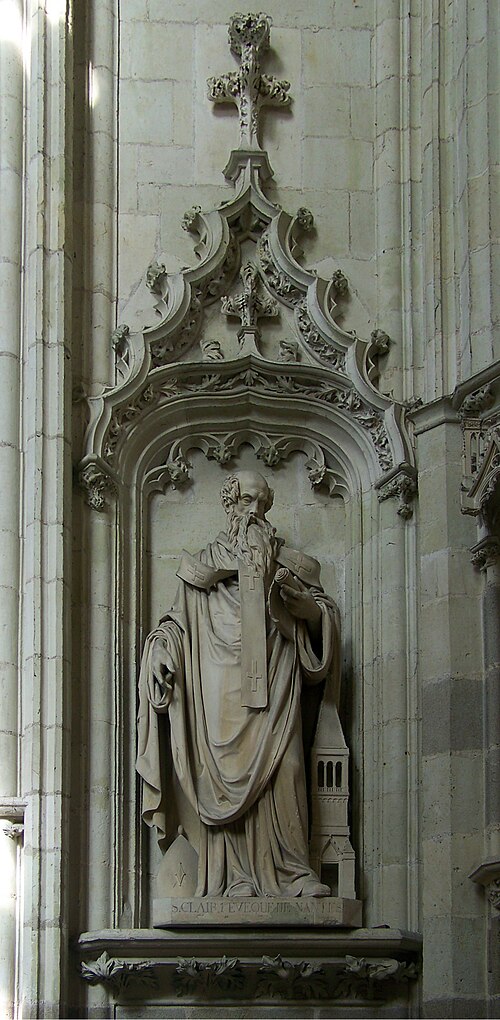
Saint
Clarus of Nantes
First Bishop of Nantes
By late traditions the first bishop of Nantes, in the later third century.
- Feast
- October 10old style October 23
- Reposed
- 3104th century
- Place
- Réguiny
- Order
- Hierarchs
Life
Saint Clarus (Clair) is venerated as the first bishop of Nantes in Brittany, according to later traditions in the second half of the third century. His memory is kept on 10 October. The centre of his veneration is the cathedral of Saints Peter and Paul at Nantes.
The traditional account
Only fragmentary testimonies about him have come down. According to the preserved tradition, Clarus was sent to Nantes by Pope Linus, the successor of Peter, seventy years after the birth of Christ, that is, around the year 69. He came from Rome with a nail from the cross on which Peter was martyred. He built an oratory dedicated to the apostle, from which Nantes Cathedral would later grow. In the chief city of Armorica he preached Christianity and made missionary journeys to the villages around. He is said to have died on one of these journeys, at Kerbellec in the village of Réguiny (Morbihan), on 10 October. His tomb, empty since the Norman invasions at the end of the ninth century, lies in a chapel beside the church of Réguiny, where there is also a votive fountain, at which healings were said to occur.
After the first cathedral was founded, in the time of Constantine the Great or somewhat later, the saint's staff, ring and head were moved there. His relics, except the head, were kept at the abbey of Saint-Aubin at Angers, where they were better protected from the Normans. Particles of relics remained at Réguiny. A painting of Saint Clarus restoring sight to the blind, destroyed by fire, was once in Nantes Cathedral. He should not be confused with another Clarus, of the fifth century, considered the first bishop of Albi, whose relics lie in the cathedral of Sainte-Cécile at Albi.
The historians' critique
The earliest documents that mention him date from the eleventh century. The Breton historian Arthur Le Moyne de La Borderie points out that the ritual of the Church of Nantes, drawn up by the precentor Helius in 1263, knows nothing of an apostolic mission of Clarus; that the nail of Peter in the cathedral was not brought by Clarus but at a time after the Norman invasions of the tenth century; that Bishop Felix of Nantes, writing in 567 with six other bishops to Saint Radegund, gives the chief role in converting the people of Nantes to Martin of Vertou; and that the traditions of Clarus's mission are later than 1400. The document of 1263 says only that Clarus was the first bishop of Nantes, sent by an unnamed pope, and that he brought the nail. A fifteenth-century version moved him back almost four centuries, making him a direct disciple of the apostles. The oldest list of the bishops of Nantes, made at the beginning of the tenth century, does not support a bishop of the city before Constantine.
In 1636 the Dominican Albert Le Grand published a fuller life of the saint, which La Borderie called "pious myth-making". A year later Pierre Biré wrote that Clarus's mission preceded that of Saint Denis in France and that from Nantes he evangelized all of Brittany. At Nantes Cathedral, after the great fire of July 2020, restoration work continues.
Commemorated the same day October 10
 Paulinus of YorkSaint · First Bishop of YorkOct 10
 Victor of XantenMartyrOct 10
 Gereon of CologneMartyr · Martyr of CologneOct 10
 Ambrose of OptinaVenerable · Elder of Optina MonasteryOct 10
 Cerbonius of PopuloniaSaint · Bishop of PopuloniaOct 10
 Eulampius and EulampiaHoly MartyrsOct 10
- Pinytus of KnossosSaint · Bishop of KnossosOct 10
 Innocent of PenzaSaint · Bishop of Penza and SaratovOct 10
 Martyrs of ZographouHoly Venerable Martyrs · Monks of Mount AthosOct 10
- Andrew of TotmaFool-for-Christ · Fool for ChristOct 10
 Methodius of PochaivVenerable · First abbot of Pochaiv MonasteryOct 10
- 200 MartyrsHoly MartyrsOct 10