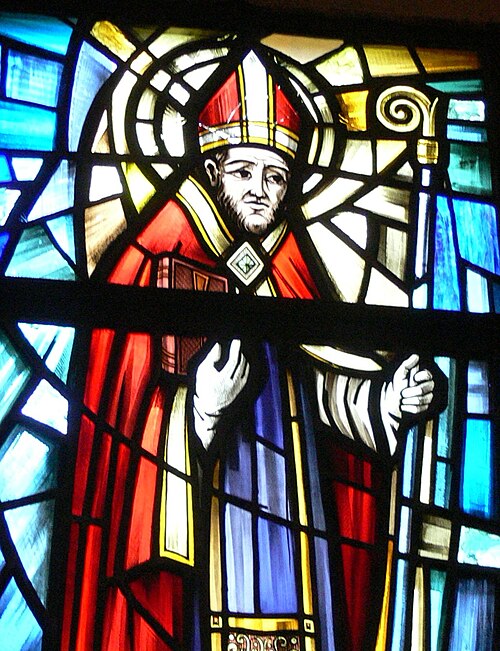
Saint
Cerbonius of Populonia
Bishop of Populonia
Bishop of Populonia during the barbarian invasions, praised by Pope Gregory the Great in his Dialogues; died in 575.
- Feast
- October 10old style October 23
- Reposed
- 5756th century
- Place
- Elba
- Order
- Hierarchs
Life
Saint Cerbonius was bishop of Populonia in Tuscany during the barbarian invasions. He fell asleep in the Lord on 10 October 575. Pope Gregory the Great praises him in his Dialogues. His life has come down to us mostly through tradition and wondrous tales.
Beginnings
According to one tradition, Cerbonius was an African, the son of Christian parents. He was ordained a priest by Regulus, not the one of the Scottish legend. When the Arian Vandals persecuted the Christians of North Africa and the community was scattered, Cerbonius fled to Italy with Regulus, Felix and some priests. After a storm at sea they landed in Tuscany and lived as hermits. During the war between the Byzantines and the Goths, Regulus was imprisoned and beheaded by the Goths, accused of aiding the Byzantines.
After the death of Bishop Florentius of Populonia, the citizens and clergy asked that Cerbonius be their bishop. Another tradition makes him bishop of Massa Marittima around 544, and his veneration there began after Massa became an episcopal see.
Summons to Rome
The people soon grew angry with him, because Cerbonius rose every Sunday at daybreak and celebrated the Liturgy instead of doing so at the usual hour. They complained to Pope Vigilius, who, angered, sent envoys to Piombino to bring the bishop to Rome. They found him eating breakfast and accused him of heresy, thinking he had eaten before the Liturgy, when he had in fact already celebrated it.
On the way, tradition says, he healed three men with fever and tamed some wild geese by making the sign of the cross over them, which is why he is shown with geese. They accompanied him to Saint Peter's and flew off after the saint blessed them again. In Rome, the next morning at daybreak, Cerbonius went into the pope's chamber, woke him and asked whether he did not hear angels singing. Vigilius said he heard nothing. Cerbonius went off to serve, and the pope gave him leave to celebrate at any hour of the morning he pleased and sent him back to Piombino.
Encounter with Totila
Because he had hidden Roman soldiers, Totila, king of the Ostrogoths, during his invasion of Tuscany, ordered him torn apart by a wild bear, on the Field of the Blackbird. But the bear, brought before the bishop, stood petrified, raised on its hind legs with jaws open, then slowly lowered itself, closed its mouth and began to lick his feet with unexpected gentleness. Totila set him free. After Totila's Goths came the Lombards, who drove him out, and the saint took refuge on the island of Elba.
Death and veneration
Old and near death, he asked to be buried at Populonia, still in Lombard hands, advising his disciples to return to sea at once after the burial. According to tradition they crossed the strait of Piombino unseen by their enemies, hidden miraculously by clouds and mist. At Poggio on Elba the story is kept of a strong southwest wind which made the ship's passage easy.
His relics are kept in the cathedral of Massa Marittima in Tuscany. His memory is kept on 10 October.
Commemorated the same day October 10
 Paulinus of YorkSaint · First Bishop of YorkOct 10
 Victor of XantenMartyrOct 10
 Gereon of CologneMartyr · Martyr of CologneOct 10
 Ambrose of OptinaVenerable · Elder of Optina MonasteryOct 10
 Clarus of NantesSaint · First Bishop of NantesOct 10
 Eulampius and EulampiaHoly MartyrsOct 10
- Pinytus of KnossosSaint · Bishop of KnossosOct 10
 Innocent of PenzaSaint · Bishop of Penza and SaratovOct 10
 Martyrs of ZographouHoly Venerable Martyrs · Monks of Mount AthosOct 10
- Andrew of TotmaFool-for-Christ · Fool for ChristOct 10
 Methodius of PochaivVenerable · First abbot of Pochaiv MonasteryOct 10
- 200 MartyrsHoly MartyrsOct 10