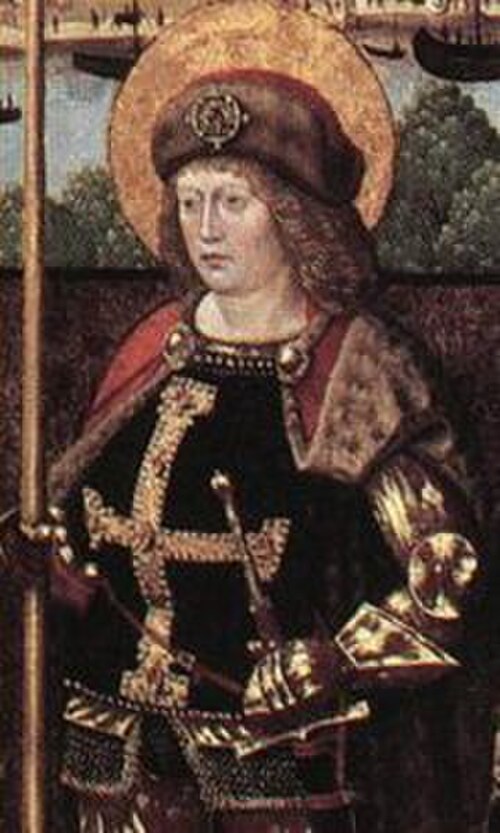
Martyr
Gereon of Cologne
Martyr of Cologne
Martyr, possibly a soldier, beheaded at Cologne probably in the early fourth century.
- Feast
- October 10old style October 23
- Reposed
- 3044th century
- Place
- Cologne
- Order
- Martyrs
Life
Saint Gereon of Cologne was, according to tradition, a soldier of the Theban Legion, beheaded at Cologne around 304, probably in the early fourth century. He was called the "Golden Saint". The Church remembers him on 10 October.
According to the legend Gereon belonged to the Theban Legion, made up of Christians from Egypt, called to the north of the empire in the time of the emperor Maximian, who ruled from 285 to 305. The legion was marching from Milan toward Cologne across the Alps, with its units scattered along the road. The Christian soldiers did not consider themselves free to take part in the pagans' battles and confessed their faith openly. For this they were put to death by order of the angered emperor. Maurice and most of his companions were killed at Agaunum, now Saint-Maurice in Switzerland, in 286 or around 290. Others were killed at Milan, and others at Cologne, where Gereon and fifty of his companions suffered. Saint Gregory of Tours says that Gereon and his companions were a detachment of fifty men of the Theban Legion, killed by order of Maximian for refusing to sacrifice to pagan gods to win victory in battle. Some of his companions are named Cassius, Gregory the Moor, Florentius, Innocent, Constantine and Victor. Bede the Venerable says that their feast was in the calendars of Sarum, Barking and Durham. Later medieval legends raised the number of his companions to 290 or 319. It is said that Norbert of Xanten found, through a vision, the place at Cologne where the relics of Saint Ursula and her companions, of Gereon and of other martyrs lay hidden. There were other executions too, at Xanten, whose name comes from "saint".
Gereon became a beloved soldier saint and is shown in art as a Roman soldier or a medieval knight. With other saints who were beheaded, he is invoked by those who suffer from migraine. The Basilica of Saint Gereon in Cologne is dedicated to him. In the fifteenth century Stefan Lochner painted a triptych of the adoration of the Magi, whose side panels show Ursula with her companions and Gereon with his warriors. Moved in 1810 to the choir chapel of the cathedral, it is there still. A small town in France, Saint-Géréon, bears his name, and his image is on the thirteenth-century seal of the convent of Saint Gereon.
Commemorated the same day October 10
 Paulinus of YorkSaint · First Bishop of YorkOct 10
 Victor of XantenMartyrOct 10
 Ambrose of OptinaVenerable · Elder of Optina MonasteryOct 10
 Clarus of NantesSaint · First Bishop of NantesOct 10
 Cerbonius of PopuloniaSaint · Bishop of PopuloniaOct 10
 Eulampius and EulampiaHoly MartyrsOct 10
- Pinytus of KnossosSaint · Bishop of KnossosOct 10
 Innocent of PenzaSaint · Bishop of Penza and SaratovOct 10
 Martyrs of ZographouHoly Venerable Martyrs · Monks of Mount AthosOct 10
- Andrew of TotmaFool-for-Christ · Fool for ChristOct 10
 Methodius of PochaivVenerable · First abbot of Pochaiv MonasteryOct 10
- 200 MartyrsHoly MartyrsOct 10