
Venerable
Methodius of Pochaiv
First abbot of Pochaiv Monastery
According to tradition, a Greek monk of Athos and the first abbot of Pochaiv Monastery, who died in 1228.
- Feast
- October 10old style October 23
- Reposed
- 122813th century
- Place
- Pochaiv
- Order
- Venerables
Life
Saint Methodius of Pochaiv (died 1228) is, according to tradition, a Greek monk of Athos and the first abbot of the monastery at Pochaiv, in Volhynia. No reliable written testimony about him has survived, apart from the veneration of the people and a Polish work in manuscript. His commemoration is tied to the day of the synaxis of the saints of Volhynia, 23 October, while the calendar also has 10 October; the day of his death, 3 June, is given by the Serbian and Russian sources.
The tradition
According to tradition, Methodius came from Greece and struggled as a monk on Mount Athos. A Ukrainian source gives him born in 1091, perhaps in Byzantium, and dead in 1228 at the age of 137; the Russian and Serbian sources give only death in 1228. In 1213 he was passing near the environs of Pochaiv. At that time he met a landowner, Turkul. According to the work kept in the archive of the Pochaiv Lavra, "Monastyr Skit", written in Polish in 1732 and unpublished (of whose content little is known), Turkul was a pious man who greatly loved the mountain of Pochaiv and had seen there in a dream the Mother of God; perhaps he was a cellion monk.
Methodius, a deep elder, learned his visions from Turkul and understood that the Mother of God herself had chosen that place in Volhynia for a monastery. As a memorial on Mount Pochaiv he chose a tall linden, cleaned its trunk of bark, smoothed it and painted on it the image of the Mother of God as she had appeared in the dream to Turkul. Enthused, Turkul decided to give the mountain to the Mother of God. Methodius returned to Athos and Turkul followed him there and stayed long, and finally persuaded the monk Methodius to return to Pochaiv and build a monastery for the spiritual enlightenment of all Volhynia.
In 1219 they both returned from Athos and began to build. They called twelve builders (as at the Kiev Caves Lavra), and the monastery was finished in 1220 and consecrated in honor of the Transfiguration. The first inhabitants of the newly built monastery were the same twelve builders, headed by Abbot Methodius. Other monks from the east gathered around them, and beside the monastery separate cells were built for the new hermit monks. It was a monastery of hermits, in which the monks did not live together but each led his own life as he could. Among the hermits were the twelve builders and a few others, and under Methodius' leadership there were twenty-five hermit monks.
The abbot
Methodius loved the Pochaiv monastery greatly. He was a well-educated monk, wrote commentaries on the Gospel, a so-called "Gospel of instruction", opened a school at the monastery and gathered many manuscript books. He was esteemed and loved by his fellow strugglers and was a wise teacher to them. The Russian source, unlike the Ukrainian, calls him abbot, and the Ukrainian calls him archimandrite. Two years before his death he fell gravely ill and from then on rarely left the chapel by the monastery gate, where he liked to withdraw for prayer.
He died on 3 June 1228. On the third day after his death the brothers buried him and placed on his grave a stone with the inscription: "Here lies the builder and guardian of this holy place". The Ukrainian source gives the same text with the word "renewer" in place of "builder". It is not known who he was; perhaps he was a Ukrainian who went early to Athos, was tonsured there and later became a priest, probably at the Rossikon monastery, which had great and constant ties with his homeland. Later the Pochaiv monastery declined, in hard and troubled times, but it lived long as a monastery of hermits until near the end of the sixteenth century, when it was restored on a different footing, as a communal monastery.
Commemorated the same day October 10
 Paulinus of YorkSaint · First Bishop of YorkOct 10
 Victor of XantenMartyrOct 10
 Gereon of CologneMartyr · Martyr of CologneOct 10
 Ambrose of OptinaVenerable · Elder of Optina MonasteryOct 10
 Clarus of NantesSaint · First Bishop of NantesOct 10
 Cerbonius of PopuloniaSaint · Bishop of PopuloniaOct 10
 Eulampius and EulampiaHoly MartyrsOct 10
- Pinytus of KnossosSaint · Bishop of KnossosOct 10
 Innocent of PenzaSaint · Bishop of Penza and SaratovOct 10
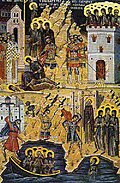 Martyrs of ZographouHoly Venerable Martyrs · Monks of Mount AthosOct 10
- Andrew of TotmaFool-for-Christ · Fool for ChristOct 10
- 200 MartyrsHoly MartyrsOct 10