Venerable
Theodore of Thessalonica
A venerable monk of Thessalonica, commemorated in the calendar of the Orthodox Church.
- Feast
- October 18old style October 31
- Era
- 4th century
- Order
- Venerables
Life
Holy Venerable Theodore of Thessalonica is commemorated together with Saint Symeon and Saint Euphrosyne of Thessalonica. Symeon and Theodore were the founders of the monastery of Mega Spilaion (the Great Cave). They were born at the beginning of the fourth century in Thessalonica, of pious and educated parents, and studied theology, philosophy, rhetoric and poetry. Desert asceticism was then flourishing, and the young men, inspired by its examples, began the monastic life. First they struggled on Mount Olympus, then on Ossa, then on Pelion. They visited the ascetics on Mount Athos and travelled to the Holy Land and to Sinai. On their return from Sinai, at Jerusalem, they received ordination from Bishop Maximus of Jerusalem.
At Jerusalem both young hieromonks had the same dream: the Mother of God, accompanied by the holy apostles Paul, Andrew and Luke, commanded them to go to Achaia and find there her icon, painted by Saint Luke. Receiving the bishop's blessing, the brothers set out for the north-eastern coast of the Peloponnese, where the three apostles had preached the Gospel: Paul at Corinth, Andrew at Patras and Luke in the outer regions of Achaia. Arrived in Achaia, they prayed God to show them the way. That same night, in a dream, the Lord commanded them to go to the river Bouras, two hours' walk from Achaia, and find there a pious shepherdess named Euphrosyne, who would lead them to where the icon was. The next morning they saw that the shepherdess was already waiting for them, bowed to them and called them by name. Startled by her foresight, they did not dare to approach her. Euphrosyne, seeing this, called the All-Holy Mother of God to her aid and struck with her staff the rock on which she sat, and at once a spring of the purest water burst from the rock, which to this day bears her name.
She told them that she lived in a neighbouring village, Galata, and often pastured her father's flock near a high rock. Twice she had seen a goat from the flock climb the rock to the mouth of a cave and come back with a wet muzzle. Guessing there was a spring there, she climbed up, pushed through thick undergrowth, came to the mouth of an enormous cave and heard someone calling her by name. She looked around and saw on the upper wall of the cave an icon of the Mother of God. A voice from the icon told her to wait for the coming of Father Symeon and Father Theodore. The monks climbed up to the cave and found everything as the shepherdess had said. They took down the icon with reverence. News of the new icon spread through the whole peninsula, Christians came to venerate it, and the Lord worked many miracles through it. Monks gathered around Symeon and Theodore, and they began to travel through the Peloponnese preaching the Gospel and urging the inhabitants to become Christians. In the reign of Julian the Apostate they were driven from those parts for a short time, but returned after his death. Both died at Mega Spilaion. Euphrosyne built herself a small cell near the cave and lived in it as a hermit to the end of her life.
Theodore is commemorated on 31 October, according to the Greek tradition. Their names are not included in the present Menologion of the Russian Church.
Commemorated the same day October 18
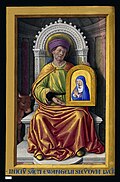 LukeApostle · Apostle and EvangelistOct 18
 Peter of CetinjeSaint · Metropolitan of MontenegroOct 18
 Asclepiades of AntiochSaint · Patriarch of AntiochOct 18
 Gwen TeirbronSaint · Wife of FraganOct 18
 Justus of BeauvaisMartyrOct 18
 Proculus of PozzuoliMartyr · Martyr of PozzuoliOct 18
 Wenna of CornwallSaint · Queen in CornwallOct 18
 Marinus of AnazarbusMartyrOct 18
 David of SerpukhovVenerable · Founder of David's HermitageOct 18
- Julian of PersiaVenerable · Abbot in MesopotamiaOct 18
- Andrew VoskresenskyHieromartyr · Archpriest of MoscowOct 18
- Brothen and GwendolenHoly MartyrsOct 18