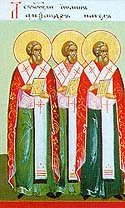
Saint
Alexander of Constantinople
First Bishop of Constantinople
Bishop of Byzantium from 314 and first bishop of Constantinople, a defender of the faith against Arianism.
Life
Saint Alexander of Constantinople was bishop of Byzantium from 314 and the first archbishop of Constantinople, the city receiving that name during his episcopate, in 330. He lived in the days of the emperors Constantine the Great and Constantius, and the Church remembers him as a defender of the true faith against Arianism. Scholars consider that much of what is told of him belongs to tradition.
Early life
According to the Synaxarion, Alexander came from Calabria, and his parents were named George and Vryaine. From childhood he was given to God and lived in a monastery, where he grew in virtue and in keeping the commandments. It is said that he fasted twenty days without any food, that he was granted divine visions, and that he endured many trials, among them attacks by the Saracens. For many years he travelled through Greece with his disciples Vitalius and Nicephorus.
He was chosen as vicar (chorepiscopus) to the aged bishop Metrophanes of Byzantium. According to tradition, age and illness did not allow Metrophanes to go to the First Ecumenical Council at Nicaea in 325, so Alexander represented him there. Some scholars regard this account as later. After Metrophanes, Alexander received the see in 314, at the age, the sources say, of seventy-three.
Episcopate
In his time Constantine the Great made Byzantium the new capital of the empire, and the city was dedicated on 11 May 330. Alexander is therefore the first bishop of Constantinople. In 336 the first local synod of the bishops of the surrounding region was held in the city. Alexander debated with pagan philosophers and fought against heresies. According to a story kept by the church historians, in a dispute with a pagan philosopher he commanded him, in the name of Jesus Christ, to be silent, and the philosopher remained speechless until the bishop allowed him to speak. Many pagans were won over by this example. Gregory the Theologian and Epiphanius of Salamis praised him, and Theodoret of Cyrrhus called him an apostolic bishop.
The struggle with Arianism
When the Arian controversy began, Patriarch Alexander of Alexandria asked for his help against Arius. Arianism was condemned at Nicaea. Later Arius asked to be received back into communion, and Emperor Constantine, persuaded by the Eusebian bishops, ordered Alexander to receive him. Alexander knew that Arius had not truly repented, and although he was threatened with deposition and exile, he refused. He shut himself in the church of Hagia Irene, then the cathedral of the city, and prayed fervently that God might take him from this world rather than let him receive into the Church one who was only pretending. Arius died on the way to the church, before he could be received.
Repose and veneration
Alexander did not long survive this, and he fell asleep in 337, according to some sources in 340. On his deathbed, it is said, he named his vicar Paul as his successor and warned his clergy against Macedonius, who became bishop in 342 and whose teaching gave rise to Macedonianism. The Church counted him a saint after his repose. His service was printed in Venice in 1771. He is commemorated on 30 August, together with the patriarchs John IV and Paul IV of Constantinople.
Commemorated the same day August 30
 John the FasterSaint · Patriarch of ConstantinopleAug 30
 Fiacre of BreuilVenerable · Hermit and gardenerAug 30
 John VIII XiphilinosSaint · Patriarch of ConstantinopleAug 30
 Paul IV of ConstantinopleSaint · Patriarch of ConstantinopleAug 30
 Felix and AdauctusHoly MartyrsAug 30
 Makarije SokolovićSaint · Patriarch of PećAug 30
- Paul III of ConstantinopleSaint · Patriarch of ConstantinopleAug 30
- Agilus of RebaisVenerable · Abbot of RebaisAug 30
 Ignatius LebedevVenerable Martyr · Schema-archimandriteAug 30
 Spiridon of PećSaint · Patriarch of PećAug 30
 Varlaam MoțocSaint · Metropolitan of MoldaviaAug 30
- Gregory II of RasSaint · Bishop of RasAug 30