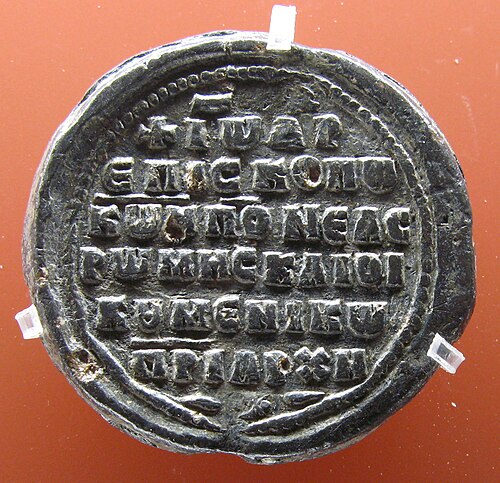
Saint
John VIII Xiphilinos
Patriarch of Constantinople
Ecumenical Patriarch from 1064 to 1075, a native of Trebizond, known as a jurist and scholar.
Life
Saint John VIII Xiphilinos was Ecumenical Patriarch of Constantinople from 1064 to 1075, a native of Trebizond and a notable scholar and jurist of eleventh-century Byzantium. The Church remembers him on 30 August. He was the uncle of the historian John Xiphilinos the Younger, who made an epitome of the Roman History of Dio Cassius.
He was born in Trebizond, of a well-known family, between 1005 and 1012, and lost his father early. Around 1030 he came to Constantinople, where he studied under John Mauropous and became a friend of the philosopher and historian Michael Psellos. He studied law and became a judge of the hippodrome and, around 1045 under Constantine IX Monomachos, head of the new law school as nomophylax. When the emperor's favour was lost, he left the capital and took the monastic habit on Mount Olympus in Bithynia, where his friend Psellos was also living.
In 1064, after the death of his friend Constantine Lichoudes, Emperor Constantine X Doukas called him back to the capital, and on 1 January 1064 he was installed as patriarch. His ministry fell in a time of grave crisis for the empire, with the defeat at Manzikert in 1071 and the succession of several emperors. As patriarch he took an active part in affairs of state and defended the rights of the Church against the claims of emperors. He tried to draw closer to the Armenians, who like Byzantium were threatened by the Turkish invasion. He released the empress Eudokia from her promise not to remarry, which opened the way for her marriage to Romanos IV Diogenes. He issued synodal decisions on betrothal, by which betrothal was held equal to marriage in spiritual weight, and on impediments to marriage. In 1070 he issued a decree forbidding priests to act as advocates in court. In 1072 he presided over an assembly of metropolitans at the oratory of Saint Alexius, which decided that metropolitans present in the capital could vote again in episcopal elections if they gave the patriarch prior notice.
He wrote a Life of Saint Eugenios of Trebizond, commentaries on Gospel passages, and letters, but was better known for his legal works than his theological ones. He fell asleep on 2 August 1075 and was buried at the monastery of Angourion.
Commemorated the same day August 30
 John the FasterSaint · Patriarch of ConstantinopleAug 30
 Alexander of ConstantinopleSaint · First Bishop of ConstantinopleAug 30
 Fiacre of BreuilVenerable · Hermit and gardenerAug 30
 Paul IV of ConstantinopleSaint · Patriarch of ConstantinopleAug 30
 Felix and AdauctusHoly MartyrsAug 30
 Makarije SokolovićSaint · Patriarch of PećAug 30
- Paul III of ConstantinopleSaint · Patriarch of ConstantinopleAug 30
- Agilus of RebaisVenerable · Abbot of RebaisAug 30
 Ignatius LebedevVenerable Martyr · Schema-archimandriteAug 30
 Spiridon of PećSaint · Patriarch of PećAug 30
 Varlaam MoțocSaint · Metropolitan of MoldaviaAug 30
- Gregory II of RasSaint · Bishop of RasAug 30