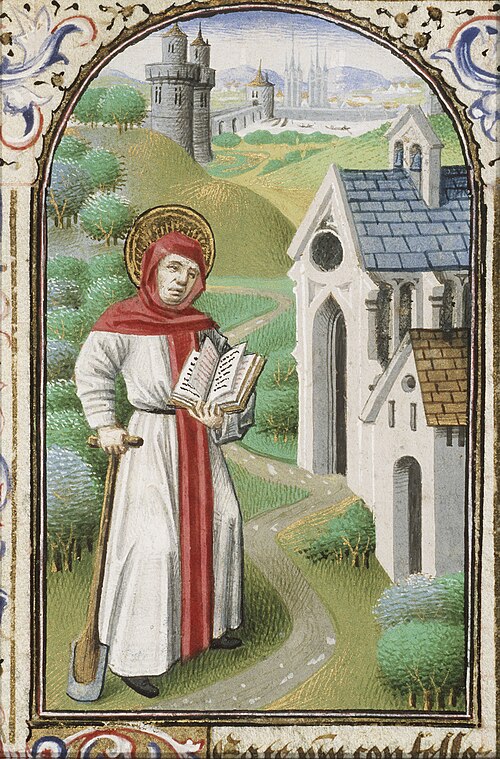
Venerable
Fiacre of Breuil
Hermit and gardener
Irish priest, abbot and hermit in France near Meaux, who died in 670, patron of gardeners.
- Feast
- August 30old style September 12
- Reposed
- 6687th century
- Place
- Meaux
- Order
- Venerables
Life
Saint Fiacre of Breuil was an Irish priest, abbot and hermit of the seventh century, who settled near Meaux in France and died on 18 August 670. He was known for his holiness and for his gift of healing the sick, and from his time the veneration of him as patron of gardeners has been kept. He is venerated mainly in the West, and the Church commemorates him on 30 August.
Life
He was born in Ireland, toward the end of the sixth century, in a noble family, and was raised in a monastery, where he became a monk and learned the craft of medicinal herbs. He was ordained priest and became abbot. It is said that he had his hermitage, perhaps even a monastery, near Saint Fiachra's Well at Kilferagh in County Kilkenny. Crowds ran to him because of his holy life and his cures, and he sailed to France in search of deeper solitude.
He arrived at Meaux in 628. Bishop Faro, who had once received kindnesses from the Irish missionary Columbanus, was well disposed to him and gave him a place at Breuil in Brie, to live in solitude in the forest. There Fiacre built a hermitage, a garden of vegetables and herbs, an oratory in honour of the Mother of God and a shelter for travellers. He lived in great self-restraint, in prayer, fasting, vigil and work with his hands in his garden. The fame of his miracles spread far, as he healed various diseases by laying on of hands.
He fell asleep on 18 August 670 and was buried in the church of the place of his hermitage. The settlement grew into a village that took the name Saint-Fiacre, in the department of Seine-et-Marne.
Legends
According to legend, Faro allowed him as much land as he could trace with a furrow in one day. Fiacre drew a furrow with the end of his staff, and the earth opened, trees fell and briers were uprooted. A suspicious woman ran to Faro and told him that the bishop was being deceived and that this was sorcery, but Faro understood that it was the work of God. It is said that from then on Fiacre forbade women to enter the precincts of the hermitage, on pain of a grave illness. In 1641 Queen Anne of Austria, who ascribed the recovery of Louis XIII and the birth of the future Louis XIV to his prayers, did not dare to enter the monastery when she thanked the saint.
His sister Syra came to France as well and became a nun. She was blind, but according to the story, through Fiacre's prayers her sight was given back.
Veneration
From the ninth century a power to work miracles was ascribed to his relics, and the sick of various diseases came to his shrine. To be healed it was thought enough to touch his arm. In 1568, for fear of the Calvinists, the relics were moved to the cathedral of Meaux, where they are kept, and in the seventeenth and eighteenth centuries the town was a great centre of devotion to him. He is patron of gardeners and, in France, of cab drivers, and by a more recent custom of those who suffer from haemorrhoids. The Roman Catholic Church commemorates him on 30 August.
Commemorated the same day August 30
 John the FasterSaint · Patriarch of ConstantinopleAug 30
 Alexander of ConstantinopleSaint · First Bishop of ConstantinopleAug 30
 John VIII XiphilinosSaint · Patriarch of ConstantinopleAug 30
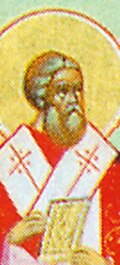 Paul IV of ConstantinopleSaint · Patriarch of ConstantinopleAug 30
 Felix and AdauctusHoly MartyrsAug 30
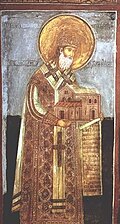 Makarije SokolovićSaint · Patriarch of PećAug 30
- Paul III of ConstantinopleSaint · Patriarch of ConstantinopleAug 30
- Agilus of RebaisVenerable · Abbot of RebaisAug 30
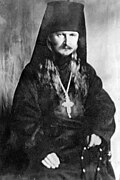 Ignatius LebedevVenerable Martyr · Schema-archimandriteAug 30
 Spiridon of PećSaint · Patriarch of PećAug 30
 Varlaam MoțocSaint · Metropolitan of MoldaviaAug 30
- Gregory II of RasSaint · Bishop of RasAug 30