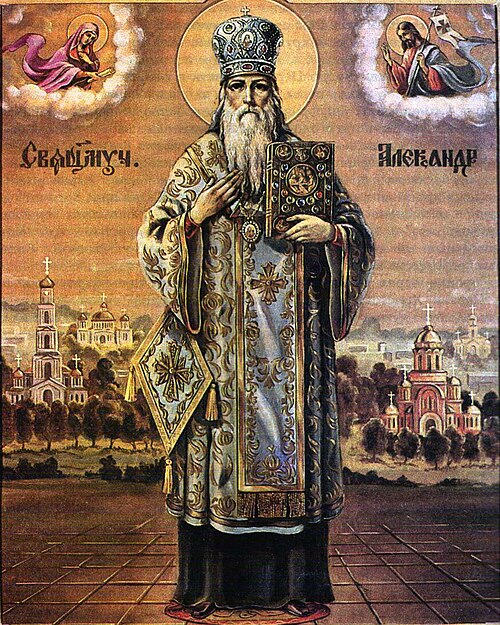
Hieromartyr
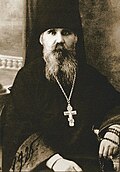
Alexander Petrovsky
Archbishop of Kharkiv
Archbishop of Kharkiv, born at Lutsk in 1851 into a deacon's family, who died in prison in 1940; glorified in 2000.
Life
Saint Alexander Petrovsky the Hieromartyr (1851 to 1940) was Archbishop of Kharkiv, a deacon's son from Lutsk, a teacher in people's schools, then monk, abbot and bishop in the years of Soviet persecution. Arrested in 1938 when over eighty, he died in the hospital of Prison No. 1 in Kharkiv on 24 May 1940. Venerated locally in the Diocese of Kharkiv from 1993, he was canonized by the Russian Church in 2000 among the New Martyrs and Confessors.
The teacher
He was born on 23 August 1851 at Lutsk, in Volhynia, into a deacon's family. He lost his father early and was raised by his mother, whom he loved dearly. He completed four classes of the Volhynia Theological Seminary and for many years was a teacher in people's schools. From 1892 he taught in the parish school of the village of Knyaginino, Dubno district, and in 1897 he was appointed reader (psalmist) of the Church of the Exaltation of the Cross there.
The monk
On 1 September 1899 he entered the Holy Trinity Monastery at Derman, and on 9 June 1900 he received monastic tonsure, keeping his name Alexander, and was assigned as steward. On 15 August 1900, in the cathedral of the Pochaiv Lavra, he was ordained hierodeacon, and on 29 October 1900 hieromonk, being named sacristan of the Derman monastery while continuing his obedience as steward and teaching at the parish school. From 18 November 1900 he also bore the duties of superior. In 1901 he was moved to the Epiphany Monastery at Kremenets as treasurer. He taught the Law of God and took part in the Epiphany Brotherhood of Kremenets, which aimed to strengthen the Orthodox faith and resist Catholicism and Uniatism; in 1902 he became the brotherhood's treasurer. Archbishop Modest (Strelbitsky) of Volhynia gave him a blessing "for activity and zeal in the office of treasurer".
The Ukrainian source tells this beginning differently: that he was tonsured in 1900 at the Donskoy Monastery in Moscow, where he was ordained hieromonk, and was then raised to archimandrite and named abbot of the Mgar Monastery. The more detailed chronology of the Russian source goes another way: he reaches the Donskoy only in 1908. Both versions are given here.
In 1903 he was moved to the Turkestan diocese, as treasurer and then steward of the bishop's house, member of the diocesan school council and the auditing committee (the Ukrainian source adds that he was also a member of the Palestine Society). In 1905 he was named temporary member of the Turkestan spiritual consistory and treasurer of the Turkestan missionary society, and "for service in the spiritual department" received a pectoral cross. The climate harmed his health, so in February 1906 he was transferred to the Dormition Monastery at Zhirovichi, in the Grodno diocese, again as treasurer and also head of the two-class parish school.
At the start of 1908, at 38, he moved to the stavropegial Donskoy Monastery in Moscow and was soon appointed acting superior. The life of the monastery was clouded by a long conflict between the abbot and the brethren; the procurator of the synodal office in Moscow wrote: "It may be supposed that under the abbacy of the newly transferred hieromonk Alexander, of whom the opinions are the best, peace and order will again settle in the monastery". From 1911 (the Ukrainian source says 1910) he was abbot of the Transfiguration Monastery at Lubny (Mgar), and from December 1917 abbot of the Pskov-Caves Monastery.
Service in the Poltava region
In 1918 he moved to Poltava, living with Archbishop Theophanes (Bystrov). From 1919 he was rector of the skete church of the Kozelshchina Nativity of the Mother of God convent for women in Poltava province, and then spiritual father of the skete formed by some of the nuns near the river Psel. He had a tenor voice, loved singing and knew how to inspire the people to sing together. The service was celebrated with zeal, according to the typikon, and the all-night vigil lasted no less than four hours and went with great spiritual uplift. In 1932 the authorities closed the skete, and in that year he was abbot of the Kyiv-Nikolaev Monastery.
Bishop
On 30 October 1932, at Kyiv, he was consecrated Bishop of Uman, vicar of the Kyiv diocese. From 25 August 1933 he was Bishop of Vinnytsia. In 1934 he was a member of the Provisional Patriarchal Holy Synod under the Deputy Locum Tenens, Metropolitan Sergius (Stragorodsky). From 20 May 1937 he was Archbishop of Kharkiv. At that time only one Orthodox church remained open in the city, the Kazan church, which so many people attended that Communion lasted for hours.
Arrest and death in prison
On 28 July 1938 he was arrested by the NKVD for the Kharkiv region, suspected of counter-revolutionary propaganda and agitation as a member of the anti-Soviet church organization of the "Ioannites", and accused of spying for Poland. On 17 June 1939 he was sentenced to ten years in prison. On 5 January 1940 the sentence was annulled and the case returned for further investigation, but he was not released, despite his advanced age. He was held in the ward for the incurably ill and died in the hospital of Prison No. 1 in Kharkiv, in the eighty-ninth year of his life. The Russian source and the body of the Ukrainian text give the date as 24 May 1940; the header of the Ukrainian one writes 12 May.
His body was sent by mistake from the prison to the municipal forensic morgue. When the mistake was discovered, the prison gave an order to bring it back, but the faithful managed to substitute the body and bury him in secret at the Zalyutin cemetery in Kharkiv, marking the grave with a special sign. His relics are today in the Annunciation Cathedral in Kharkiv.
Canonization and veneration
On 10 February 1993, at the initiative of Metropolitan Nikodim (Rusnak) of Kharkiv and Bogodukhov, Archbishop Alexander was rehabilitated. On 22 June 1993 the Synod of the Ukrainian Orthodox Church glorified him as a locally venerated saint of the Diocese of Kharkiv. In August 2000 the Council of Bishops of the Russian Orthodox Church canonized him among the holy martyrs and included him in the Synaxis of the New Martyrs and Confessors of Russia. On 1 April 2015, with the blessing of the Holy Synod of the Ukrainian Orthodox Church, the commemoration of the Synaxis of the Saints of the Vinnytsia Land was established, in which, among fifteen ascetics connected with the region, the Hieromartyr Alexander (Petrovsky), Archbishop of Kharkiv, was included. The Synaxis is kept on 14 September (new style). There is a monument to him in Kharkiv.
Commemorated the same day May 19
 Dmitry DonskoyRight-Believing · Grand Prince of MoscowMay 19
 Dunstan of CanterburySaint · Archbishop of CanterburyMay 19
 PudentianaMartyrMay 19
 John of GothiaSaint · Bishop of GothiaMay 19
 Cornelius of KomelVenerable · Founder of Komel MonasteryMay 19
 Ignatius of VologdaVenerable · Prince of Uglich turned monkMay 19
 Parthenius of RomeMartyr · Martyr of Armenian originMay 19
 Konstantin DyakovHieromartyr · Metropolitan of KyivMay 19
 Onufry GagalyukHieromartyr · Archbishop of KurskMay 19
 Cornelius of PaleostrovVenerable · Founder of Paleostrov MonasteryMay 19
 Sergius of ShukhtovoVenerable · SchemamonkMay 19
 Joasaph ZhevakhovHieromartyr · Bishop of MogilevMay 19