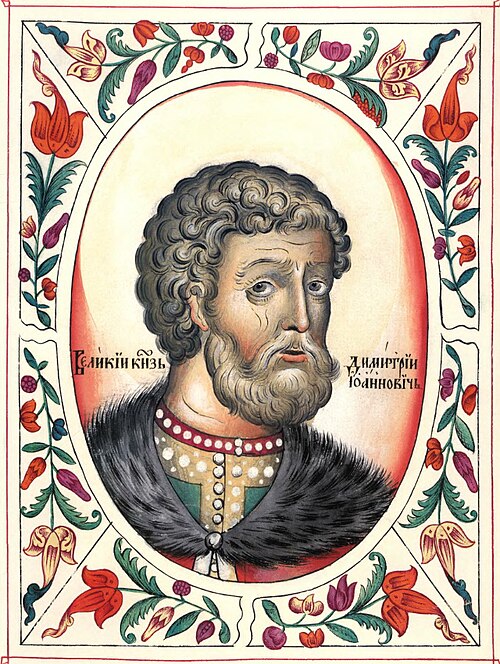
Right-Believing
Dmitry Donskoy
Grand Prince of Moscow
Grand prince of Moscow from 1359 to 1389, who led the Russian army to victory at Kulikovo Field.
- Feast
- May 19old style June 1
- Reposed
- 138914th century
- Place
- Moscow
Life
The Holy Right-Believing Grand Prince Dmitry Donskoy was prince of Moscow from 1359 and grand prince of Vladimir from 1362 until his death in 1389. He led the Russian army to the victory at Kulikovo in 1380 over the Tatars. The nickname Donskoy, of the Don, comes from the river on whose bank the battle was fought. He was canonized by the Russian Orthodox Church on 6 June 1988, and his memory is kept on 19 May.
Childhood and youth
He was born in Moscow on 12 October 1350, the eldest son of Prince Ivan II and his second wife Alexandra, daughter of Vasily Velyaminov, the military commander of Moscow. His father died on 13 November 1359, when Dmitry was nine, and he came to the throne. The synaxarion says he was raised in piety and loved God from childhood. His education was overseen by Saint Alexis, Metropolitan of Moscow, who had been friend and adviser to his father. The metropolitan effectively directed the affairs of state in the years of Dmitry's minority until his own death in 1378, and tied the interests of the Russian Church to those of Moscow.
In 1360, after the turmoil in the Golden Horde, the grand principality of Vladimir passed to Dmitry Konstantinovich of Suzdal. In 1362 Dmitry of Moscow received a yarlyk (patent of rule) from Khan Murad and, with the boyars and his cousin Vladimir Andreyevich of Serpukhov, drove his rival from Vladimir. The Russian synaxarion stresses that the young prince spared his adversary, letting him reign at Suzdal, and sought to join strength with mercy. In 1366 he married Eudoxia, daughter of Dmitry of Suzdal, with whom he had at least twelve children. After his death she became the nun Euphrosyne and is honoured as a saint.
Reign and gathering of the land
Dmitry followed an increasingly independent policy. In 1367 the Moscow Kremlin was built in stone for the first time, and the new walls withstood the sieges by Algirdas of Lithuania in 1368 and 1370. There followed wars with the principality of Tver, whose princes sought Lithuanian and Horde support, and a peace with Lithuania arranged by Metropolitan Alexis. From 1374 he stopped paying tribute to Mamai. In 1375, after another attempt by Mikhail of Tver to press his claim, Dmitry gathered the forces of the other Russian princes, and Mikhail acknowledged him as elder brother. Dmitry was the first prince of Moscow to openly defy Mongol rule in Russia.
Kulikovo
The Horde was weakened by civil war. In 1378 Mamai sent an army, which Dmitry defeated at the river Vozha. Two years later Mamai himself came with a large army against Moscow. Before the battle, on 18 August 1380, Dmitry went to Saint Sergius of Radonezh, who blessed him, foretold victory and sent two monks, the schemamonks Alexander Peresvet and Andrew Oslyabya. Modern sources note that Sergius gave the blessing only after he was sure that all peaceful means had been tried. The prince left Moscow on 20 August. The synaxarion adds that in camp an icon of Saint Nicholas appeared in the air over a pine tree and descended into the prince's hands.
On 8 September 1380, the feast of the Nativity of the Mother of God, between the Don and the Nepryadva, about 250 kilometres south of Moscow, the Russian army defeated the Tatar-Mongol army of Mamai. The fight opened with a duel between two champions: the Russian, Alexander Peresvet, and the Tatar, Temir-Murza, who killed each other in the first charge. According to the synaxarion, a Lithuanian warrior in the prince's army, Montvid Montvilo, took on his own body the sword blow meant for the grand prince, and the sword struck the icon of Saint Nicholas he wore on his chest. From Montvilo descends the Motovilov family, to which belonged Nicholas Motovilov, who recorded the conversation with Saint Seraphim of Sarov.
After the victory Dmitry ordered a thanksgiving service to God and Saint Nicholas and built a church and monastery on that site. He founded the Dormition Monastery on the river Dubenka and the church of the Nativity of the Mother of God by the graves of the fallen. From that day he was called of the Don. The Memorial Saturday before the day of Saint Demetrius of Thessalonica, Dimitrievskaya, was appointed in memory of the Orthodox warriors killed at Kulikovo.
Last years
Mamai was overthrown by the general Tokhtamysh, who reasserted Mongol rule in Russia and sacked Moscow in 1382 for Dmitry's resistance to Mamai. Dmitry nevertheless swore loyalty and was confirmed as collector of tribute and grand prince of Vladimir. Moscow's prestige among the Russian principalities had greatly increased. Dmitry spent his last years strengthening his authority, and toward the end of the reign he permanently united the thrones of Moscow and Vladimir, practically doubling the principality's territory.
He fell asleep in the Lord on 19 May 1389, aged thirty-nine, having taken the schema, and was buried in the Cathedral of the Archangels in the Kremlin. He was the first grand prince to bequeath his titles to his son Vasily I without asking the khan's consent. A bone fragment, said to be from his sword hand, was removed from the tomb during a renovation of the cathedral.
Veneration
Russian historiography regards him as a national hero and central figure of medieval Russia. Dmitry was canonized on 6 June 1988 at the Trinity Lavra of Saint Sergius, at the Local Council of the Russian Orthodox Church under Patriarch Pimen. He is remembered on 19 May (Menaion date) and, in synaxes, on 6 July with the saints of Radonezh, on 22 September with the saints of Tula, and in the Synaxis of the Saints of Moscow. In the civil calendar of the Churches on the old calendar these days fall thirteen days later (19 May is 1 June).
Commemorated the same day May 19
 Dunstan of CanterburySaint · Archbishop of CanterburyMay 19
 PudentianaMartyrMay 19
 John of GothiaSaint · Bishop of GothiaMay 19
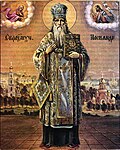 Alexander PetrovskyHieromartyr · Archbishop of KharkivMay 19
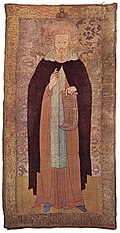 Cornelius of KomelVenerable · Founder of Komel MonasteryMay 19
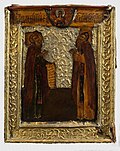 Ignatius of VologdaVenerable · Prince of Uglich turned monkMay 19
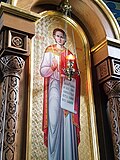 Parthenius of RomeMartyr · Martyr of Armenian originMay 19
 Konstantin DyakovHieromartyr · Metropolitan of KyivMay 19
 Onufry GagalyukHieromartyr · Archbishop of KurskMay 19
 Cornelius of PaleostrovVenerable · Founder of Paleostrov MonasteryMay 19
 Sergius of ShukhtovoVenerable · SchemamonkMay 19
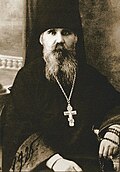 Joasaph ZhevakhovHieromartyr · Bishop of MogilevMay 19