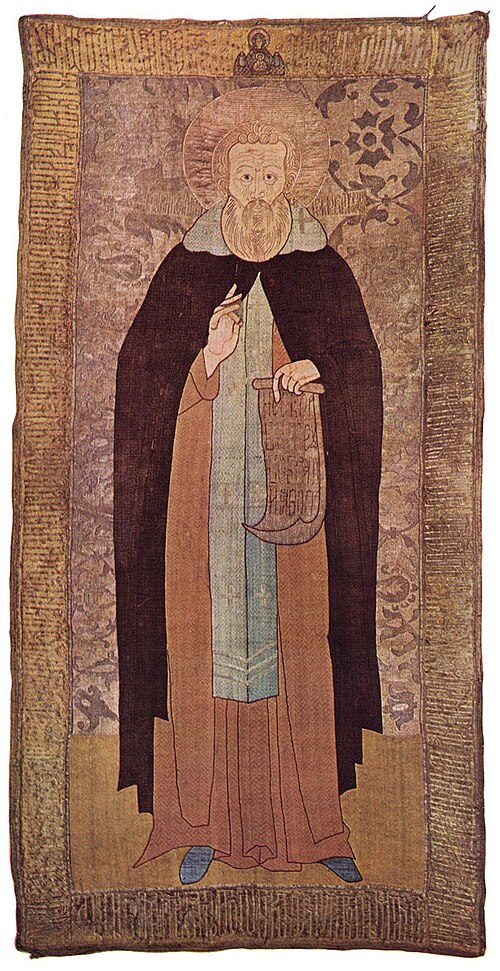
Venerable
Cornelius of Komel
Founder of Komel Monastery
Russian monk, founder of the Komel monastery, born in 1457 and died in 1537.
- Feast
- May 19old style June 1
- Reposed
- 153716th century
- Order
- Venerables
Life
Saint Cornelius of Komel (1457 - 19 May 1537) the venerable was the founder of the Komel monastery near Vologda and author of a monastic rule, the third Russian monastic rule. He was glorified for the whole Russian Church by the church council of 25 January 1600. He is commemorated on 19 May (1 June in the new style). The main source about him is the Life written in 1589 by his disciple Nathanael.
Youth
His secular name is not known. He was born in 1457 into a noble boyar family, the Kryukovs, of Rostov. His uncle, the clerk Lucian, served at the court of the wife of Grand Prince Vasily the Blind of Moscow and helped him become a clerk at the grand prince's court. His uncle's influence was so great that when Lucian decided to become a monk at the Kirillo-Belozersky monastery, his nephew followed him. At his tonsure he was twenty, and his chief obedience in the monastery was copying books. The author of the Life says, at the end of the sixteenth century, that the books copied by him are still at Kirillov. At twenty-seven he left the monastery for a time and returned with his brother Akinfy, who was tonsured with the name Anthimus. Later he left the Kirillo-Belozersky monastery for good and began to wander through other monasteries. At Novgorod he drew the attention of Archbishop Gennady, who, seeing his learning, wanted to ordain him priest, but he refused. He was ordained in 1501 by Metropolitan Simon of Moscow.
The Komel monastery
Leaving Novgorod, he settled in a hermitage in its neighbourhood, then moved to Tver. In 1497 he settled in the Komel forest, not far from Vologda, where gradually, from a small "hermitage", he made his monastery. In 1501 he built the first wooden church, dedicated to the Presentation of the Mother of God in the Temple, and in 1515, when the number of monks had grown, a stone church was built. In the same year he began to write the monastery's rule, which became the third Russian monastic rule. At Komel he organized workshops for copying books and painting icons. He himself copied books: the monastery inventory of 1630 lists a Psalter written by the venerable Cornelius, a Service Book written by the wonderworker Cornelius and the "Tradition of the wonderworker Cornelius". Great importance was given to charity and almsgiving: help was given to those who came not only by word but materially, to the poor and the sick. The guest house outside the monastery walls was never empty. In years of famine, like many other monasteries, it was the only hope of rescue from death by hunger, and at its walls parents left children they could no longer feed.
Because of a conflict with Grand Prince Vasily III (the cause is not known), Cornelius withdrew around 1529 to Lake Sura with his disciple Gennady. Vasily III repeatedly demanded that Cornelius return to the monastery he had founded (in 1530 the grand prince even refused Cornelius leave to consecrate the church he had built in the Sura hermitage). For a time Cornelius spent in seclusion at the Trinity-Sergius Lavra, but then, after the conflict ended, he returned to his monastery, gave up the abbacy and remained in seclusion. Gennady became abbot at Sura. During a Tatar attack on the Vologda land, Cornelius withdrew with the brethren to the neighbourhood of the Kirillo-Belozersky monastery. He died on 19 May 1537 in the monastery he founded, at the age of eighty-two.
The rule
The rule in manuscripts bears the title "On Life, chosen from the divine Scriptures, on the arrangement handed down to us from the holy fathers for the salvation of souls, and given in writing to my brethren in Christ in the monastery of the most glorious Mother of God, her honoured Presentation, in which we live". According to the Life it was composed between 1515 and 1529. Its sources were the Russian monastic rules then existing: the skete rule of Nil Sorsky and the cenobitic rule of Joseph of Volokolamsk. From Nil he took a long introduction, supplemented with his reflections on the abbot's responsibility for the fate of the monks and the basic principles of monastic life after Basil the Great. The concrete instructions for communal monasticism are taken from the long redaction of Joseph's rule. The dominant requirement, repeated many times, is absolute non-possession for the monks and complete community of the monastery's property, even more ascetic than in Joseph's rule.
His disciples
There were disciples of his who after his death founded monasteries of their own: Cyril of Novoezero, Gennady of Kostroma and Lyubimograd (the Spaso-Gennadiev monastery), Herodion of Iloezero, Zosimas of Vorbozoma, Philip of Irap, Simon of Soyga, Lawrence of Komel, third abbot of the monastery, and the monk Nathanael, author of the Life.
Commemorated the same day May 19
 Dmitry DonskoyRight-Believing · Grand Prince of MoscowMay 19
 Dunstan of CanterburySaint · Archbishop of CanterburyMay 19
 PudentianaMartyrMay 19
 John of GothiaSaint · Bishop of GothiaMay 19
 Alexander PetrovskyHieromartyr · Archbishop of KharkivMay 19
 Ignatius of VologdaVenerable · Prince of Uglich turned monkMay 19
 Parthenius of RomeMartyr · Martyr of Armenian originMay 19
 Konstantin DyakovHieromartyr · Metropolitan of KyivMay 19
 Onufry GagalyukHieromartyr · Archbishop of KurskMay 19
 Cornelius of PaleostrovVenerable · Founder of Paleostrov MonasteryMay 19
 Sergius of ShukhtovoVenerable · SchemamonkMay 19
 Joasaph ZhevakhovHieromartyr · Bishop of MogilevMay 19