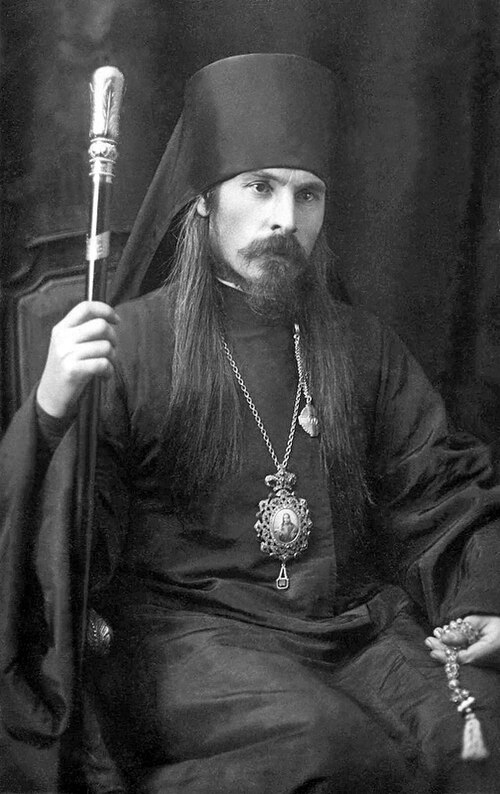
Hieromartyr
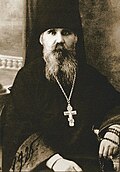
Onufry Gagalyuk
Archbishop of Kursk
Archbishop of Kursk and Oboyan, born in 1889, killed in 1938 at Blagoveshchensk.
Life
Saint Onuphrius (Gagalyuk), Hieromartyr and Archbishop of Kursk and Oboyan, was a bishop of the Russian Orthodox Church who, during fifteen years as a bishop, passed through prisons, exile and the camps while defending the Church against the Renovationist and Gregorian schisms. He was shot at Blagoveshchensk in the Far East in 1938 and numbered among the saints in 2000. He is venerated in Russia, in Ukraine and in Poland, where he was born.
Childhood
In the world he was Anton Maximovich Gagalyuk, born on 2 April 1889 in the town of Opole in the Lublin province (today Opole Lubelskie in Poland), near the town of Novo-Alexandria. His father, Maxim, was a forester, and his mother, Catherine, of Catholic origin, later became the nun Natalia. The family had six children, three boys and three girls, and lived in a small wooden house at the edge of the forest.
When Anton, the eldest, was five years old, his father was mortally wounded by timber thieves he had caught in the act. They set fire to the forester's house, leaving the widow and six children without a roof. Anton was taken into an orphanage in Lublin, where his mother worked as a cook, and there he completed the parish school. Because he studied well, the orphanage sent him at its own expense to the theological school in Chełm.
Two healings
He graduated from the theological school and the Seminary of Chełm. During his seminary years he fell gravely ill with pneumonia, and Saint Onuphrius the Great appeared to him and healed him. Later, as a student of the Petersburg Theological Academy, before his third year, he was sent to the Monastery of Saint Onuphrius at Jabłeczna in the Chełm land to lecture on theology to teachers. On this journey he fell ill and was near death, but Saint Onuphrius appeared to him a second time and healed him again. Then he resolved once and for all to become a monk.
On 5 October 1913 he was tonsured with the name Onuphrius, in honour of his patron, and ordained hierodeacon and then hieromonk. In 1915 he graduated from the Petrograd Academy as a candidate of theology, with a thesis on salvation in the writings of Metropolitan Philaret (Drozdov) of Moscow.
A priest in troubled times
From 15 July 1915 he taught at the pastoral and missionary seminary at the Grigoriev-Bizyukov Monastery in the diocese of Kherson. During the civil war the monastery was looted by bandits and Hieromonk Onuphrius was kidnapped. Local peasants rescued him and took him to Beryslav, where he became rector of the Dormition church. In 1922 he was raised to archimandrite and appointed rector of the church of Saint Nicholas in Krivoy Rog.
At that time, through his brother Andrew, the Renovationist Metropolitan Evdokim (Meshchersky) invited him to join the Renovationists. Archimandrite Onuphrius refused, unwilling to betray canonical Orthodoxy.
Bishop and confessor
On 23 January 1923, in the Kiev Caves Lavra, he was consecrated Bishop of Yelisavetgrad, vicar of the diocese of Kherson, by Metropolitan Michael (Yermakov) and Bishop Dimitry. He arrived in Yelisavetgrad on 6 February. A few days later the representative of the Renovationist Supreme Church Administration visited him and asked his church allegiance. The bishop answered that he did not and would never recognise the Renovationist administration and its “bishops” and “priests”, and that he obeyed only his canonical superiors, Metropolitan Michael and Bishop Prokopy.
The next day, six days after his consecration, he was arrested. He was charged with failing to register with the authorities, with heading an unregistered church administration and even with espionage, because he had asked the officer who came to arrest him with interest about the institution he served. The real reason was his refusal to support the schism. He was held in prison in Yelisavetgrad and then in Odessa and released in May 1923, without trial, on condition that he leave the Odessa province. In a report to Patriarch Tikhon he wrote that even the enemies of the Church acknowledged that he was entirely clean politically.
He settled in Krivoy Rog, where he worked to organise a vicariate and sent his Yelisavetgrad flock an epistle against the Renovationists. After Patriarch Tikhon's release many clergy returned to Orthodoxy, and in Odessa the struggle against the schism was led by Archpriest Jonah Atamansky. Bishop Onuphrius wrote epistles to the faithful and apologetic, instructive and historical articles.
In October 1923 he was arrested again and taken to the prison in Kharkov. Released in January 1924 on condition that he not leave Kharkov, he went on denouncing the Renovationists and carried on a large correspondence with his spiritual children. He also opposed the Gregorian schism, which rejected patriarchal government of the Church and at first enjoyed the support of the authorities.
Exile and prisons
In December 1926 he was arrested and exiled to the north, to the village of Kudymkar, where he was forbidden even to read prayers or sing in the choir in church. In exile he went on writing. In October 1928 he was imprisoned in Tobolsk and then sent into exile at Surgut on the Ob, and then to the remote village of Uvat. He remained loyal to the deputy patriarchal locum tenens, Metropolitan Sergius (Stragorodsky).
At the end of 1929 he was allowed to live in central Russia and chose the town of Stary Oskol. Metropolitan Sergius created a new diocese there and appointed him Bishop of Stary Oskol. The authorities allowed him to serve in only one church, the Theophany Cathedral, and forbade him to travel through the diocese. He was evicted from his lodgings three times. His flock loved him dearly for his piety and his prayerful celebration of the services.
Archbishop of Kursk
In March 1933 he was arrested and held for three months in the prison in Voronezh. From 11 August 1933 he was Bishop of Belgorod, administering the diocese of Kursk, from 22 November 1933 Bishop of Kursk, and from 30 January 1934 Archbishop of Kursk and Oboyan. Here too he was allowed to serve in only one church. In 1934 he declared his adherence to the elevation of Metropolitan Sergius as Metropolitan of Moscow.
In July 1935 he was arrested on the charge of forming a counter-revolutionary group. He was accused of preaching too often, including against Darwin's theory, of giving material help to clergy released from prison and of blessing monastic tonsures. He did not admit guilt. On 4 December 1935 he was sentenced to ten years in the camps and sent to the Far East, to an NKVD state farm at the Srednebelaya station in the Amur region. There he was with other priests, among them Saint Victor Karakulin, who died in 1937 from exhausting labour.
Martyrdom
On 27 February 1938 a new case was opened against him and he was taken to the prison in Blagoveshchensk. On 17 March he was sentenced to death and was shot on 1 June 1938 (19 May in the Old Style). Condemned and killed with him were Bishop Anthony (Pankeev), the priests Mitrofan Vilgelmsky, Hippolytus Krasnovsky, Alexander Yeroshov, Michael Deyneko, Nicholas Sadovsky, Basil Ivanov, Nicholas Kulakov, Maxim Bogdanov, Alexander Saulsky and Paul Popov, the priest Paul Bryantsev, who died in prison before the execution, and the readers Gregory Bogoyavlensky and Michael Voznesensky, all of them numbered among the saints. He was rehabilitated on 16 March 1990.
Veneration
On 22 June 1993 the Synod of the Ukrainian Orthodox Church numbered him among the local saints of Slobozhanshchyna, with his feast on 19 May (1 June). In 1995, with the blessing of Patriarch Alexis II, he was venerated as a local saint of the diocese of Kursk, and since 2003 he has been included in the Synaxis of the Saints of Kursk. In August 2000 the Jubilee Council of Bishops of the Russian Church numbered him among the New Martyrs and Confessors of Russia for veneration throughout the Church.
The Polish Orthodox Church included him in the Synaxis of the Holy Martyrs of Chełm and Podlasie, canonised on 8 June 2003 in Chełm and commemorated on the first Sunday of June. He is also honoured in the Synaxis of the Saints of Odessa and is depicted on the icons of the saints of Yelisavetgrad and Belgorod. In Krivoy Rog a monument has been raised to him, together with Bishop Porphyry, as “the Holy Martyrs of Krivoy Rog”.
Commemorated the same day May 19
 Dmitry DonskoyRight-Believing · Grand Prince of MoscowMay 19
 Dunstan of CanterburySaint · Archbishop of CanterburyMay 19
 PudentianaMartyrMay 19
 John of GothiaSaint · Bishop of GothiaMay 19
 Alexander PetrovskyHieromartyr · Archbishop of KharkivMay 19
 Cornelius of KomelVenerable · Founder of Komel MonasteryMay 19
 Ignatius of VologdaVenerable · Prince of Uglich turned monkMay 19
 Parthenius of RomeMartyr · Martyr of Armenian originMay 19
 Konstantin DyakovHieromartyr · Metropolitan of KyivMay 19
 Cornelius of PaleostrovVenerable · Founder of Paleostrov MonasteryMay 19
 Sergius of ShukhtovoVenerable · SchemamonkMay 19
 Joasaph ZhevakhovHieromartyr · Bishop of MogilevMay 19