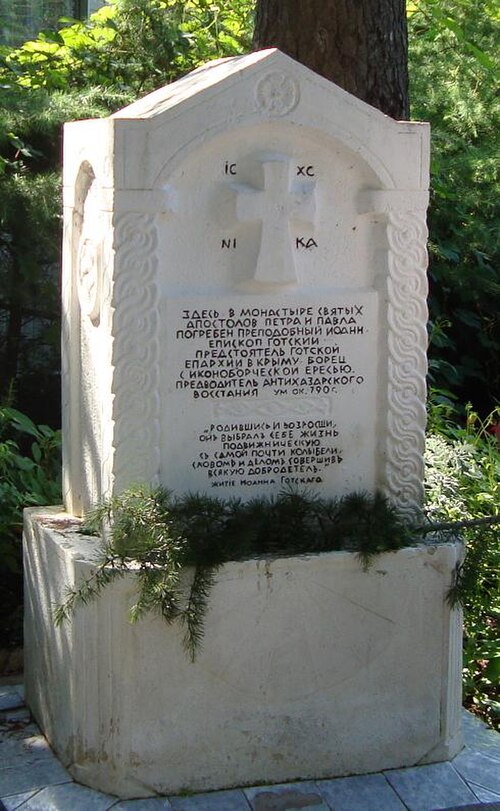
Saint
John of Gothia
Bishop of Gothia
Bishop of Gothia in Crimea who led a revolt in 787 that expelled the Khazars; died around 791.
Life
Saint John of Gothia was bishop of Gothia in the Crimea, a confessor of the right faith in the time of the struggle with iconoclasm, and the leader of an uprising against the Khazars in 787. He died around 791 at Amastris on the northern coast of Asia Minor. He is commemorated on 19 May (1 June in the new style) and on 26 June.
Beginnings
He was born in the first half of the eighth century at Partenit in the Crimea, in the family of Leon and Photina. His paternal grandfather came from the theme of the Armeniacs in Asia Minor and had served as a spearman; the family was probably Greek and moved to the Crimea because of unrest at home. His mother, Photina, had vowed before his birth to dedicate him to the service of God, and he, says the Life, chose a life of struggle almost from the cradle.
In 754, when the bishop of Gothia, wishing to please the iconoclast Emperor Constantine Copronymus, signed the decrees of the iconoclast council in Constantinople and received as reward the see of metropolitan of Heraclea in Thrace, the people of Gothia chose John in his place. He went to Jerusalem, where he stayed three years, and then to Georgia, where he was consecrated bishop around 758, and afterwards returned to his homeland. After the death of the iconoclast Emperor Leo IV, in 780, he visited Constantinople and spoke with the Empress Irene about the right faith. At the Second Council of Nicaea (787), which secured the victory of the veneration of icons, he was not present, but sent as his representative the monk Cyril.
The uprising against the Khazars
In 787, in Gothia, then under Khazar rule, a popular uprising broke out, supported by the secular ruler of the region. John was one of its initiators and took an active part. The Khazar garrison was expelled from Doros, the capital of the region, and the rebels seized the mountain passes leading into the country. But the Khazar khan soon retook the city, in less than a year. John was handed over to the Khazars, but the khagan spared his life and imprisoned him at Phoulloi. From there he escaped to Amastris in the Byzantine Empire, on the opposite shore of the Black Sea, where he died four years later.
The Serbian tradition says that before his death he said: "In forty days I go to be judged with the khagan," and after forty days he died. The bishop's body was brought home. According to one version it was buried in the Parthenon monastery, now that of Saint George, near Cape Fiolent close to Balaklava; according to another, at Partenit on Mount Ayu-Dag, in the church of the Holy Apostles Peter and Paul, which by tradition was built on his initiative, and where a memorial to him has been raised.
His Life, written in Greek between 815 and 842, has been preserved. He was numbered among the holy hierarchs. The only church in the Moscow Patriarchate dedicated to him is at Partenit, at the metochion of the monastery of Cosmas and Damian.
Commemorated the same day May 19
 Dmitry DonskoyRight-Believing · Grand Prince of MoscowMay 19
 Dunstan of CanterburySaint · Archbishop of CanterburyMay 19
 PudentianaMartyrMay 19
 Alexander PetrovskyHieromartyr · Archbishop of KharkivMay 19
 Cornelius of KomelVenerable · Founder of Komel MonasteryMay 19
 Ignatius of VologdaVenerable · Prince of Uglich turned monkMay 19
 Parthenius of RomeMartyr · Martyr of Armenian originMay 19
 Konstantin DyakovHieromartyr · Metropolitan of KyivMay 19
 Onufry GagalyukHieromartyr · Archbishop of KurskMay 19
 Cornelius of PaleostrovVenerable · Founder of Paleostrov MonasteryMay 19
 Sergius of ShukhtovoVenerable · SchemamonkMay 19
 Joasaph ZhevakhovHieromartyr · Bishop of MogilevMay 19