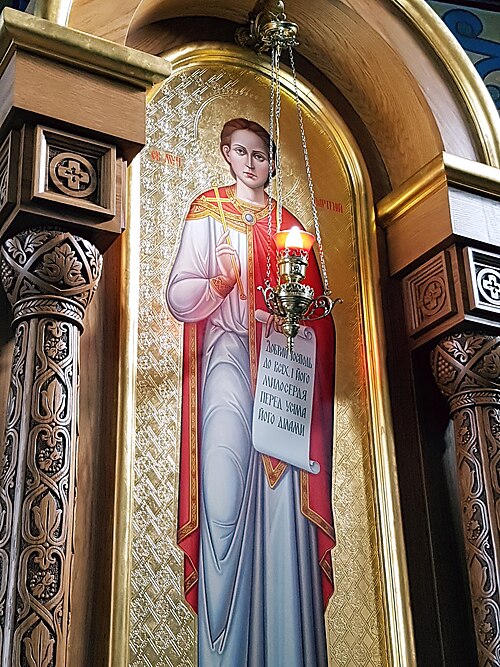
Martyr
Parthenius of Rome
Martyr of Armenian origin
Martyr of Rome of Armenian origin, died in the 3rd century, venerated in the Orthodox and Catholic Churches.
Life
Saint Parthenius of Rome, martyr, of Armenian descent, suffered in the third century, according to tradition in the year 250, in the time of the emperor Decius, together with his brother, Calocerus. He is commemorated on 19 May in the Roman Catholic Church and, according to the Serbian source, on 29 October (16 October Old Style) in the Orthodox Church. He is venerated by both Catholics and Orthodox; his relics are at the Greek-Catholic Basilian monastery at Zhovkva, in Galicia, of which he is the patron.
The story
"The Martyrdom of Calocerus, Parthenius, Victoria, Anatolia and Audax" was written apparently in Picenum, probably before the end of the seventh century. According to it, Parthenius and his brother, Calocerus, were eunuchs serving in the palace of the wife of the emperor Decius. They were charged with embezzlement and with the capital crime of Christianity. Ignoring the financial accusations, Parthenius and his brother defended the Christian faith. The court took their defence as a confession of Christianity and sentenced them to death. Parthenius was thrown into a bonfire but did not burn; to carry out the sentence, guards took flaming brands from the fire and beat him to death. He was buried in the catacombs beneath the church of Saint Callixtus.
According to the Ukrainian source, he came from Armenia, had won great respect among distinguished people while still young, and the news reached Rome, where, after a meeting with the emperor Decius, he was appointed primicerius of the imperial chancery, that is, chief imperial notary; he had great standing among the Roman nobles and was a good friend of the prefect of Rome, Aemilianus, a secret Christian. When many Christians began to flee Rome, after the emperor's decree ordering all Christians to be tortured, Parthenius and his brother, the hieromartyr Calocerus, willingly stayed at their posts, awaiting the death of martyrdom. After torments lasting all day the executioners did not succeed in making them renounce; then they were sentenced to be burned, but, to the amazement of the executioners and all, the flame would not spread to the saints; after this miracle they were killed in great fury by hard blows of a burning torch on the head.
The relics
In the eighteenth century the relics of Parthenius were moved to Vienna, where they came from Rome in 1782. Father Jerome Streletsky, a Basilian, found them there in a neglected state and asked the pope that they be taken to Zhovkva, which was agreed. In 1784, with the permission of Pope Pius VI, they were taken to Zhovkva, in eastern Galicia (then in the Austrian Empire, today in western Ukraine), from where the saint is regarded as patron of the town. In the 1990s the church in which the shrine stands was returned to the Ukrainian Greek-Catholic Church; today it is the monastery and church of the Most Sacred Heart of Christ of the Basilian order, where the relics are kept, with the pope's seals on them. The saint's memory is kept in Galicia on 19 May and on the Sunday after the Exaltation of the Holy Cross, in memory of the translation of the relics.
Commemorated the same day May 19
 Dmitry DonskoyRight-Believing · Grand Prince of MoscowMay 19
 Dunstan of CanterburySaint · Archbishop of CanterburyMay 19
 PudentianaMartyrMay 19
 John of GothiaSaint · Bishop of GothiaMay 19
 Alexander PetrovskyHieromartyr · Archbishop of KharkivMay 19
 Cornelius of KomelVenerable · Founder of Komel MonasteryMay 19
 Ignatius of VologdaVenerable · Prince of Uglich turned monkMay 19
 Konstantin DyakovHieromartyr · Metropolitan of KyivMay 19
 Onufry GagalyukHieromartyr · Archbishop of KurskMay 19
 Cornelius of PaleostrovVenerable · Founder of Paleostrov MonasteryMay 19
 Sergius of ShukhtovoVenerable · SchemamonkMay 19
 Joasaph ZhevakhovHieromartyr · Bishop of MogilevMay 19