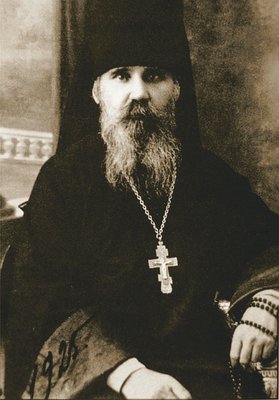
Hieromartyr
Joasaph Zhevakhov
Bishop of Mogilev
Bishop of Mogilev, born Prince Zhevakhov, who died a martyr at Kursk in 1937.
Life
Saint Joasaph of Mogilev, the Hieromartyr (in the world Prince Vladimir Davidovich Zhevakhov, or Javakhishvili, 1874 to 1937), was a bishop of the Russian Church, of the ancient Georgian princely family Javakhishvili. Before tonsure he was a lawyer, official and active man in the church life of Kyiv, and from 1924 a monk and then a bishop. He passed through the Solovki camp and exile and was shot at Kursk on 4 December 1937. The Russian Church numbered him among the New Martyrs in 2002.
Family and the years in the world
He was born on 24 December 1874 (by one source, 24 November), in the estate of Linovitsa, Pyryatin district, Poltava province, as twin brother of Nikolai Davidovich Zhevakhov (1874 to 1945), in the family of Prince David Dmitrievich Zhevakhov, of the Georgian princely house Javakhishvili. His father, Prince Dmitry Mikhailovich Zhevakhov, had been married to Lyubov Davidovna, born Gorlenko, great-granddaughter of a cousin of Saint Joasaph of Belgorod. He spent his childhood and youth in his father's estate and in Kyiv, where his mother had a house.
He graduated from the Second Kyiv Gymnasium, then the Galagan College, and in 1899 from the law faculty of Kyiv University. From 1900 he was an official at the Kyiv Court of Justice, from 1902 to 1914 honorary justice of the peace, and later senior counsellor in the Kyiv provincial administration and official for special assignments at the governor-general of Kyiv, Podolia and Volhynia. He took part in the monarchist movement and was a member of the Russian Assembly. From October 1908 he was an active member of the Orthodox Missionary Society and a founding member of the Orthodox Kamchatka Brotherhood, established by Hieromonk Nestor (Anisimov). From 1912 he was an honorary member of the Znamenskoe Missionary Brotherhood of Kursk.
Link with Saint Joasaph of Belgorod
From 1910 he was on the commission for making the shrine for the holy relics of Saint Joasaph of Belgorod (Gorlenko), a distant relative. His name is also linked with Saint Joasaph through a spiritual censorship activity, in which on 4 (17) August 1912 the prince approved the publication of the score of the "Prayer of Saint Joasaph of Belgorod" and the "Hymn to Saint Joasaph of Belgorod", on verses by Alexandra Platonova, by the Ukrainian composer A. P. Orlovsky.
In 1911 he was the initiator of the excavations in the old monastic caves in the suburb of Kyiv called Zverynets. At the caves the Zverynets skete was founded, whose honorary guardian became Prince Zhevakhov. In December 1913 the church of the Nativity of the Mother of God was consecrated in the skete, of which Zhevakhov was warden, and on 29 August 1914 a side chapel in honour of Saint Joasaph of Belgorod was consecrated. He also wrote an explanation of the "Prayer of Saint Joasaph" (1912, 1915) and a genealogical table of the family of the princes Zhevakhov (1914).
Monk and bishop
After the revolution he had to hide, among other places in the Zverynets skete, and then worked at the Ukrainian Academy of Sciences. In 1924 he was arrested for the first time and spent seven months in the prison at Kyiv. Right after release he wrote to Patriarch Tikhon asking his blessing to receive monasticism: after the "Golgotha" lived that year, in half a year of prison, he had felt the need of resurrection to a new life and had resolved irrevocably to withdraw wholly from the world and devote the rest of his days to God. On 26 December 1924, in the Zverynets skete, Bishop Macarius (Karmazin) of Uman tonsured him a monk, with the name Joasaph, in honour of Saint Joasaph of Belgorod, and ordained him hieromonk.
From 6 July 1926 he was bishop of Dmitriev, vicar of the diocese of Kursk. Soon he was arrested and from 1926 to 1929 was imprisoned in the Solovki Special Purpose Camp. After the camp he spent three years in exile in the Narym district. He was a consistent supporter of Metropolitan Sergius. From 19 September 1932 he was bishop of Pyatigorsk, then from 28 October 1932 bishop of Cheboksary, an appointment he declined. From 29 June 1934 he was bishop of Mogilev, and from 1936 he also governed the diocese of Minsk. He then lived at Belgorod. On 16 October 1936 he was arrested and sent to the town of Borovichi, where his sister lived. In 1937 he was able to return briefly to Belgorod.
Martyrdom and glorification
In 1937 he was arrested by the UNKVD of the Kursk region, accused of "leading a counter-revolutionary fascist organization of churchmen". Among other things he was charged with having called the murder of Kirov a "deserved punishment" for the executions carried out on Kirov's orders. On 4 December 1937 he was condemned by the troika of the UNKVD of the Kursk region and shot the same day.
On 17 July 2002, by a decision of the Holy Synod of the Russian Church, his name was entered in the Synaxis of the New Martyrs and Confessors of the Russian Church. The Russian Church commemorates the Hieromartyr Joasaph on 5 December, not on the day of his death, 4 December, because 4 December (new style) is the great feast of the Entry of the Mother of God into the Temple. On 17 September 2014, in the Transfiguration Cathedral, the head of the FSB directorate of the Belgorod region, Oleg Yuzhakov, in the presence of Metropolitan John (Popov) of Belgorod, handed to Metropolitan Herman (Moralin) of Kursk a copy of the criminal case opened in the 1930s against Bishop Joasaph. The file contains the arrest warrant, the decision on the preventive measure, the interrogation record, the questionnaire of the arrested man, the troika's decision on execution and a certificate of posthumous rehabilitation. Metropolitan Herman thanked him and said that recently the house in which the bishop lived in exile had been found at Kursk, and promised a memorial plaque on it.
Commemorated the same day May 19
 Dmitry DonskoyRight-Believing · Grand Prince of MoscowMay 19
 Dunstan of CanterburySaint · Archbishop of CanterburyMay 19
 PudentianaMartyrMay 19
 John of GothiaSaint · Bishop of GothiaMay 19
 Alexander PetrovskyHieromartyr · Archbishop of KharkivMay 19
 Cornelius of KomelVenerable · Founder of Komel MonasteryMay 19
 Ignatius of VologdaVenerable · Prince of Uglich turned monkMay 19
 Parthenius of RomeMartyr · Martyr of Armenian originMay 19
 Konstantin DyakovHieromartyr · Metropolitan of KyivMay 19
 Onufry GagalyukHieromartyr · Archbishop of KurskMay 19
 Cornelius of PaleostrovVenerable · Founder of Paleostrov MonasteryMay 19
 Sergius of ShukhtovoVenerable · SchemamonkMay 19