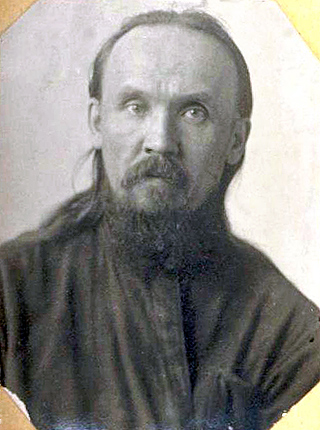
Saint
Alexis Buy
Bishop of Urazovo
Bishop of Urazovo, vicar of the Voronezh diocese and leader of the Josephite movement, who died in 1937 at Sandarmokh.
- Feast
- February 12old style February 25
- Reposed
- 193720th century
- Place
- Sandarmokh
Life
Bishop Alexei (Semyon Vasilyevich Buy) was Bishop of Urazovo, vicar of the Voronezh diocese, and one of the leaders of the Josephite movement, which rejected the line of Metropolitan Sergius Stragorodsky. Born in 1892 into a peasant family in Siberia, he was shot on 3 November 1937 at Sandarmokh in Karelia. His life was fiercely disputed, between the praises of partisans and the complaints of opponents, and the sources say contradictory things about his character.
Youth and monasticism
He was born in 1892 in the settlement of Ksenievsky in the Tomsk district (today the town of Asino), into a peasant family moved to Siberia from the Vitebsk governorate. He attended the parish and ecclesiastical schools at Tomsk, worked in a parish school, was secretary of the Znamensky monastery at Krasnoyarsk and studied by correspondence at the seminary there, where in 1915 he passed the examinations of the fourth class but could not continue for lack of money. In September 1915 he entered the service of Archbishop Anatoly Kamensky at Tomsk as a cell attendant, attended the seminary in the town and, on 29 September, was tonsured a monk with the name Alexei; on 11 October he was ordained hierodeacon and on 4 April 1917 hieromonk. In 1917 he graduated from the Tomsk seminary. In 1918 he taught at the catechetical school at Biysk, in 1919 he was personal secretary to Archbishop Anatoly, and in 1920 he moved after him to Irkutsk, where on 27 June 1922 he was named abbot of the Prince Vladimir monastery. That autumn he was arrested for not recognizing the Renovationist diocesan administration, was released after three months, then acquitted by a court, but forced to leave Irkutsk. On 21 April 1923 Archbishop Anatoly Grisyuk of Samara named him abbot of the Alexander Nevsky monastery in the Bugulma district, with the rank of archimandrite.
Bishop
Archbishop Anatoly wanted to make him vicar with a see at Bugulma but was arrested first. On 1 January 1924, at Ufa, Bishops John Poyarkov of Dovlekanovo, Mark Bogolyubov of Sterlitamak and Veniamin Frolov of Baika decided to set up the see of a vicar at Bugulma, saying the Samara diocese had no leader and no Orthodox bishop in communion with the others, and that a single candidate would cost little, being abbot of a community. On the same day, in the Nicholas Cross church at Ufa, Archimandrite Alexei was consecrated Bishop of Bugulma, vicar of Samara, by Bishops Boris Shipulin of Ufa, John Poyarkov, Mark Bogolyubov and Veniamin Frolov. The consecration was performed without the prior approval of Patriarch Tikhon, who had sent a telegram asking them to wait, and Bishop John asked forgiveness for doing it on their own, out of "extreme need and happy chance". Later, in 1928, a note of the Synod around the locum tenens said that Alexei had reached the episcopate by deception, from cell attendant. He went to Moscow, where Patriarch Tikhon recognized his consecration and, on 13 March 1924, named him Bishop of Petropavlovsk, vicar of Omsk. On 12 April 1925 he signed the act by which supreme church authority passed to Metropolitan Peter Polyansky. He was then Bishop of Semipalatinsk, for two months governed the Yekaterinburg diocese, from October 1925 was Bishop of Velizh, without ever reaching it, and from February 1926 Bishop of Kozlov, vicar of Tambov. In spring 1926 he was arrested and spent six months at Butyrka in Moscow.
On 28 February 1927 Archbishop Seraphim Samoylovich named him administrator of the Voronezh diocese, and on 13 July 1927 he was named Bishop of Urazovo, vicar and temporary administrator of it. The situation at Voronezh was hard: the Renovationists, declining in the time of Archbishop Peter Zverev, had revived after his arrest and held most of the churches. His arrival did not worry them: they wrote that the new bishop made no impression and would be a not very dangerous opponent. But he took the exiled priests under his protection, appointing them to the best parishes, and toward the local clergy he behaved defiantly. According to informers he was hot-tempered and harsh, often unyielding, and deprived priests of parishes for minor faults. Complaints reached Metropolitan Sergius, and the Synod took them seriously.
The "Buyevite" movement
At first he accepted Metropolitan Sergius's Declaration and did not protest his order for commemorating the state authorities at services. But in January 1928 his position changed; the historian Nikolai Sapelkin thinks he decided to break with Sergius to forestall his decision about him. On 22 January 1928, supported by exiled priests, he addressed the clergy and faithful of the diocese with an epistle saying that Sergius had slid toward Renovationism, exceeded his powers and violated the canons, so that he had cut himself off from the unity of the Church and lost the right of primate, and that his orders had no value for them. He took Metropolitan Joseph Petrovykh as his "spiritual leader", who approved the epistle but refused to head the Voronezh clergy administratively, saying: "Govern yourselves, or you will ruin both me and yourselves."
On 27 January 1928 Sergius and the Synod removed him from governing the diocese "for schism", retired him, suspended him from service and handed him to canonical judgment, and the diocese was entrusted to Bishop Vladimir Gorkovsky. Alexei did not recognize the decision and kept over eighty parishes, the centre of the Josephite movement in the diocese being the Alexeyevsky Akatov monastery in Voronezh. According to the historian Mikhail Shkarovsky, the "Buyevite" clergy numbered up to four hundred men, in about forty districts, being the most radical wing of the Josephites. Expelled from Voronezh, from 20 May 1928 he lived at Yelets and headed the Josephite parishes of southern Russia and Ukraine.
Prison and martyrdom
On 7 March 1929 he was arrested in Moscow; at the search he behaved defiantly and mocked the agents. On 17 May 1929 he was sentenced to three years, served at Solovki, where he took part in secret services of the Josephites. In the camp he kept his authority, and in February 1930 134 people were arrested, accused of belonging to a church-monarchist organization led by him. He was arrested at Solovki and taken to Voronezh; he refused to admit guilt, but after some of those in the case gave testimony he partly admitted it. In the wave of persecution of 1937 he was shot on 3 November 1937 in the forest at Sandarmokh in Karelia.
Commemorated the same day February 12
 Benedict of AnianeVenerable · Reformer of monastic lifeFeb 12
 Meletius of AntiochSaint · Patriarch of AntiochFeb 12
 Eulalia of BarcelonaMartyrFeb 12
 Julian the HospitallerSaintFeb 12
 Alexis of MoscowSaint · Metropolitan of Kiev and all RusFeb 12
 Antony II KauleasSaint · Patriarch of ConstantinopleFeb 12
 Martyrs of AbitinaeHoly MartyrsFeb 12
 Meletius of KharkivSaint · Archbishop of KharkivFeb 12
 DamianMartyrFeb 12
 Prochorus the IberianVenerable · Founder of the Monastery of the CrossFeb 12
 Christos the GardenerNew MartyrFeb 12
- Victoria of AlbitinaMartyrFeb 12