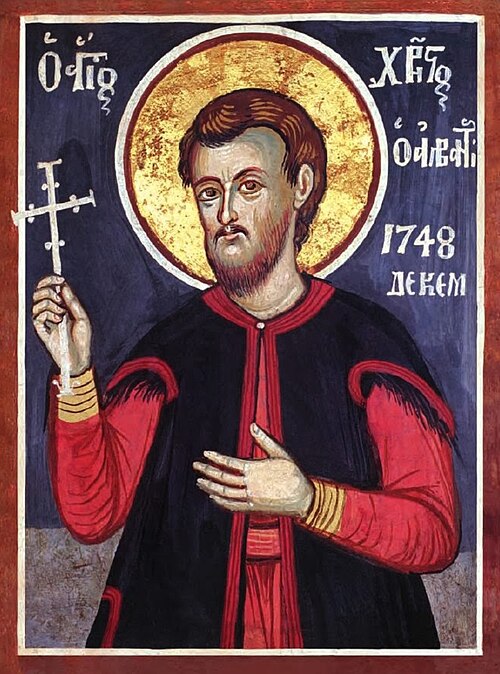
New Martyr
Christos the Gardener
Orthodox saint from Albania in the 18th century, known as Christos the Gardener or the Arvanite.
- Feast
- February 12old style February 25
- Reposed
- 174818th century
- Place
- Përmet
- Order
- Martyrs
Life
Saint Christos the Gardener (Christos the Albanian, the Arvanite), new martyr, was a gardener of Albanian descent, born at Përmet, killed at Constantinople on 12 February 1748 for remaining faithful to Christ. He is venerated in the Greek Churches and in the Orthodox Church of Albania, where he is one of the most venerated saints; his commemoration is not entered in the calendar of the Russian Church. He is commemorated on 12 February.
Life
He was born at Përmet, in Albania, and lived at the beginning of the eighteenth century, in the time of Ottoman rule in the Balkans. Little is known of his youth, only that he was a gardener and sought new business opportunities at Constantinople, leaving Albania behind. According to the Russian source he left at forty for Constantinople; according to the Greek he arrived there in 1746, at the age of forty; the English source says that in 1748 he began working in the sultan's garden, which is why he is shown in icons holding apples.
One day, in the market, he quarrelled with a Turk about the price of his goods (apples). The quarrel flared, and the Turk, in revenge, accused Christos of having sworn to accept Islam. He brought him before the judge, with false witnesses who confirmed the accusation. Christos remained firm in the confession of faith, saying that he would not become a Muslim; being a Christian, his word was not equal to that of a Muslim. They beat him and threw him into prison, without bread and water, and tortured him severely.
Martyrdom
For two years he was in prison, tortured to renounce Christianity, but remained faithful. In the same prison was the scholar and poet Kaisarios Dapontes, who watched the saint's torments and later wrote his martyrdom. Kaisarios obtained that the fetters be taken from his feet and brought him a little food to strengthen him, but the gardener refused, saying: "Why should I eat? I do not expect to live, but to die for Christ, so let me die of hunger and thirst for Christ." He was sentenced to beheading for apostasy, for refusing to acknowledge the alleged conversion to Islam. To have money for a memorial service, he asked Dapontes to sell a metal file he had. He remained steadfast in the faith of his fathers and on the same day, 12 February 1748, the executioners cut off his head, at Constantinople. Through Kaisarios Dapontes his testimony became known; Dapontes later became a monk on Athos. The Church regards him as a saint and commemorates him on 12 February; our sources do not give the date of canonization.
Commemorated the same day February 12
 Benedict of AnianeVenerable · Reformer of monastic lifeFeb 12
 Meletius of AntiochSaint · Patriarch of AntiochFeb 12
 Eulalia of BarcelonaMartyrFeb 12
 Julian the HospitallerSaintFeb 12
 Alexis of MoscowSaint · Metropolitan of Kiev and all RusFeb 12
 Antony II KauleasSaint · Patriarch of ConstantinopleFeb 12
 Martyrs of AbitinaeHoly MartyrsFeb 12
 Meletius of KharkivSaint · Archbishop of KharkivFeb 12
 DamianMartyrFeb 12
 Prochorus the IberianVenerable · Founder of the Monastery of the CrossFeb 12
 Alexis BuySaint · Bishop of UrazovoFeb 12
- Victoria of AlbitinaMartyrFeb 12