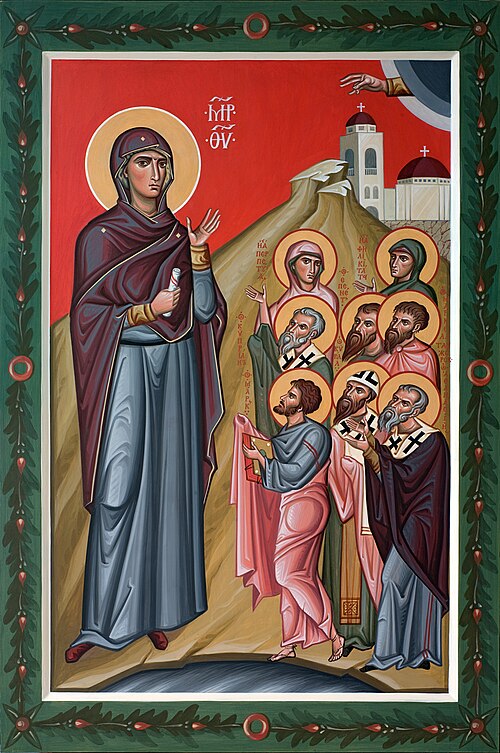
Holy Martyrs
Martyrs of Abitinae
Forty-nine Christians of the province of Africa condemned in 304 for holding Sunday worship against the ban.
- Feast
- February 12old style February 25
- Reposed
- 3044th century
- Place
- Abitinae
- Order
- Martyrs
Life
The forty-nine martyrs of Abitinae were Christians of the Roman province of Africa who were condemned in 304, under the emperor Diocletian, for holding the Sunday liturgy that the law forbade. The Church remembers them for their plain confession: they could not live without the Lord's Day and the Holy Eucharist.
The edict and the gathering
On 24 February 303 Diocletian had issued his first edict against the Christians. It ordered the destruction of the Holy Scriptures and of places of worship throughout the Empire and forbade Christians to assemble for worship. Fundanus, the bishop of Abitinae, obeyed and handed the books of the church over to the authorities. Yet some of the faithful went on meeting in secret under the priest Saturninus.
They were arrested and brought before the local magistrates, who sent them to Carthage, the capital of the province, to be tried.
The trial at Carthage
The trial took place on 12 February before the proconsul Anullinus. Among the accused was the senator Dativus. Under questioning he confessed that he was a Christian and had taken part in the gathering, but even under torture he at first would not say who had led it. During the hearing the advocate Fortunatianus, brother of Victoria, one of the accused, charged Dativus with having lured her and other young women to the service. Victoria replied that she had gone of her own free will. The proconsul stopped the torture and asked Dativus again whether he had been at the gathering, and again he said yes. Asked who had urged them on, he answered: "The priest Saturninus and all of us." He was taken to prison and died soon after of his wounds.
The priest Saturninus was questioned in turn and stood firm even under torture. The others followed his example, men and women alike, among them four children.
"We cannot live without the Lord's Day"
One answer was heard again and again at the trial. Emeritus, in whose house the gathering had been held, was asked why he had broken the emperor's command. He said: "Sine dominico non possumus," which means "We cannot live without the Lord's Day." He meant the celebration of the Holy Eucharist, which the emperor had forbidden, but in which they chose to take part even at the price of torture and a sentence of death.
Commemoration
The Roman Martyrology, which lists all their names, commemorates them on 12 February. Among them are the priest Saturninus, the children of Saturninus (Saturninus, Felix, Maria, a consecrated virgin, and the little Hilarianus), the readers Emeritus and Ampelius, with his infant son Benignus, then Dativus, Victoria of Carthage and many others, men and women. Saint Restituta is sometimes counted among them. According to tradition, the relics of Saint Victoria and Saint Benignus are kept in the monastery of Lešje in Serbia. Saint Augustine mentions Abitinae in his writing on baptism, around the year 400. Calendars also remember the martyrs on other dates, among them 11 and 20 February.
Commemorated the same day February 12
 Benedict of AnianeVenerable · Reformer of monastic lifeFeb 12
 Meletius of AntiochSaint · Patriarch of AntiochFeb 12
 Eulalia of BarcelonaMartyrFeb 12
 Julian the HospitallerSaintFeb 12
 Alexis of MoscowSaint · Metropolitan of Kiev and all RusFeb 12
 Antony II KauleasSaint · Patriarch of ConstantinopleFeb 12
 Meletius of KharkivSaint · Archbishop of KharkivFeb 12
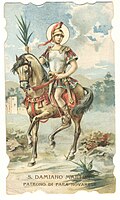 DamianMartyrFeb 12
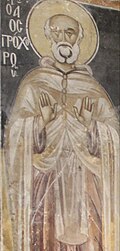 Prochorus the IberianVenerable · Founder of the Monastery of the CrossFeb 12
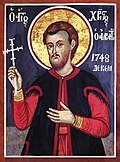 Christos the GardenerNew MartyrFeb 12
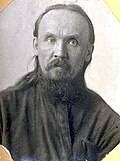 Alexis BuySaint · Bishop of UrazovoFeb 12
- Victoria of AlbitinaMartyrFeb 12