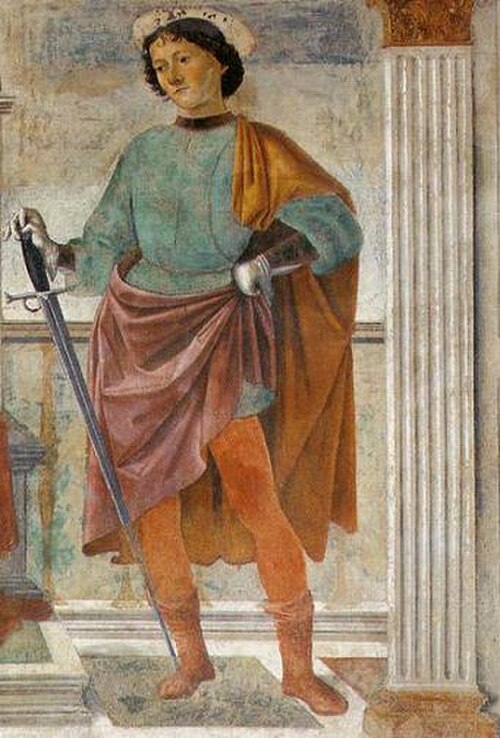
Saint
Julian the Hospitaller
Saint venerated in West and East, patron of the cities of Ghent, Macerata and Saint Julian's in Malta.
- Feast
- February 12old style February 25
- Reposed
- 100010th century
- Place
- Le Mans
Life
Saint Julian the Hospitaller, also called Julian the Poor, is a saint venerated in the Catholic Church and also in the Eastern Orthodox Church, patron of travellers and of those who keep hostels. His life has come down chiefly as a legend, and the earliest known mention of him dates from the late twelfth century. He is the patron of the cities of Ghent in Belgium, Macerata in Italy and Saint Julian's in Malta, and his feast falls on 12 February.
Origin
The sources do not agree on his birthplace and give three possibilities: Le Mans in France, Ath in Belgium and Naples in Italy. The location of the hospitals he built is likewise uncertain: some seek them on the banks of the river Gardon in Provence, others on an island near the river Potenza, towards Macerata. His story is included in the Golden Legend of the Dominican Jacobus de Voragine, in the thirteenth century, and a Our Father of Saint Julian appears as early as 1353 in Boccaccio's Decameron and is still passed on by word of mouth in parts of Italy.
The legend
According to Jacobus de Voragine, on the night Julian was born his father, a man of noble blood, saw pagan witches secretly lay a curse on the child: he would kill his parents. The father wished to be rid of the boy, but his mother would not allow it. When Julian grew up and learned why his mother wept, he swore he would never commit such a sin and set off, with great faith in Christ, as far from his family as he could. Some versions say it was his mother who told him at the age of ten, others that a stag he met while hunting told him, a scene often used in paintings of the saint.
After fifty days of walking he reached Galicia, where he married a good woman, in some tellings a wealthy widow. Twenty years later his parents set out to look for their son, now thirty years old. They came to the altar of Saint James, son of Zebedee, and on leaving found a woman whom they asked for lodging for the night. She took them in and told them that her husband Julian was out hunting, which is why the saint is also counted patron of hunters. His wife fed them and gave them Julian's bed.
The devil met Julian and told him that his wife was with another man. Coming home and finding two people asleep in his bed, Julian took them for his wife and her lover and killed them both. When he discovered his mistake, he vowed to spend the rest of his life in works of charity. With his wife he made a pilgrimage to Rome, and then they came to a river crossing, where they built a hospice for weary and sick travellers, and Julian carried people across. The Russian sources add that he spent his whole fortune on seven hospitals and twenty-five houses for pilgrims. In one version Christ came to him as a pilgrim stricken with leprosy and Julian received him; in another, a beggar whom he had ferried across the river and to whom he had given his bed was revealed the next day as an angel and announced his forgiveness.
Another pious legend says that the devil, disguised as a worn-out pilgrim, was admitted to the hospice and caused great disorder in the night. Julian, angry, sent everyone away and swore to admit no one again. Christ came to his door as a pilgrim and asked humbly for shelter in the name of God. Julian refused, but then recognized him, retracted his word and began again to help all in need.
Veneration
Saint Julian is invoked by travellers far from home who pray for safe lodging. His name is borne by churches, hospitals and inns, and according to some opinions the oldest church of Paris, Saint-Julien-le-Pauvre, is dedicated to him. A thirteenth-century stained glass window of him survives at Chartres Cathedral, and early frescoes are found at Trento Cathedral. In art his attributes are a falcon, a drawn sword and, more rarely, an oar; he may be shown on horseback or beside a stag, with a river and a boat behind him.
In Malta devotion to him began in the fifteenth century, after the discovery of his relics at Macerata, and was introduced by the noble De Astis family. The Knights Hospitaller spread it further: in 1539 they rebuilt the church at Senglea, and in 1590 they built another in the parish of Birkirkara, a district called Saint Julian's ever since.
Commemorated the same day February 12
 Benedict of AnianeVenerable · Reformer of monastic lifeFeb 12
 Meletius of AntiochSaint · Patriarch of AntiochFeb 12
 Eulalia of BarcelonaMartyrFeb 12
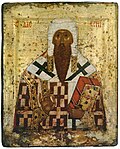 Alexis of MoscowSaint · Metropolitan of Kiev and all RusFeb 12
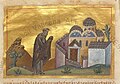 Antony II KauleasSaint · Patriarch of ConstantinopleFeb 12
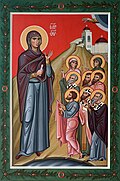 Martyrs of AbitinaeHoly MartyrsFeb 12
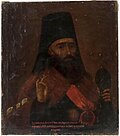 Meletius of KharkivSaint · Archbishop of KharkivFeb 12
 DamianMartyrFeb 12
 Prochorus the IberianVenerable · Founder of the Monastery of the CrossFeb 12
 Christos the GardenerNew MartyrFeb 12
 Alexis BuySaint · Bishop of UrazovoFeb 12
- Victoria of AlbitinaMartyrFeb 12