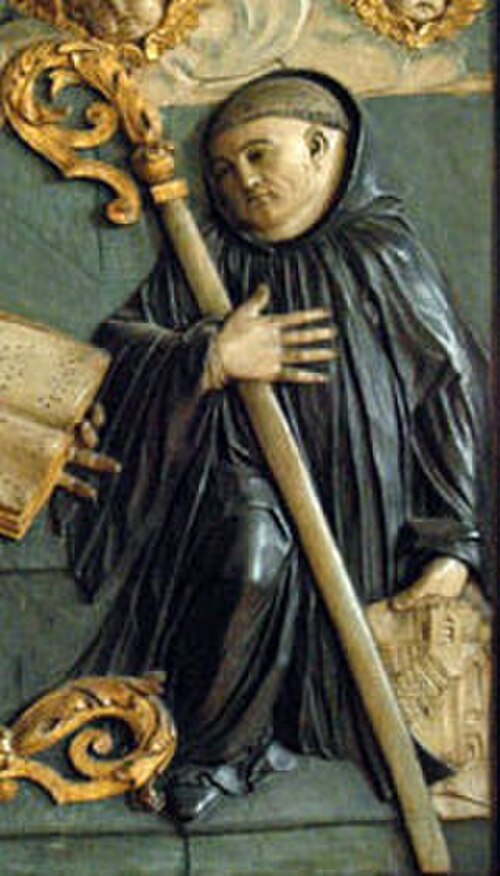
Venerable
Benedict of Aniane
Reformer of monastic life
Monk called the Second Benedict, reformer of monastic life in the Carolingian Empire, who died in 821.
- Feast
- February 12old style February 25
- Reposed
- 8219th century
- Place
- Aachen
- Order
- Venerables
Life
Saint Benedict of Aniane, venerable, called the Second Benedict, was a monk and reformer of monastic life in the empire of Charlemagne. He fell asleep in 821. He is commemorated on 12 February.
Youth
He was born around 747-750, in Languedoc, with the Gothic name Witiza, the son of Count Aigulf of Maguelonne, of Visigothic stock. He was raised at the court of the Frankish king Pepin the Short and entered the king’s service, then Charlemagne’s court, and took part in the Italian campaign of 773. There, trying to save his brother who was drowning in the river Ticino, he nearly drowned himself. The event settled him to leave the world, something long formed in him. He left the court and entered the monastery of Saint Sequanus, Saint-Seine, taking the name Benedict.
Father of monks
At Saint-Seine he was made cellarer and then elected abbot, but understanding that the monks would not submit to his strict rule, he left and returned to his father’s estates in Languedoc, where he built a hermitage. Around 780 he founded at Aniane a community after Eastern asceticism, which did not develop as he wished; in 782 he founded on the same site a monastery after the Rule of Saint Benedict. His success there gave him great influence, which he used to found and reform many other monasteries, becoming in effect abbot of all the monasteries of Charlemagne’s empire. In 781 Louis the Pious, king of Aquitaine, asked him to reform the monasteries of his land, and later, as emperor, entrusted to him the unity of practice and the contact among the monasteries. He knew the writings of the holy Fathers well, and churchmen such as Alcuin sought his counsel. In 814 Louis had him build a monastery on the river Inde, near the court at Aachen, called at first the Monastery of the Redeemer on the Inde and later Kornelimünster.
Reform of monastic life
In 817 he led at Aachen a council of abbots that drew up a code of regulations, the Codex regularum, binding on all monasteries. Benedict sought to restore the old strictness of monastic life where it had slackened. He then compiled the Concordia regularum, in which he sets parts of the Rule of Saint Benedict beside parallel passages from other rules, to show the agreement of principles. He fought against the heresy of the Adoptionists. Although the new rules fell into disuse soon after his death and Louis’s, they left lasting traces in Western monasticism. He died at Kornelimünster, in 821; he was buried the next day, which is why his day is given sometimes as 11, sometimes as 12 February.
Commemorated the same day February 12
 Meletius of AntiochSaint · Patriarch of AntiochFeb 12
 Eulalia of BarcelonaMartyrFeb 12
 Julian the HospitallerSaintFeb 12
 Alexis of MoscowSaint · Metropolitan of Kiev and all RusFeb 12
 Antony II KauleasSaint · Patriarch of ConstantinopleFeb 12
 Martyrs of AbitinaeHoly MartyrsFeb 12
 Meletius of KharkivSaint · Archbishop of KharkivFeb 12
 DamianMartyrFeb 12
 Prochorus the IberianVenerable · Founder of the Monastery of the CrossFeb 12
 Christos the GardenerNew MartyrFeb 12
 Alexis BuySaint · Bishop of UrazovoFeb 12
- Victoria of AlbitinaMartyrFeb 12