Martyr
Eulalia of Barcelona
Virgin of thirteen, martyred at Barcelona in the persecution of Diocletian in 303.
- Feast
- February 12old style February 25
- Reposed
- 3034th century
- Place
- Barcelona
- Order
- Martyrs
Life
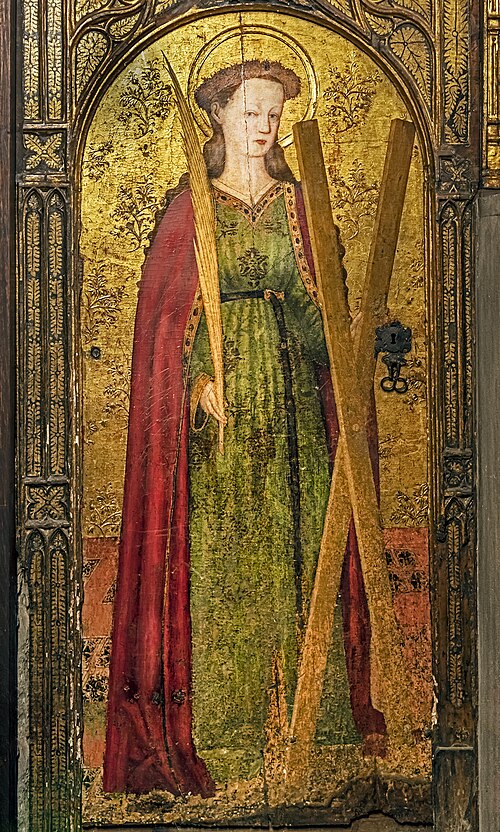
Holy Martyr Eulalia of Barcelona was a virgin of thirteen who received the crown of martyrdom at Barcelona, in the persecution of Diocletian, on 12 February 303. She is the patron saint of the city of Barcelona. She lived before the separation of the Churches and is therefore venerated by both the Catholic and the Orthodox Church. Her veneration, however, is mainly in the West, in Catalonia. The story of her life is very like that of Saint Eulalia of Mérida, and some scholars ask whether they are the same person.
Eulalia was born around 290, in a noble family near the city of Barcelona, then called Barcino. In the time of the persecution of Christians under the emperors Diocletian and Maximian, the governor Dacian arrived in the city with orders to persecute the Church. After a time Eulalia left her parents' house, entered the city and rebuked the governor openly for what he was doing to Christians.
Dacian ordered her stripped and tortured in many ways, among them scourging. According to Christian sources she was subjected to thirteen tortures, of which the twelfth was crucifixion on a cross in the form of an X and the thirteenth beheading. For this reason she is painted with this cross. Other scholars think that she was tortured in public on an X-shaped frame and her body left on display, and that images of this gave rise to the belief in her crucifixion. As with Eulalia of Mérida, it is said that during the torments a dove flew from her mouth. Eulalia prayed that God would take her to heaven and died of her wounds. Tradition also tells that she was put in a barrel filled with shards of glass and rolled down the street now called Baixada de Santa Eulàlia.
Her body was at first buried in the church of Santa Maria de les Arenes, now Santa Maria del Mar. In 713, at the Moorish conquest, it was hidden and was found again only in 878. In 1339 it was moved to an alabaster sarcophagus in the crypt of the new cathedral, dedicated to Saint Eulalia. In Barcelona statues and streets bear her name, and her festival is held for a week around 12 February.
Commemorated the same day February 12
 Benedict of AnianeVenerable · Reformer of monastic lifeFeb 12
 Meletius of AntiochSaint · Patriarch of AntiochFeb 12
 Julian the HospitallerSaintFeb 12
 Alexis of MoscowSaint · Metropolitan of Kiev and all RusFeb 12
 Antony II KauleasSaint · Patriarch of ConstantinopleFeb 12
 Martyrs of AbitinaeHoly MartyrsFeb 12
 Meletius of KharkivSaint · Archbishop of KharkivFeb 12
 DamianMartyrFeb 12
 Prochorus the IberianVenerable · Founder of the Monastery of the CrossFeb 12
 Christos the GardenerNew MartyrFeb 12
 Alexis BuySaint · Bishop of UrazovoFeb 12
- Victoria of AlbitinaMartyrFeb 12