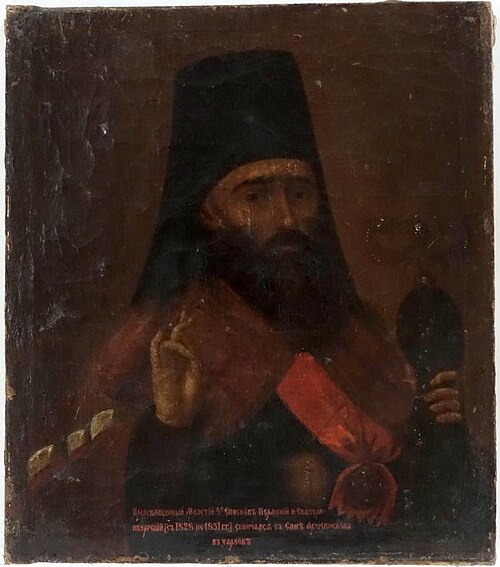
Saint
Meletius of Kharkiv
Archbishop of Kharkiv
Archbishop of Kharkiv and Akhtyrka, who lived from 1784 to 1840.
- Feast
- February 12old style February 25
- Reposed
- 184019th century
- Place
- Kharkiv
- Order
- Hierarchs
Life
Saint Meletius of Kharkiv, Hierarch, was Archbishop of Kharkiv and Akhtyrka, a poor and gentle pastor, a man of learning and a missionary among the Old Believers, in the Urals and in Buryatia. Born on 6 (17) November 1784 at Stariye Sanzhary in the Poltava governorate, he fell asleep on 29 February (12 March) 1840 at Kharkiv. He was canonized for veneration throughout the Russian Church on 21 February 1978. He is commemorated on 12 (25) February, his name day, and on 29 February (in non-leap years 28 February), the day of his repose.
School
Born Mikhail Ivanovich Leontovich, into a family of servants of the Church, from the age of four he learned in his father's house to read in church and secular books, to write beautifully and to know the basics of Russian and Latin grammar. On 2 September 1794 he entered the parish school at Poltava, which he finished with success at twelve, then continued at the bursa in Yekaterinoslav, where he was one of the best pupils, and in September 1799 moved to the seminary there, finished in 1808. As the best student he was sent to the St Petersburg Theological Academy, which he finished in August 1814 in the first category, with the degree of master; he was lecturer in Greek and, two months after graduation, was named conference secretary and teacher of Greek, preparing meanwhile to become a monk. On 7 January 1816 he asked the academy authorities to be allowed to become a monk, but the request was not granted, and on 30 July 1817 he was moved to the seminary at Kyiv, as inspector and teacher of church history and Greek; the seminary opened on 27 October 1817.
Monk
On 11 (23) February 1820, in the brotherhood of the Kyiv Theological Academy, he was tonsured a monk by Metropolitan Eugene, on the day of commemoration of Saint Meletius of Antioch, whose name he received. On 22 February he was ordained hierodeacon and after two days hieromonk. On 9 August 1821 he was named rector of the Mogilev seminary and abbot of the Kutein monastery near Orsha, where he was raised to archimandrite. In August 1823 he was moved to be rector of the Pskov seminary, and in 1824 he returned to Kyiv as rector of the academy.
Bishop
On 21 November (3 December) 1826 he was raised to Bishop of Chyhyryn, vicar of the Kyiv diocese and abbot of the Saint Michael Golden-Domed monastery. On 21 April (3 May) 1828 he was moved to Perm, where he wrote the "Catechism for Ordinands", to prepare candidates for the priesthood, and began a wide missionary work among the Old Believers. In spring 1829 he travelled through the diocese, serving in parish churches. On 18 July 1831 he was moved to Irkutsk and raised to archbishop, where he worked by preaching and mission, especially in the remote parts of Buryatia. Because of his health, on 22 June (4 July) 1835 he was moved to the see of Sloboda Ukraine and arrived at Kharkiv on 9 (21) November 1835; in February 1836 the diocese was renamed Kharkiv and Akhtyrka.
In 1839 he fell gravely ill. On 6 (18) December 1839, on the name day of Emperor Nicholas, paying no heed to his illness, he served the Liturgy and, because of the bad weather, fell still more ill. He fell asleep on 29 February (12 March) 1840. He was buried by subscription, because, though he received a large state salary and large revenues from the diocese, he left behind only 350 roubles in banknotes, two telescopes, two pieces of velvet, books and the strictly necessary linen. He was buried on 5 (17) March 1840 in the crypt of the Pokrovsky monastery.
On 3 (15) December 1875 a fire broke out in the Protection church, which burned everything, but the fire did not touch Meletius's coffin. In 1948 his relics were moved to the Annunciation cathedral at Kharkiv, where they lie today, in the left side chapel of Saint Barbara, by the wall near the choir.
Canonization
The question of his canonization was first raised in 1918, at the All-Ukrainian Church Council at Kyiv, but was not carried through. On 21 February 1978 the Holy Synod of the Russian Church canonized him for veneration throughout the Church, thanks to the effort of Archbishop Nikodim (Rusnak) of Kharkiv. The service and akathist were composed by him and edited by Metropolitan Nikodim (Rotov). So as not to irritate the authorities, the canonization was done almost unnoticed: the Journal of the Moscow Patriarchate reported only that the patriarch and Synod had blessed the akathist, and a year later a short note on the event appeared.
Commemorated the same day February 12
 Benedict of AnianeVenerable · Reformer of monastic lifeFeb 12
 Meletius of AntiochSaint · Patriarch of AntiochFeb 12
 Eulalia of BarcelonaMartyrFeb 12
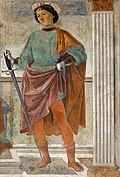 Julian the HospitallerSaintFeb 12
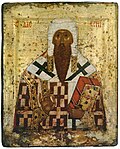 Alexis of MoscowSaint · Metropolitan of Kiev and all RusFeb 12
 Antony II KauleasSaint · Patriarch of ConstantinopleFeb 12
 Martyrs of AbitinaeHoly MartyrsFeb 12
 DamianMartyrFeb 12
 Prochorus the IberianVenerable · Founder of the Monastery of the CrossFeb 12
 Christos the GardenerNew MartyrFeb 12
 Alexis BuySaint · Bishop of UrazovoFeb 12
- Victoria of AlbitinaMartyrFeb 12