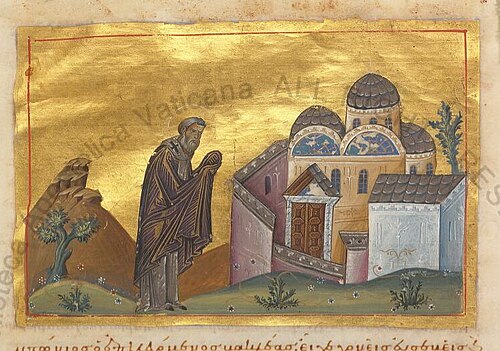
Saint
Antony II Kauleas
Patriarch of Constantinople
Ecumenical Patriarch of Constantinople from August 893 until his death in 901.
- Feast
- February 12old style February 25
- Reposed
- 90110th century
- Place
- Constantinople
- Order
- Hierarchs
Life
Saint Antony II Kauleas was ecumenical patriarch of Constantinople from August 893 until his repose on 12 February 901. The Church remembers him as a merciful monk, a great founder of monasteries and a pastor who worked for the reconciliation of the Church.
He was born in 829 at Constantinople into a family of Phrygian origin. His father, after marriage, had been ordained priest. Antony received his basic schooling in the capital and, after his mother's death, at twelve, became a monk in a monastery of Constantinople. He studied theology there and, according to tradition, was ordained priest and chosen abbot. He was gentle and pious and became known for the holiness of his life and for unusual almsgiving; tradition says he also made his father a monk.
He came to the attention of Stylianos Zaoutzes, the all-powerful minister of the emperor Leo VI the Wise. Antony had supported the emperor against Patriarch Photius and afterwards worked for the reconciliation of the Church, bringing the supporters of Photius and Ignatius to agreement. After the death of Patriarch Stephen I, the emperor's brother, Leo raised Antony to the patriarchal throne; he was elected on 3 August 893. As patriarch he called a synod attended also by envoys of Rome, who judged the schism caused by Photius and Ignatius to be ended, without any of them being condemned. He did not bless the emperor's marriage to Zoe Zaoutzaina and deposed the priest who had performed it, but in 900 he himself performed the emperor's third marriage.
He supported monasticism and, with the help of the emperor, who preached at the dedication, he founded or restored the monastery of Kaulea. He fell asleep on 12 February 901 and was buried in the church of that monastery. He is credited with the gift of prophecy and with miracles at his tomb. His life was written at the beginning of the tenth century by a Nikephoros, and later, in 1347, by Nikephoros Gregoras. His memory appears in Constantinopolitan liturgical texts of the tenth century and in the Menologion of Basil II; it also reached Rus, in the calendar of the Kholm Gospel. The Orthodox and Catholic Churches commemorate him on 12 February. He was followed, on 1 March of that year, by Nicholas Mystikos.
Commemorated the same day February 12
 Benedict of AnianeVenerable · Reformer of monastic lifeFeb 12
 Meletius of AntiochSaint · Patriarch of AntiochFeb 12
 Eulalia of BarcelonaMartyrFeb 12
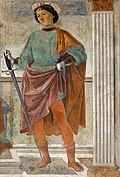 Julian the HospitallerSaintFeb 12
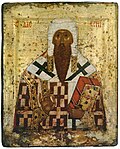 Alexis of MoscowSaint · Metropolitan of Kiev and all RusFeb 12
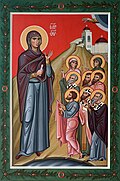 Martyrs of AbitinaeHoly MartyrsFeb 12
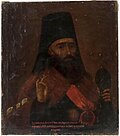 Meletius of KharkivSaint · Archbishop of KharkivFeb 12
 DamianMartyrFeb 12
 Prochorus the IberianVenerable · Founder of the Monastery of the CrossFeb 12
 Christos the GardenerNew MartyrFeb 12
 Alexis BuySaint · Bishop of UrazovoFeb 12
- Victoria of AlbitinaMartyrFeb 12