Venerable Martyr
Anatoly Smirnov
A Russian monk who died a martyr for his faith in Christ during the communist persecution.
Life
Venerable Martyr Anatoly Smirnov, a hieromonk, an ascetic of Glinsk, a choir director and composer, was shot in the early thirties at Sukhumi, in Abkhazia. The Russian Church honours him among the New Martyrs and Confessors, on 11 August and 7 February, and on 8 September in the Synaxis of the Saints of the Central Asian Metropolitan District.
Glinsk and Turkestan
Father Anatoly was a highly educated monk who led an ascetic life. He was a wonderful singer and a remarkable choir director and wrote spiritual music. At the beginning of the twentieth century he was invited, with other monks of the Glinsk Hermitage, the venerable martyrs hieromonks Seraphim Bogoslovsky and Theognostus Pivovarov, to the Holy Trinity missionary monastery for men, founded in 1882 on the shore of Lake Issyk-Kul by Bishop Alexander Kulchitsky, to spread Orthodoxy in the Turkestan region and enlighten the Asian nomads. There the monks of Glinsk made friends with the monks Pachomius Rusin and Heraclius. It is not possible today to establish exactly the biographical data of these ascetics of Kazakhstan. It is known only that by 1909 the monks Seraphim and Anatoly were called to the episcopal city of Verny (now Almaty), where they received ordination and served at the church of the Dormition of the Turkestan bishop's house; in 1912 they received for it the right to wear the epigonation. They also cared for the Iveron-Seraphim convent. In 1916 Hieromonk Anatoly directed the bishop's choir at the Ascension Cathedral in Verny.
The Aksai skete
After the Bolsheviks came to power, in March 1918, and Bishop Pimen Belolikov was shot, the monks went into the mountains and, eight versts from the city, in the place Medeo, founded a skete on the hill of Mokhnataya, with a church dug into the mountainside by Father Seraphim. Later the skete was given to nuns, and the brethren sought greater solitude. A new place was found on Mount Kyzyl-Zhar, in the Aksai gorge, shown by God: while searching, the monks stayed the night near an apiary at the foot of the mountain and suddenly saw a bright light on the mountain. Climbing, they examined the place from which an unearthly radiance came and, returning, said: "What a wondrous place. What joy there is there. What holiness, what beauty, what grace." There they set their cells, some hundred metres apart, and dug three caves, one for provisions and two for prayer. They served in Father Anatoly's large wooden cell. They mowed hay, grew potatoes and planted carnations by the spring.
The killing of the monks
The summer of 1921 was very rainy and ended in an enormous mudflow, on the feast of the Tikhvin icon of the Mother of God. In August 1921 the five monks of the skete went to Verny, to the church of Saint Nicholas, for the feast of Saint Panteleimon. Two stayed in the city, and three returned to the skete. On the morning of 11 August 1921 the hieromonks Seraphim and Theognostus were killed by armed robbers dressed as Red soldiers, while Father Anatoly, warned by Father Seraphim, ran to the apiary for help and stayed alive. He sang the funeral service, buried them and served the forty days for the murdered monks. After this, Father Anatoly, Father Pachomius and Father Heraclius did not stay to live in the skete.
Last years
After 1921 Father Anatoly lived for a time in Verny, served at the All Saints church of the Iveron-Seraphim convent, which after the closing of the convent was still open for a while, where he also directed the choir and wrote music. In the mid-twenties he went to Sukhumi, where he lived in the mountains and corresponded with the nuns of Verny. Soon they received word of Father Anatoly's arrest and shooting.
Commemorated the same day July 29
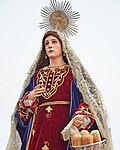 MarthaSaint · Sister of LazarusJul 29
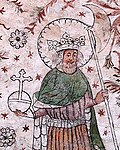 Olaf of NorwayRight-Believing · King of NorwayJul 29
 Lupus of TroyesSaint · Bishop of TroyesJul 29
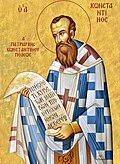 Constantine I of ConstantinopleSaint · Patriarch of ConstantinopleJul 29
- Constantine III of ConstantinopleSaint · Patriarch of ConstantinopleJul 29
 Serapia of RomeMartyr · Martyr of RomeJul 29
 Eustathius of MtskhetaMartyr · Persian convert, martyr in GeorgiaJul 29
 Callinicus of GangraMartyrJul 29
 Constantine of KosinoVenerable · Abbot of Kosino MonasteryJul 29
 Cosmas of KosinoVenerableJul 29
 Anatoly KamenskySaint · Archbishop of IrkutskJul 29
 Daniel of CherkasyMartyrJul 29