Venerable
Andrei Rublev
The Iconographer
Russian monk, the greatest icon painter of medieval Rus, author of the icon of the Holy Trinity.
- Feast
- July 4old style July 17
- Reposed
- 142815th century
- Place
- Andronikov Monastery
- Order
- Venerables
Life
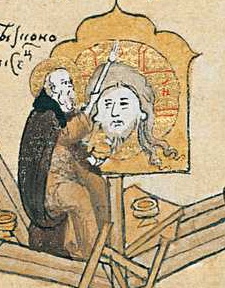
The Venerable Andrei Rublev was a Russian monk and iconographer, regarded as the greatest painter of icons and frescoes of medieval Rus. He is the author of the icon of the Holy Trinity, one of the best known Orthodox icons in the world. He was canonized by the Russian Orthodox Church in 1988. He is commemorated on 4 July (old style), his main feast, and on 29 January, the memory of his repose.
Life
Very little is known about the life of Andrei, and his birthplace is unknown. He was born between 1360 and 1370 near Moscow. While still young he went to the Holy Trinity Monastery, where he was deeply impressed by Saint Sergius of Radonezh. After the death of Saint Sergius in 1392, Saint Nikon became abbot, and Andrei was a novice under him. Before 1405, with Nikon's blessing, he moved to the Spaso-Andronikov Monastery, where he received monastic tonsure. There he learned iconography from Theophanes the Greek and from the monk Daniil the Black, his friend and fellow ascetic. Russian sources say that some scholars think he may have learned the craft in his youth in Byzantium and Bulgaria, but this is not certain.
His first mention in the chronicles is from 1405, when he painted icons and frescoes for the Cathedral of the Annunciation in the Kremlin, together with Theophanes the Greek, the great Byzantine master who moved to Russia, and with Prokhor of Gorodets. His name was listed last, since he was the youngest in both age and rank.
His work
The chronicles say that in 1408 he painted, with Daniil, the Dormition Cathedral in Vladimir and, between 1425 and 1427, the Trinity Cathedral of the Lavra of Saint Sergius. The Holy Trinity Monastery had been destroyed by the Tatars in 1408, and Nikon asked Andrei and Daniil to paint the new church. Russian sources also attribute to him the paintings and iconostasis of the Dormition Cathedral at Zvenigorod, a Deesis row at the Savvino-Storozhevsky monastery, and the icon of the Mother of God of Vladimir for the cathedral in Vladimir. After Daniil's death he came to the Andronikov Monastery in Moscow, where he painted his last work, the frescoes of the Saviour Cathedral. He is believed also to have painted a miniature in the Khitrovo Gospels.
The only work proven to be entirely his is the icon of the Holy Trinity, painted around 1410. It starts from the older icon of the Hospitality of Abraham, on the theme of Genesis 18, but Rublev removed Abraham and Sarah from the image and, through composition and symbols, turned the gaze to the mystery of the Trinity, showing the three angels at the table. In his art the highest asceticism and the classic harmony of the Byzantine style are woven together, and his figures are always peaceful and calm. The icon stood in the iconostasis of the Trinity Cathedral of the Lavra, where it was brought back to its place on 22 June 2024.
Repose and veneration
Andrei Rublev fell asleep at the Andronikov Monastery between 1427 and 1430, at over seventy years of age according to the synaxarion of the Orthodox Church in America, and was buried there. The synaxarion says that Daniil, who died before him, appeared to his friend and urged him to join him in eternal blessedness. Some sources give 29 January 1430 as the date of his repose.
His work influenced many iconographers, among them Dionisy. In 1551 the Stoglav Council set his style as a model for church painting. Since 1959 the Andrei Rublev Museum has been housed in the Andronikov Monastery. The Russian Orthodox Church numbered him among the saints in 1988, and the synaxaria also remember him in the synaxis of the saints of Moscow and of the saints of Radonezh.
Commemorated the same day July 4
 AnastasiaPassion-Bearer · Grand Duchess of RussiaJul 4
 MariaPassion-Bearer · Grand Duchess of RussiaJul 4
 OlgaPassion-Bearer · Grand Duchess of RussiaJul 4
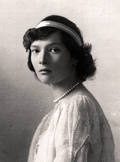 TatianaPassion-Bearer · Grand Duchess of RussiaJul 4
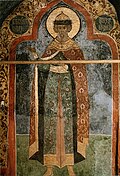 Andrei BogolyubskyRight-Believing · Grand Prince of VladimirJul 4
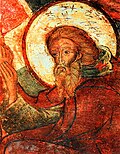 Andrew of CreteSaint · Archbishop of CreteJul 4
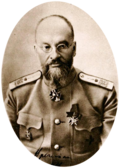 Eugene BotkinPassion-Bearer · Physician of the imperial familyJul 4
 Michael ChoniatesSaint · Metropolitan of AthensJul 4
 Anastasia of KievVenerable · Grand Duchess, later a nunJul 4
 Procopius of SázavaVenerable · Abbot of Sázava MonasteryJul 4
 Sava of Gornji KarlovacHieromartyr · Bishop of Gornji KarlovacJul 4
- Elias of JerusalemSaint · Patriarch of JerusalemJul 4