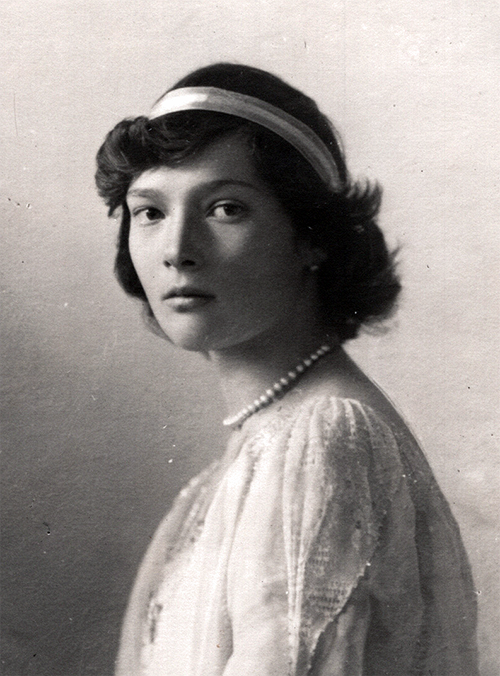
Passion-Bearer
Tatiana
Grand Duchess of Russia
Second daughter of Tsar Nicholas II, killed with her family at Yekaterinburg in 1918.
Life
The Holy Passion-Bearer Grand Duchess Tatiana Nikolaevna was the second daughter of Tsar Nicholas II and Tsarina Alexandra Feodorovna. She was killed with her family in the cellar of the Ipatiev House at Yekaterinburg, in the early hours of 17 July 1918, at the age of twenty-one. The Russian Orthodox Church canonized her in the year 2000, as a passion-bearer. Her commemoration is on 4 July in the old calendar, that is, 17 July in the new style.
Childhood
She was born on 10 June 1897 (29 May in the old style), at Peterhof, near Saint Petersburg. Her father chose her name after the heroine of Pushkin's novel in verse Eugene Onegin. The birth of a second girl was a disappointment to those around, who had hoped for an heir. She was the younger sister of Olga and the elder sister of Maria, Anastasia and the Tsarevich Alexei. With Olga she was called at home the Big Pair.
She was raised simply, like her sisters: they slept on camp beds without pillows, took a cold bath each morning, and in their free time sewed and knitted things for soldiers or for charity bazaars. Tall and slender, she was considered by many the most beautiful of the sisters. Among her siblings she was called the governess, for her domineering but also motherly ways. Of all the children she was the closest to her mother, to whom she read for hours.
Faith
Like her mother, Tatiana was deeply religious. She read the Bible often, studied theology and asked herself questions about good and evil, sorrow and forgiveness. Her English tutor said that she saw religion more as a duty than as a passion, but those close to her saw in her a nature of greater spiritual depth than her sister Olga. She did not use her imperial title, her friends called her Tatiana Nikolaevna, and on the telephone she introduced herself as Sister Romanova the Second.
In the war
When the First World War broke out, Tatiana became a Red Cross nurse, together with her mother and Olga. From 1914 to 1917 she tended wounded soldiers in the hospital at Tsarskoye Selo. A colleague tells that the girl would not spare herself: if the others could breathe carbolic acid, so could she. In September 1914 she became patron of the Tatiana Committee, founded to help the victims of the war. In August 1915 she wrote to her mother that she wished she could do more for Russia.
Arrest
After the revolution of 1917 the family was arrested and held at Tsarskoye Selo, then at Tobolsk and at Yekaterinburg. Cut off from work she loved, Tatiana suffered from idleness. In April 1918, when Alexei fell ill and could not be moved, she was the one who persuaded her mother to go to Yekaterinburg with her husband. Her mother decided that she, the level headed one, should stay at Tobolsk and look after the household and her brother. In those weeks Tatiana and her sisters sewed precious stones into their clothes, to hide them from their captors.
At Yekaterinburg the family was held in the Ipatiev House, and the girls did their own laundry and made bread. Tatiana was the one her parents sent to speak with the guards. On 14 July, at a service held in private by priests of the city, the family knelt at the prayer for the dead, which was not their custom. On 16 July, on her last day, Tatiana read with her mother from the books of the prophets Amos and Obadiah. In her notebook at Yekaterinburg she copied the words of Saint John of Kronstadt: your grief is beyond words, but the Saviour's grief in Gethsemane for the sins of the world is beyond measure, join your grief to His and you will find consolation in it.
Martyrdom
In the night of 16 to 17 July 1918 the family was woken and brought down to the cellar on the pretext that they would be taken to a safe place. The family crossed themselves as they passed a stuffed mother bear on the landing. Yakov Yurovsky read them the sentence and the squad fired. Tatiana had time only for a few sounds of fear and protest. She and Olga huddled together, calling for their mother, and the killers struck them with bayonets, but the jewels in their garments turned the blade. Tatiana was killed by Yurovsky with a shot to the head, and Olga, a moment later, by another killer.
The remains
Nearly all the bodies of the family were found in 1991 in the forest near Yekaterinburg, and on 17 July 1998 the remains of the tsar, the tsarina and three of the daughters, among them Tatiana, were buried in the cathedral of Saints Peter and Paul in Saint Petersburg. Rumours of the sisters' escape were spread for decades, and one woman claimed to be Tatiana, but scientific tests showed that the whole family was killed.
Canonization
The imperial family was canonized in 1981 by the Russian Orthodox Church Outside of Russia, as holy martyrs, and in August 2000 by the Russian Orthodox Church, as passion-bearers, in the synaxis of the New Martyrs and Confessors of Russia. Saint Tatiana is honoured, together with the tsar, the tsarina, their other children and the faithful who died with them, on 4 July in the old calendar. Her name day, the feast of the Holy Martyr Tatiana of Rome, falls on 12 January.
Commemorated the same day July 4
 Andrei RublevVenerable · The IconographerJul 4
 AnastasiaPassion-Bearer · Grand Duchess of RussiaJul 4
 MariaPassion-Bearer · Grand Duchess of RussiaJul 4
 OlgaPassion-Bearer · Grand Duchess of RussiaJul 4
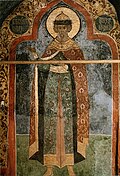 Andrei BogolyubskyRight-Believing · Grand Prince of VladimirJul 4
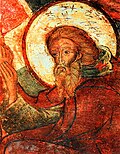 Andrew of CreteSaint · Archbishop of CreteJul 4
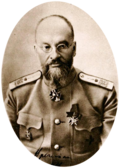 Eugene BotkinPassion-Bearer · Physician of the imperial familyJul 4
 Michael ChoniatesSaint · Metropolitan of AthensJul 4
 Anastasia of KievVenerable · Grand Duchess, later a nunJul 4
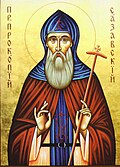 Procopius of SázavaVenerable · Abbot of Sázava MonasteryJul 4
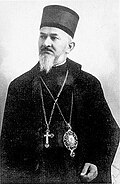 Sava of Gornji KarlovacHieromartyr · Bishop of Gornji KarlovacJul 4
- Elias of JerusalemSaint · Patriarch of JerusalemJul 4