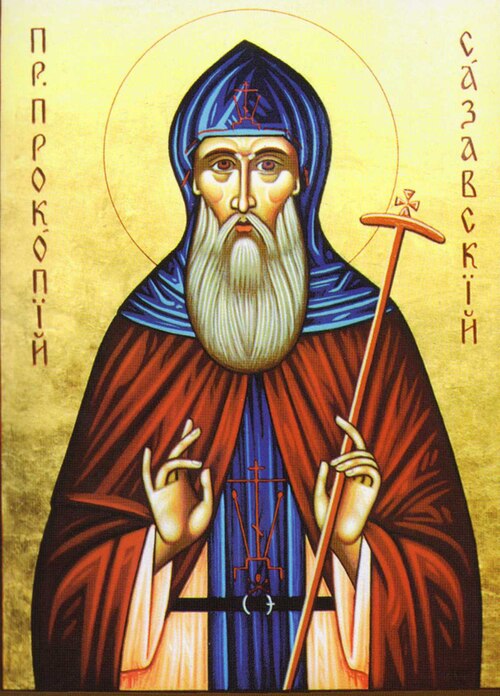
Venerable
Procopius of Sázava
Abbot of Sázava Monastery
Czech priest and hermit, abbot of Sázava, venerated in East and West, who died in 1053.
- Feast
- July 4old style July 17
- Reposed
- 105311th century
- Place
- Sázava
- Order
- Venerables
Life
The Venerable Procopius of Sázava was a priest, hermit and abbot in eleventh-century Bohemia, the founder of Sázava monastery, honoured by the Orthodox and Catholic Churches as a protector of the Czech lands. He fell asleep on 25 March 1053.
Only a little is known with certainty about his life; most of the stories come from lives written between the twelfth and fourteenth centuries. According to tradition he was born around 970 at Chotouň, near Kouřim, to parents named Vít and Božena. He studied at the Slavonic school at Vyšehrad (by other accounts, at Velehrad) and was ordained priest. He was married and had a son, Jimram (Emmeram). Later he chose monastic life, apparently at Břevnov monastery. After the Slavník family was destroyed by the Přemyslid dynasty, he withdrew to a cave near the Dalejské valley, close to Prague. It is said, from a note at the end of the Glagolitic part of a manuscript, that he wrote the Cyrillic part of the Gospel book later called the Reims Gospels.
Then he settled in the forests of the Sázava river valley, where he led an austere life, felling trees and working the land. According to legend, one day the local people saw him ploughing a field with a devil yoked to the plough, which he drove with a cross. Gradually disciples hungry for monastic life gathered around him and, under the protection of Duke Oldřich and his son Břetislav I, the monastery arose, of which Procopius was the first abbot for nearly twenty years. The community followed a rule combining the rule of Saint Basil the Great with features of that of Saint Benedict. Sázava remained a centre of Slavic culture and the last place in Bohemia where Church Slavonic was used in the services.
In the twelfth century his local veneration is attested, and in 1204 Pope Innocent III enrolled him among the saints, as the first Czech saint officially canonised. He became one of the patrons of Bohemia. In 1588 his relics were moved to the church of All Saints in Prague Castle. Sázava monastery was destroyed in the Hussite wars and the church was restored in the seventeenth century. A Baroque statue of him stands on the Charles Bridge in Prague, and in iconography he is shown as a monk with a devil beneath his feet, sometimes with a stag. Since 2017 his name has been in the calendar of the Russian Orthodox Church. The Orthodox Church of the Czech Lands and Slovakia honours him greatly. His feast is on 4 July.
Commemorated the same day July 4
 Andrei RublevVenerable · The IconographerJul 4
 AnastasiaPassion-Bearer · Grand Duchess of RussiaJul 4
 MariaPassion-Bearer · Grand Duchess of RussiaJul 4
 OlgaPassion-Bearer · Grand Duchess of RussiaJul 4
 TatianaPassion-Bearer · Grand Duchess of RussiaJul 4
 Andrei BogolyubskyRight-Believing · Grand Prince of VladimirJul 4
 Andrew of CreteSaint · Archbishop of CreteJul 4
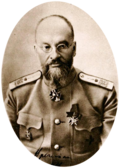 Eugene BotkinPassion-Bearer · Physician of the imperial familyJul 4
 Michael ChoniatesSaint · Metropolitan of AthensJul 4
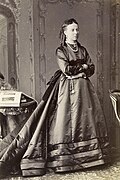 Anastasia of KievVenerable · Grand Duchess, later a nunJul 4
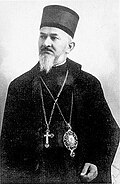 Sava of Gornji KarlovacHieromartyr · Bishop of Gornji KarlovacJul 4
- Elias of JerusalemSaint · Patriarch of JerusalemJul 4