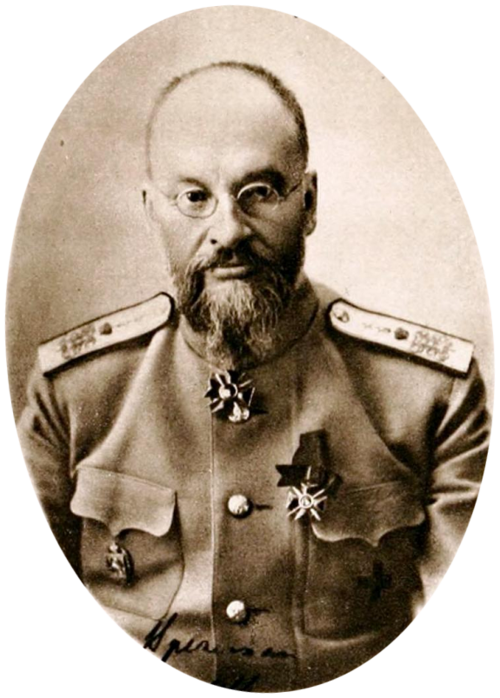
Passion-Bearer
Eugene Botkin
Physician of the imperial family
Court physician of Nicholas II, who remained with the imperial family and was killed at Yekaterinburg in 1918.
Life
Yevgeny Sergeyevich Botkin was physician at the court of Emperor Nicholas II and his family, and shared their exile to the very end. He was killed at Yekaterinburg in the night of 16 to 17 July 1918 together with the imperial family, and he is honoured as a righteous passion-bearer.
Youth and calling as a physician
He was born in 1865, the fourth son of Anastasia Alexandrovna, née Krylova, and Sergey Botkin, the famous physician of the emperors Alexander II and Alexander III and one of the founders of modern Russian medicine. He was first taught at home, then entered the fifth class of the Second Saint Petersburg Gymnasium directly. He followed his father in studying medicine and graduated in 1889 from the Military Medical Academy, third in his class.
He worked at the Mariinsky hospital for the poor and studied in Germany, at Berlin and Heidelberg. In 1893 he defended his doctoral thesis, dedicated to his father, with Ivan Pavlov as official opponent. His brother Peter later remembered him as a gentle child with a delicate inner sweetness, who was horrified by any quarrel and would step between boys who were fighting, even at the risk of being struck himself. In medicine he saw a calling to help, to console and to heal.
Service at court
In the Russo-Japanese War of 1904 he went to the front as a volunteer, in charge of the Red Cross medical service with the army in Manchuria, and he received several orders for his service. In 1907 he was appointed chief physician at Saint George Hospital in Saint Petersburg. At the request of Empress Alexandra Feodorovna he was invited to attend the imperial family, and in 1908 he became court physician to Nicholas II. At times he treated the Tsarevich Alexei, who suffered from haemophilia, as at Spała in 1912. He often spoke with the Empress in her native German and served as her interpreter when she received Russian delegations.
Married in 1891 to Olga Manuilova, he had four children, Dimitri, Yuri, Gleb and Tatiana. The marriage broke down under the strain of his long hours at court, and his eldest son fell in action in the First World War. Toward the end Botkin had grown ever more devout.
Exile and death
After the revolution of 1917, Botkin felt it his duty to accompany the Romanovs into exile, both toward his patients and toward his country. He went with them to Tobolsk and then to Yekaterinburg, to the Ipatiev House, and the Tsar counted him a friend. His last letter, left unfinished on the night of 16 July 1918, speaks of his conviction that he who endures to the end will be saved and of his resolve to fulfil his duty as a physician, though it left his children orphaned, as Abraham did not hesitate to offer his only son.
The letter was interrupted by Yakov Yurovsky, who ordered everyone to dress and come downstairs on the pretext of danger in the town. Shortly afterward the whole family and their servants, Botkin among them, who had volunteered to stay, were murdered. When the unmarked grave was found in the early 1990s, his remains bore bullet wounds in the legs, pelvis, spine and forehead.
Canonization
The Russian Orthodox Church Outside of Russia canonized him in 1981, together with the imperial family and the others killed in the Ipatiev House, as a New Martyr. In 2000 the Russian Orthodox Church canonized the imperial family as passion-bearers but not their servants. On 3 February 2016 its Council of Bishops numbered Botkin among the saints as the righteous passion-bearer Yevgeny the Physician. He is commemorated on 17 July.
Commemorated the same day July 4
 Andrei RublevVenerable · The IconographerJul 4
 AnastasiaPassion-Bearer · Grand Duchess of RussiaJul 4
 MariaPassion-Bearer · Grand Duchess of RussiaJul 4
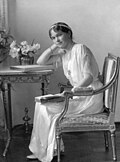 OlgaPassion-Bearer · Grand Duchess of RussiaJul 4
 TatianaPassion-Bearer · Grand Duchess of RussiaJul 4
 Andrei BogolyubskyRight-Believing · Grand Prince of VladimirJul 4
 Andrew of CreteSaint · Archbishop of CreteJul 4
 Michael ChoniatesSaint · Metropolitan of AthensJul 4
 Anastasia of KievVenerable · Grand Duchess, later a nunJul 4
 Procopius of SázavaVenerable · Abbot of Sázava MonasteryJul 4
 Sava of Gornji KarlovacHieromartyr · Bishop of Gornji KarlovacJul 4
- Elias of JerusalemSaint · Patriarch of JerusalemJul 4