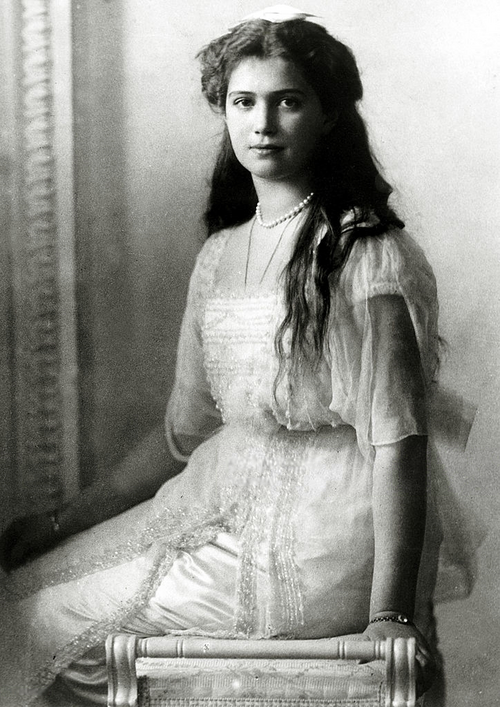
Passion-Bearer
Maria
Grand Duchess of Russia
Third daughter of Tsar Nicholas II, killed with her family at Yekaterinburg in 1918.
Life
The Holy Martyr Maria, Grand Duchess Maria Nikolaevna, was the third daughter of Tsar Nicholas II and Tsarina Alexandra Feodorovna. She was killed with her family at Yekaterinburg, in the night of 16 to 17 July 1918. She was glorified as a passion-bearer by the Russian Orthodox Church in 2000, after the Russian Orthodox Church Outside of Russia had canonized her in 1981. The Russian Church commemorates her on 17 July (new style), that is, 4 July by the old style.
Childhood
She was born on 14 June 1899 by the old style (26 June by the new style), at Peterhof near Saint Petersburg. The birth of a third daughter disappointed part of Russia, which was waiting for an heir, but her father said he was happy. Through her mother she was a great-granddaughter of Queen Victoria.
Her parents wished her and her siblings to be raised simply, so that even the servants called her Maria Nikolaevna. In the family she was called "Masha" or "Mashka". She was the elder sister of Anastasia, with whom she was known as "the little pair", sharing a room and dressing alike. The four sisters sometimes signed their letters together "OTMA", from the initials of their names.
Her character
She was a beauty, with large blue eyes that the family called "Marie's saucers". She was tall and strong, and like her grandfather Alexander III she could lift her tutors off the ground. She drew well, with her left hand, and was the only one of the sisters with an artistic gift. She cared less for schoolwork.
She had a kind and gentle soul; Grand Duke Vladimir Alexandrovich called her "the amiable baby". She was very close to her father and loved her brother Alexei dearly. She loved children and soldiers, and her dream was a marriage with many children. In 1917 Prince Carol of Romania asked for her hand, but the tsar thought her too young.
War and revolution
In the First World War she was too young to become a nursing sister like her mother and elder sisters, so she visited the wounded in the hospital at Tsarskoye Selo, played checkers and billiards with them and tried to cheer them. In the spring of 1917 she was the last of the children to fall ill with measles. She had gone out with her mother on the night of 13 March to the soldiers, to ask them to remain loyal to the family, and then she fell ill with measles and severe pneumonia. She was not told of her father's abdication until she had recovered.
Captivity
The family was arrested, at Tsarskoye Selo, then at Tobolsk and Yekaterinburg. In April 1918, when the family was briefly separated, Maria was chosen to accompany her parents to Yekaterinburg. There she tried to make friends with the soldiers guarding the Ipatiev House, spoke to them about their families and showed them her photographs. On 26 June 1918 she turned nineteen.
On 14 July the priests of the town served a service in the house and saw that the family knelt at the prayer for the departed. On 16 July, her last full day, Maria walked in the garden with her father and sisters. In the night the family was taken down to the cellar and shot. Maria was nineteen.
Her remains
After her death several women claimed to be Maria, but DNA analysis has shown that no one in the family escaped. In the grave found in 1991 there were nine skeletons, without those of Alexei and of one daughter; Russian scientists thought Maria was missing, American scientists thought Anastasia. In 2007 the burned bones of a boy and a young woman were found at a nearby site, and DNA analyses of 2008 and 2009 showed that they are those of Alexei and of one of the daughters, whom the Russians take to be Maria. In 2015 the Russian Church postponed their burial with the family, asking for further study. The bone fragments remain for now in a state repository.
Glorification
The Russian Orthodox Church Outside of Russia canonized the tsar's family in 1981, and the Russian Orthodox Church did so in August 2000, as passion-bearers, in the synaxis of the New Martyrs of Russia. Services and icons often call them martyrs. The faithful pray to Maria and the others of the family, and some have told of healings and conversions to the Orthodox Church after prayer to them.
Commemorated the same day July 4
 Andrei RublevVenerable · The IconographerJul 4
 AnastasiaPassion-Bearer · Grand Duchess of RussiaJul 4
 OlgaPassion-Bearer · Grand Duchess of RussiaJul 4
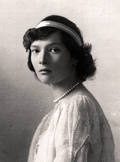 TatianaPassion-Bearer · Grand Duchess of RussiaJul 4
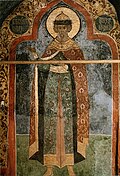 Andrei BogolyubskyRight-Believing · Grand Prince of VladimirJul 4
 Andrew of CreteSaint · Archbishop of CreteJul 4
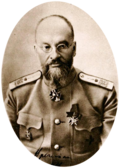 Eugene BotkinPassion-Bearer · Physician of the imperial familyJul 4
 Michael ChoniatesSaint · Metropolitan of AthensJul 4
 Anastasia of KievVenerable · Grand Duchess, later a nunJul 4
 Procopius of SázavaVenerable · Abbot of Sázava MonasteryJul 4
 Sava of Gornji KarlovacHieromartyr · Bishop of Gornji KarlovacJul 4
- Elias of JerusalemSaint · Patriarch of JerusalemJul 4