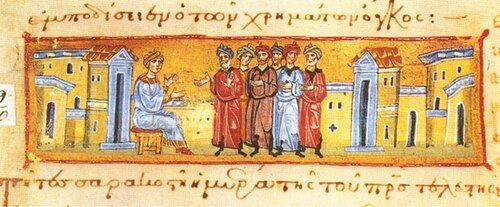
Holy Venerables
Barlaam and Joasaph
The hermit Barlaam brought Joasaph, son of an Indian king who persecuted the Church, to the Christian faith.
- Feast
- November 27old style December 10
- Era
- unknown
- Order
- Venerables
Life
The Venerable Barlaam and Joasaph are honoured in the Church's calendar as the monk who brought Joasaph, son of a king of India, to the Christian faith, and as the disciple who gave up a throne for the wilderness. Their story, told in many languages, is a Christian tale with roots in an older legend, and the historical existence of the two is not proven. The Slavic calendars remember them on 19 November, the Greek calendar on 26 August (both by the Julian calendar), and the old Roman Martyrology had them on 27 November.
The story
According to tradition, King Abenner of India, who persecuted the Church founded there by the Apostle Thomas, learned from astrologers that his only son, Joasaph, would become a Christian. To prevent this he shut the prince in a palace, away from any sight of sickness, old age and death. When the young man did go out and met a sick man, a blind man and an old man, he began to ask what life is for.
Then the monk Barlaam came to him disguised as a dealer in precious stones, saying that he carried a stone of great price which heals blindness of the soul. Through parables, such as that of the man pursued by a unicorn and that of the four caskets, Barlaam taught him the Christian faith. Joasaph believed and was baptized.
Trials and withdrawal
The king tried to turn his son back through pagan counsellors, sorcery and temptations, but Joasaph stood firm. In the end Abenner himself accepted the faith, handed the throne to his son and lived as a hermit. Joasaph reigned for a time as a Christian king, then left his crown, went into the wilderness and settled beside Barlaam. There he lived many years of ascetic labour and departed to the Lord.
History of the text
Scholars regard the tale as a Christian adaptation of the legend of the Buddha, which reached Christians through Manichaean, Persian and Arabic versions (the Book of Bilawhar and Budhasaf). The name Joasaph comes, through Arabic and Georgian, from the Sanskrit word bodhisattva. The oldest surviving Christian form is the Georgian romance Balavariani, of the tenth century, and the Georgian monk Euthymius the Athonite translated it into Greek shortly before his death in 1028. The Greek version was long attributed to Saint John of Damascus, but modern scholars do not consider it his work.
From the eleventh century the story spread across Europe in Latin and the Slavic languages and was read as the life of two saints. Its parable of the caskets appears in Shakespeare's Merchant of Venice. In Romanian it was translated in the seventeenth century by Udriște Năsturel.
Commemorated the same day November 27
 Virgil of SalzburgSaint · Bishop of SalzburgNov 27
 Palladius of HelenopolisSaint · Bishop of HelenopolisNov 27
 James the PersianGreat Martyr · Martyr of PersiaNov 27
 Theodosius of TarnovoVenerable · Bulgarian hermit and clericNov 27
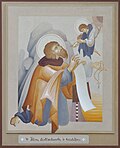 Damaskinos the StuditeSaint · Patriarchal exarch of AitoliaNov 27
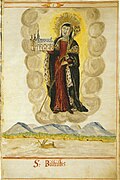 Bilihildis of AltmünsterVenerable · Abbess of AltmünsterNov 27
 Roman Olgovich of RyazanRight-Believing · Grand Prince of RyazanNov 27
 James of RostovSaint · Bishop of RostovNov 27
 Acacius of SebasteHieromartyr · Priest of SebasteNov 27
 Kronid LyubimovHieromartyr · Superior of the Trinity LavraNov 27
 Alexis GavrinVenerable Martyr · MonkNov 27
 Joasaph BoevVenerable Martyr · ArchimandriteNov 27