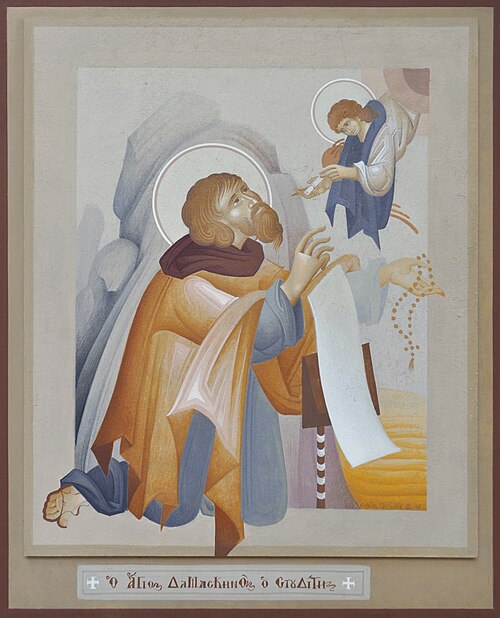
Saint
Damaskinos the Studite
Patriarchal exarch of Aitolia
Greek cleric and writer of the sixteenth century, born in Thessalonica and a monk in Constantinople.
- Feast
- November 27old style December 10
- Reposed
- 157716th century
- Place
- Thessaloniki
- Order
- Hierarchs
Life
Saint Damaskinos the Studite was a Greek cleric and scholar of the sixteenth century, born in Thessalonica, metropolitan of Nafpaktos and Arta, and the author of a collection of sermons in the spoken language of his day. The Church numbered him among the saints in 2013, and he is remembered on 27 November.
He was born in Thessalonica, between 1500 and 1520, under Ottoman rule. As a young man he went to Constantinople, where he attended the Patriarchal Academy as a student of Theophanes Eleavoulkos Notaras. He is said to have entered the Stoudios monastery, whence his name the Studite, though one scholar thinks the name comes from his reputation as a preacher, not from the monastery. He was ordained subdeacon. Between 1550 and 1558 he was in the region of Trikala, probably as a teacher. He was later a priest, a preacher in Constantinople and a patriarchal exarch.
Before 1558, while still a subdeacon, he composed his best known and best loved work, the Thesauros (Treasure), a collection of thirty-six sermons on biblical passages, written in the spoken Greek of the time. The work shows a wide knowledge of Scripture, the Fathers, history and philosophy. It was printed in Venice in the 1560s and reissued many times until the nineteenth century, and was translated into several Slavic languages and into Turkish. He also wrote an interpretation of the Lord's Prayer and an exhortation to monks who wish to be saved. His work gave rise to the so-called “damaskin” literature, which strongly influenced Bulgarian and other Slavic cultures.
In the 1560s he was consecrated bishop of Lete and Rendina and took part in the synod of Constantinople in 1565 that deposed Patriarch Joasaph II. In 1574 he was installed metropolitan of Nafpaktos and Arta and became patriarchal exarch of Aitolia. He died in 1577 in his metropolis.
He was regarded as the most learned and virtuous cleric of his time. An epigram composed for him calls him “the wisdom of the Greeks” and describes his death as a heavy hour that left all lovers of Greek learning orphaned. His memory is kept on 27 November, the day set when he was canonized, in 2013, together with Acacius of Lete and Rendina.
Commemorated the same day November 27
 Barlaam and JoasaphHoly VenerablesNov 27
 Virgil of SalzburgSaint · Bishop of SalzburgNov 27
 Palladius of HelenopolisSaint · Bishop of HelenopolisNov 27
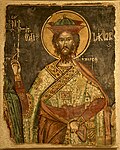 James the PersianGreat Martyr · Martyr of PersiaNov 27
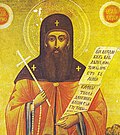 Theodosius of TarnovoVenerable · Bulgarian hermit and clericNov 27
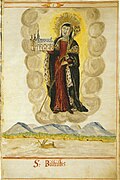 Bilihildis of AltmünsterVenerable · Abbess of AltmünsterNov 27
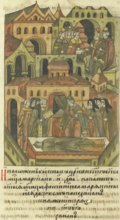 Roman Olgovich of RyazanRight-Believing · Grand Prince of RyazanNov 27
 James of RostovSaint · Bishop of RostovNov 27
 Acacius of SebasteHieromartyr · Priest of SebasteNov 27
 Kronid LyubimovHieromartyr · Superior of the Trinity LavraNov 27
 Alexis GavrinVenerable Martyr · MonkNov 27
 Joasaph BoevVenerable Martyr · ArchimandriteNov 27