Venerable
Bilihildis of Altmünster
Abbess of Altmünster
Frankish noblewoman, founder and abbess of Altmünster near Mainz, venerated locally as a saint; died in 734.
- Feast
- November 27old style December 10
- Reposed
- 7348th century
- Place
- Mainz
- Order
- Venerables
Life
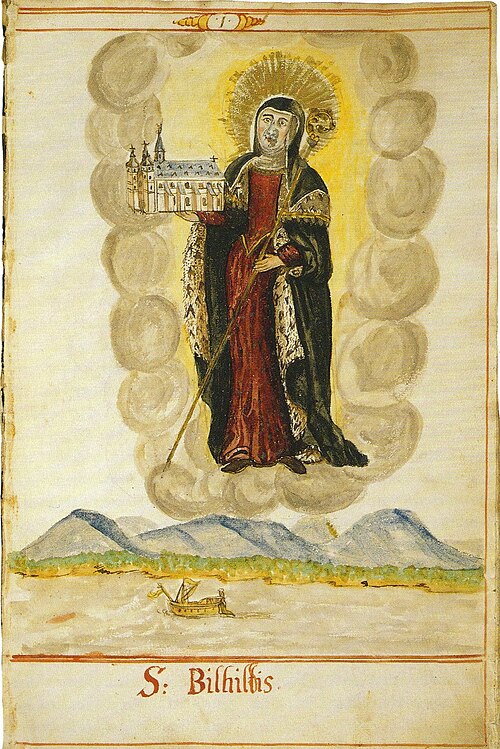
The venerable Bilihildis, also spelled Bilhild or Bilehild, was a Frankish noblewoman, the founder and first abbess of the monastery of Altmünster near Mainz, where she reposed on 27 November 734. She is honoured by the Church, above all in the region of Mainz, as a patron of the sick, and her feast is kept on 27 November.
The sources
Her life is hard to establish. The oldest lives, five in all, date from after 1060, long after her death, and rest on the traditions of the Church rather than on records of her own time. They took earlier lives as models, among them that of Saint Radegund and that of Saint Kilian. Some scholars hold that firm evidence of her existence only goes back to the twelfth century, and part of the detail in the lives is probably mistaken. What follows is therefore what tradition tells.
Youth and marriage
According to tradition she was born in the seventh century at Hocheim, usually identified with Veitshöchheim near Würzburg, to the Frankish count Iberin and his wife Mathilda, close relatives of the Merovingians. Among her kin were her sisters Hildegard and Reginhild and her uncle, Rigibert, bishop of Mainz. She was brought up a Christian, but the lives differ on whether she had been baptized: by one account the invasion of pagan "Huns" had driven the priests out of her homeland, so that she was baptized only later, though she herself believed she had received baptism as a child.
Bilihildis wished to give her life to Christ, but around 672 her parents gave her in marriage to a pagan ruler named Hetan, whose seat was at Würzburg. It is not certain which duke of that name he was: most likely Hedan I, who died in 687, but possibly Hedan II or another member of their family. One life says she married under pressure from her parents; another, that she loved her husband and tried again and again to bring him to Christianity, but his attachment to paganism turned her from him for good.
Altmünster
One day, while the duke was away at war, Bilihildis, already with child, fled to her uncle Rigibert at Mainz. There she bore a son, who soon died. Some sources say she then went back to her husband and brought him to the faith; others that the duke had already fallen in battle and that she lived at Mainz to the end. She asked the bishop for leave to found a house for religious women and, with the wealth she had from her parents, which she had sold at Hocheim, she built the monastery of Altmünster between 691/694 and 700/720, and became its first abbess.
It is told that before her death the nuns doubted whether she had been chrismated in due time. A divine revelation showed that she was not at fault for being unbaptized, and she was then chrismated, so that she could rightly be abbess. She fell asleep in the Lord on 27 November 734 and was buried in the abbey church. The lives say that her tomb soon gave off a sweet fragrance and that many miracles took place there.
Veneration
Firm evidence of her veneration survives from around the year 1000, and in the eighteenth century it spread widely. Her relics are today in Mainz Cathedral. In 1991 her skull was examined scientifically, and the result confirmed that it may be hers. An abbess's habit and a model of the monastery she founded are also kept. At Altmünster a sudarium, a cloth attributed to Christ, was later venerated, given according to some versions by a queen Imnechild and according to others by Kunegundis.
Commemorated the same day November 27
 Barlaam and JoasaphHoly VenerablesNov 27
 Virgil of SalzburgSaint · Bishop of SalzburgNov 27
 Palladius of HelenopolisSaint · Bishop of HelenopolisNov 27
 James the PersianGreat Martyr · Martyr of PersiaNov 27
 Theodosius of TarnovoVenerable · Bulgarian hermit and clericNov 27
 Damaskinos the StuditeSaint · Patriarchal exarch of AitoliaNov 27
 Roman Olgovich of RyazanRight-Believing · Grand Prince of RyazanNov 27
 James of RostovSaint · Bishop of RostovNov 27
 Acacius of SebasteHieromartyr · Priest of SebasteNov 27
 Kronid LyubimovHieromartyr · Superior of the Trinity LavraNov 27
 Alexis GavrinVenerable Martyr · MonkNov 27
 Joasaph BoevVenerable Martyr · ArchimandriteNov 27