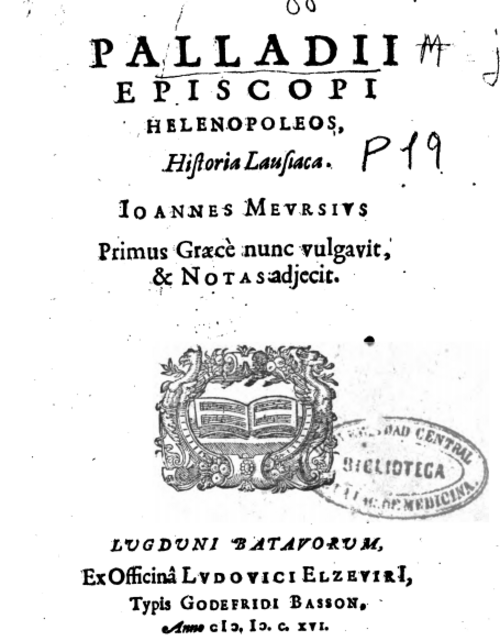
Saint
Palladius of Helenopolis
Bishop of Helenopolis
Bishop of Helenopolis in Bithynia, disciple of John Chrysostom, author of the Lausiac History.
- Feast
- November 27old style December 10
- Reposed
- 4315th century
- Place
- Galatia
- Order
- Hierarchs
Life
Saint Palladius, bishop of Helenopolis, was a devoted disciple of Saint John Chrysostom and the author of the Lausiac History, the best known collection of lives of the monks of ancient Egypt. He was born in Galatia in 363 or 364 and fell asleep in the Lord in the second decade of the fifth century, or, according to some sources, between 420 and 430. The Church honors him as a hierarch and as the chronicler of the desert fathers.
Youth and travels
Palladius gave himself to monastic life in 386 or soon after, living at first on the Mount of Olives. Wishing to know the struggles of the Fathers of the desert at first hand, he went to Egypt and reached Alexandria in 388. Around 390 he passed on to Nitria and visited the famous monk Or, and a year later he went southwest to Kellia, a great monastic community spread over many kilometers of the Nitrian desert, some forty miles south of Alexandria. He learned from those ascetics and came to know their lives.
Bishop and trials
After these journeys his health failed and he went to Palestine in search of a milder climate. In the year 400 he was ordained bishop of Helenopolis in Bithynia, and soon became caught up in the controversies around Saint John Chrysostom. In 405 he travelled again to Rome to testify that Chrysostom was not a heretic. For this, Emperor Arcadius exiled him for six years to Syene in Egypt, where he wrote his life of Saint John Chrysostom, in the form of a dialogue. In 412 or 413 he was restored to the episcopate, now as bishop of Aspuna in Galatia.
Writings
His main work, the Lausiac History, was written in 419-420 for Lausus, a chamberlain at the court of Emperor Theodosius II; it is also titled The Lives of the Friends of God. It describes monastic life in Egypt and the Middle East and is a precious source for the beginnings of monasticism. He is also credited with the Dialogue on the Life of John Chrysostom.
Veneration
Palladius ended his life at Aspuna, in his own diocese. The Church commemorates him on the day of the veneration of all the saints of Egypt, and the Coptic Orthodox and Syriac Orthodox Churches call him "the Solitary" and keep his feast on 29 November.
Commemorated the same day November 27
 Barlaam and JoasaphHoly VenerablesNov 27
 Virgil of SalzburgSaint · Bishop of SalzburgNov 27
 James the PersianGreat Martyr · Martyr of PersiaNov 27
 Theodosius of TarnovoVenerable · Bulgarian hermit and clericNov 27
 Damaskinos the StuditeSaint · Patriarchal exarch of AitoliaNov 27
 Bilihildis of AltmünsterVenerable · Abbess of AltmünsterNov 27
 Roman Olgovich of RyazanRight-Believing · Grand Prince of RyazanNov 27
 James of RostovSaint · Bishop of RostovNov 27
 Acacius of SebasteHieromartyr · Priest of SebasteNov 27
 Kronid LyubimovHieromartyr · Superior of the Trinity LavraNov 27
 Alexis GavrinVenerable Martyr · MonkNov 27
 Joasaph BoevVenerable Martyr · ArchimandriteNov 27