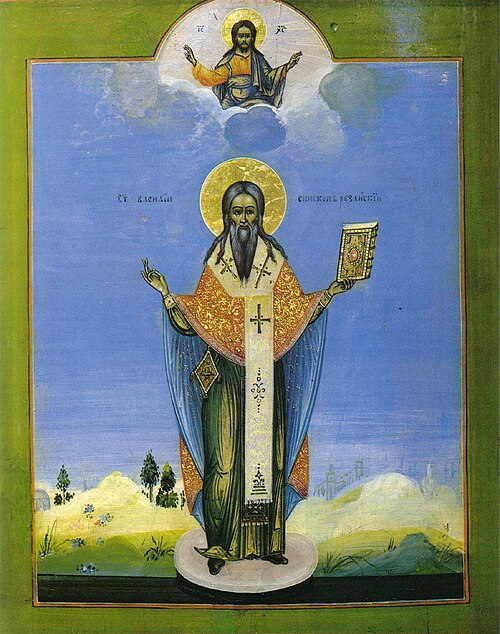
Saint
Basil of Ryazan
Bishop of Ryazan and Murom
Bishop of Ryazan and Murom, by tradition tonsured a monk at Murom.
Life
Saint Basil of Ryazan, Hierarch, was bishop of Ryazan and Murom, venerated by the Russian Church as a hierarch. Dates of his life are uncertain: he died in 1294 or 1295, by other reckonings between 1356 and 1360. He is remembered on 3 July (the day of his repose) and on 10 June (the day of the translation of his relics).
According to tradition he was tonsured a monk at Murom and then consecrated bishop of Murom. He is mentioned in the Laurentian Chronicle. After the city of Murom was laid waste by unbelievers, the right-believing Prince George Yaroslavich came from Kyiv to Murom, who renewed the church of the Annunciation and the second church, of the Holy Passion-Bearers Boris and Gleb, and set in them, as before, a bishop named Basil, a righteous and pious man.
The “Tale of Bishop Basil,” composed in the middle of the sixteenth century, says that he worked a miracle while bishop of Murom. The crowd, through the snares of the devil, accused Basil of shameful conduct (“O bishop, it is unworthy of you to have maidens in your house, on your bed”) and resolved to drive him from Murom, and some even wished to kill him. Bishop Basil, after prayer, went out to the Oka, spread his episcopal mantle on the water, stood on it with an icon of the Mother of God in his hands and so, in six hours, was carried against the current as far as Old Ryazan. The priests, the prince with the boyars and the people came out on the bank of the Oka to meet the saint and then received him with joy. The see was moved from Murom to Old Ryazan. After the destruction of Old Ryazan by the Tatars, Saint Basil moved to Pereyaslavl-Ryazansky, that is, today's Ryazan. According to tradition he came here too along the Oka and the Trubezh on his mantle, with the same Murom icon of the Mother of God, to the church of Boris and Gleb, and here he founded a new bishopric. His ministry lasted only ten years. On 3 July 1295 (in other sources, between 1356 and 1360) he fell asleep. His body was buried in the cathedral of Boris and Gleb.
The tradition about Saint Basil is confused and anachronistic. Two bishops of Ryazan are known with the name Basil, one from the end of the thirteenth century, the other from the middle of the fourteenth, second and fourth in the list of Ryazan hierarchs. It is held more probable that he lived in the first half or middle of the fourteenth century. The time when his veneration began is not known. He was not canonized among the saints of Murom at the councils of 1547 and 1553, but his local veneration most likely came from the glorification of the Murom wonderworkers by the council. In 1568, through a change in the site of the church of Boris and Gleb, Saint Basil's grave, which was inside it, came to lie outside. On 10 June 1609 the archbishop of Ryazan and Murom, Theodorit, found the saint's relics and moved them to a place sheltered from enemies, the Dormition (now Nativity of Christ) cathedral of Ryazan; they were laid under a covering on the left choir. From that time Saint Basil's name “is commemorated in all the churches of the diocese of Ryazan.” In the 1630s a stone tomb was built over the relics in the Dormition cathedral and above it was placed the icon “The Prayer of Basil,” in which the saint floats on the river on the mantle spread on the water, with the icon of the Mother of God in his right hand and a staff in his left. In 1712, under Metropolitan Stephen Yavorsky, a stone chapel was built over the site of the original burial, by the church of Boris and Gleb. In 1753 the tomb in the Dormition cathedral was converted into a shrine with the saint's image. By a decree of 1814 the Holy Synod permitted the commemoration of Saint Basil on 21 May, together with the wonderworkers of Murom; by a decree of 1881 the days of 3 July (repose) and 10 June (translation of relics) were established. Today his relics are in the Nativity of Christ cathedral of Ryazan.
Commemorated the same day June 10
 Etheldreda of ElyVenerable · Abbess of ElyJun 10
 Olivia of PalermoMartyrJun 10
 John of TobolskSaint · Metropolitan of TobolskJun 10
 Maximus of AveiaMartyr · Deacon and martyrJun 10
 Mitrophan Chi SungHieromartyr · First Chinese Orthodox priestJun 10
 Dosifei of KyivVenerable · Rassophore at the Kiev Caves LavraJun 10
 Philotheus of TobolskSaint · Metropolitan of Siberia and TobolskJun 10
 Gerasim DobroserdovSaint · Bishop of AstrakhanJun 10
 Paul of TobolskSaint · Metropolitan of TobolskJun 10
 Schema-abbess Tamar MarjanishviliConfessor · Georgian schema-abbessJun 10
 Dalmat of IsetskVenerable · Founder of Dalmatov MonasteryJun 10
 Antonia and AlexanderHoly MartyrsJun 10