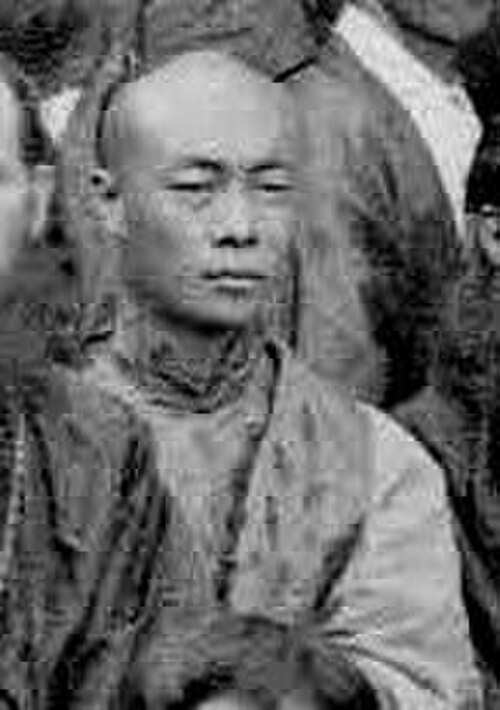
Hieromartyr
Mitrophan Chi Sung
First Chinese Orthodox priest
First Orthodox priest of Chinese descent, killed at Beijing in June 1900 during the Boxer Rebellion.
Life
Saint Mitrophan Chi Sung (Chang Chi-chung, 1855-1900) the hieromartyr was the first Orthodox priest of Chinese descent and one of the first Chinese martyrs of Orthodoxy. He was killed in Beijing on 10 June 1900, during the Boxer Rebellion, together with his wife and other relatives. He is one of the 222 Chinese Martyrs, first approved for local veneration by the Holy Synod of the Russian Church in 1902; on 3 February 2016 the Council of Bishops of the Russian Church blessed the church-wide veneration of the hieromartyr Mitrophan and of the martyrs who suffered with him. He is commemorated on 10 June.
Youth
The Russian Spiritual Mission in Beijing, established in 1685, preached Christianity to the Chinese, and many Chinese became Orthodox, but before Mitrophan no Chinese man had been an Orthodox priest. He was born on 10 December 1855 (by the Chinese calendar the tenth day of the twelfth month), with a typical Han name, Chang Yangji. He lost his father when small and was raised by his grandmother, Ekaterina, and his mother, Marina, who was a teacher at a girls' school. At baptism he was given the Greek name Mitrophan. He was regarded as a very quiet and humble man, "of gentle disposition, very cautious and silent, peaceable and not provocative; when some, even very heavy, offence occurred, he did not try to justify himself".
He was educated at the Russian mission in Beijing by the scholar (juren) Longyuan, who prepared him for eventual priestly service, at the urging of Archimandrite Palladius (Kafarov), head of the Fifteenth Mission (1865-1878), who encouraged him. Mitrophan hesitated, thinking himself unworthy. In 1874 Archimandrite Palladius appointed him catechist. The new head of the mission, Archimandrite Flavian (Gorodetsky), from 1879, supported the idea that Mitrophan should receive the priesthood, though he himself refused it. Pressed by Flavian and persuaded by the teacher Longyuan, Mitrophan obeyed and was ordained priest by Saint Nicholas (Kasatkin) of Japan, according to the Russian source in July 1882 at Tokyo (according to the English source, in 1880, at twenty-five).
Under Flavian, Father Mitrophan helped in translating books into Chinese, and until 1896 served in the mission church. He was not acquisitive, and so many abused his trust. He bore many offences and insults from his own and from outsiders and in 1896 fell into a quiet derangement of mind, after which he lived over three years outside the mission's enclosure, on half his former salary.
Martyrdom
His relatively uneventful life was ended when in 1900 the Boxer Rebellion broke out in north-eastern China. The Boxers were a secret society that practised martial arts and wanted to destroy foreign influence in China; they first rose against the Qing dynasty but then united with it to attack those they regarded as enemies. During the rebellion they brutally killed hundreds of Christians and foreigners, by disembowelment, burning alive and beheading, and many were forced to recant their faith. On the evening of 1 June 1900 (the 17th of the fifth month) the buildings of the Russian Spiritual Mission were burned, and many Chinese Orthodox, escaping the danger, gathered in Father Mitrophan's house, among them former ill-wishers of his, whom he did not despise. Seeing that some were disturbed, he strengthened them with words of encouragement. He himself went several times a day to look at the burned church. On 7 June, according to the English source, his son Isaiah, a soldier, was beheaded near the Pingzemen Gate.
On 10 June, in the evening, about the tenth hour (by the Chinese reckoning), Chinese soldiers and Boxers surrounded Father Mitrophan's dwelling, in which there were up to seventy Chinese Orthodox. Some managed to leave the house, while the priest, with many women and children, stayed and were tortured. The Boxers pierced his chest "like honeycombs" and he died in the courtyard of his house, under a date tree; he was forty-four. Present were his wife Tatiana, of the Li family, and three sons: Isaiah, Sergei and John. His son John, aged seven, had the worst end: they slashed his shoulders and cut off his nose, ears and toes; Maria, the fiancée of Isaiah, had hidden him in an outhouse, but he was found asking neighbours for water, who refused him; they mocked him, calling him "er mao zi" ("secondary foreigner"), and he answered that he was only a follower of God. Asked whether his wounds pained him, he said that he did not suffer for the cause of Christ. When he was captured again by the Boxers, he walked calmly to his death, and an old man tried to intercede for him, saying it was not the child's fault that he had been raised a Christian, but in vain. Maria, nineteen, the fiancée of Isaiah, had stayed to help others escape; her brother-in-law Sergei had urged her to flee, but she refused. The priest's wife, Tatiana, at first escaped the slaughter with Maria's help, but was captured later and beheaded near the Andingmen Gate. The son Sergei, who escaped the slaughter, the only survivor of his whole family, became an archpriest.
Veneration
Neighbours carried the body of the hieromartyr to the place where the mission's almshouse had been, and later the hieromonk Abraham (Chasovnikov) took it, and in 1903, when the feast of the Chinese martyrs was first celebrated, his remains were laid with those of others under the altar of the church of the martyrs of the Russian Mission in Beijing.
Commemorated the same day June 10
 Etheldreda of ElyVenerable · Abbess of ElyJun 10
 Olivia of PalermoMartyrJun 10
 John of TobolskSaint · Metropolitan of TobolskJun 10
 Maximus of AveiaMartyr · Deacon and martyrJun 10
 Basil of RyazanSaint · Bishop of Ryazan and MuromJun 10
 Dosifei of KyivVenerable · Rassophore at the Kiev Caves LavraJun 10
 Philotheus of TobolskSaint · Metropolitan of Siberia and TobolskJun 10
 Gerasim DobroserdovSaint · Bishop of AstrakhanJun 10
 Paul of TobolskSaint · Metropolitan of TobolskJun 10
 Schema-abbess Tamar MarjanishviliConfessor · Georgian schema-abbessJun 10
 Dalmat of IsetskVenerable · Founder of Dalmatov MonasteryJun 10
 Antonia and AlexanderHoly MartyrsJun 10