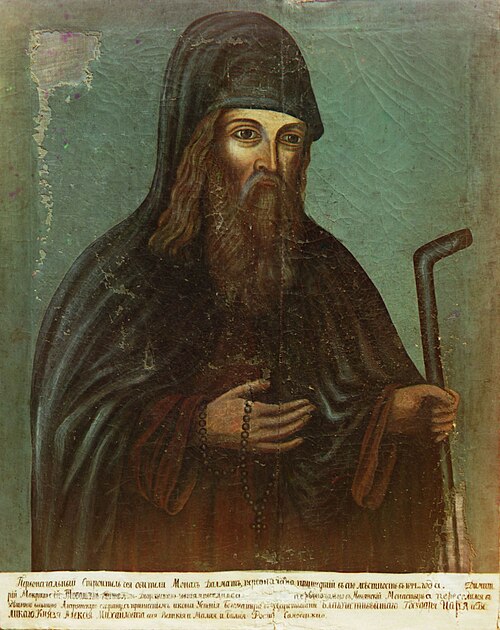
Venerable
Dalmat of Isetsk
Founder of Dalmatov Monastery
Founder of the Dormition Monastery at Dalmatov, born in 1594 at Berezov; the town of Dalmatov bears his name.
- Feast
- June 10old style June 23
- Reposed
- 169717th century
- Place
- Dalmatovsky Monastery
- Order
- Venerables
Life
Saint Dalmat of Isetsk, also called Dalmat of Perm, in the world Dmitry Ivanovich Mokrinsky, was the founder of the Dormition Monastery at Dalmatovo in western Siberia. A former official of the Siberian administration, he became a monk late in life, lived as a hermit on the Iset River, and gathered a community that survived repeated devastation. He reposed in 1697 at over a hundred years of age, and the town of Dalmatov, which grew up around the monastery, bears his name.
Our knowledge of his life comes mainly from the "Account of the Founding of the Dalmatov Monastery", written early in the eighteenth century by his son, Archimandrite Isaac (Mokrinsky).
Origins and service in the world
Dmitry Mokrinsky was born in 1594 in the fort of Berezov in the Tobolsk region (today Beryozovo in the Khanty-Mansi Autonomous Okrug), into the family of the Cossack ataman Ivan Mokrinsky. His mother probably came from newly baptized Siberian Tatars of the clan of the Tyumen murza Iligey, or from the Ostyaks. There were three sons in the family: Dmitry, Savvaty and Fyodor.
Siberian records list Dmitry among the "boyar sons" and show that around 1627-1628 he was transferred with his family from Berezov to Tobolsk. In 1628 he served as a town official in Tobolsk, and in 1633 as a steward in the fort of Vagai. In December 1628 a fire broke out in the administrative office where he slept, destroying the town seal, the governor's papers and a large sum of money; after an inquiry, all charges against him were dropped.
He had five children, and his grain allowance was not enough to support his family, so he also took to farming. His son Isaac wrote that he was not very rich but lived without great want, kept his house in plenty and, by his faith, was diligent in attending church.
Monk and hermit
In 1642 or 1643 Dmitry left his service, his wife and his children and was tonsured a monk with the name Dalmat at the Monastery of the Saviour and the Theophany in Nevyansk. He probably chose this monastery because his brother Savvaty lived in the Nevyansk settlement.
Around 1644, seeking solitude, Dalmat left the monastery, where he had been offered the post of builder, and settled in a cave at the confluence of the Techa and the Iset, at a place called Beloye Gorodishche. In the same year he built a wooden chapel there.
The land belonged to the Tatar Iligey, who leased it for hunting and fishing to men from Irbit and Nevyansk. Urged on by the tenants, he twice tried to drive Dalmat out of his cave. The Life says that in 1645, as Iligey was going to the cave to expel him, the Mother of God appeared to him and commanded him to give the land to the hermit. In the spring of 1646 Iligey gave Beloye Gorodishche to Dalmat, and in 1659 a royal charter confirmed the land to the monastery.
The hermitage on the Iset
Disciples soon gathered around Dalmat, and the Iset hermitage came into being, the first Russian settlement in the Iset valley. His first companion was the elder Ivan from Nizhny Novgorod. From 1649 Timofey Nevezhin, the founder of the town of Kurgan, lived in the hermitage in return for a donation, doing all kinds of work without pay.
With the blessing of Archbishop Gerasim (Kremlyov) of Tobolsk a wooden chapel was built. The chief treasure of the community was the icon of the Dormition of the Mother of God, which Dalmat had brought from the Nevyansk monastery.
In September 1651 the hermitage was burned by the troops of the Siberian prince Devlet-Girey. Some of the monks were killed and the rest taken captive. Dalmat was away at the time; returning to the ashes, he found the icon of the Dormition unharmed. Afterwards disciples came to him again and the community was rebuilt.
In the early 1650s Athanasius (Lyubimov), later the first Archbishop of Kholmogory and Vaga, came to Dalmat and lived as his disciple for more than ten years. With the blessing of Archbishop Simeon of Tobolsk a Church of the Dormition was built with a side chapel of Saint Demetrius of Priluki, cells were raised, and the community was enclosed with a palisade.
The monastery and its trials
In 1651 the elders petitioned Tsar Alexis Mikhailovich and the governor of Tobolsk for the land. By a royal charter of 17 May 1659 the hermitage was confirmed as a monastery, and its protection was entrusted to the Tobolsk governor. The first abbot was Dalmat's son Isaac, who had been tonsured in his father's monastery after 1651.
A separate cell was set apart for Dalmat, where he lived in seclusion, keeping in the entryway the coffin he had made for himself as a reminder of the hour of death. Yet in a letter of 1664 he wrote that the brethren began no work, spiritual or bodily, without his direction. He also sent patrols into the steppe to give warning of approaching nomads.
Between 1662 and 1664 the monastery was ravaged several times by nomadic raids; records say that after one raid it was burned and levelled to the ground. During these years Dalmat was several times close to death. Twice his monastery was destroyed to its foundations, and twice he rebuilt it from the ruins.
A strict rule and a convent
Dalmat kept a very strict monastic rule. In 1664, when he was denounced for not celebrating the name days of the tsar and his family, he replied in his own hand that when these days fell in Great Lent only a service of supplication was held, and the celebration was kept after Bright Week.
To spread the Orthodox faith beyond the Urals, Dalmat and his son Isaac founded in 1684, near the Dormition Monastery, a convent of the Entry of the Theotokos into the Temple, where twenty-seven sisters lived.
The reforms of Nikon
After Patriarch Nikon's revision of the service books, Dalmat did not accept the changes at once. Because of the monastery's ties with the Old Believers, his son Isaac was removed from the office of abbot around 1668, and the penalties against him were lifted only in 1685. A former abbot who had been tonsured at Dalmatovo denounced Dalmat as a schismatic, and the historian Vasily Tatishchev wrote that he had joined the schism before becoming a monk and was later brought back to Orthodoxy by the bishop of Tobolsk; this report is considered to rest on unreliable rumour. A "Letter on the Antichrist and His Hidden Kingdom", addressed to the Old Believers, is also attributed to him.
Repose
Saint Dalmat reposed in peace in June 1697 at the age of one hundred and three. The monastery chronicle says he died on 24 June, ripe in virtue like full wheat for the heavenly granary; other sources give 25 June. His son, Abbot Isaac, buried him with tears in the coffin he had prepared for himself, beside the altar of the wooden Church of the Dormition, which he had founded.
Popular veneration
The grave was set in a brick vault, and in 1707 a wooden chapel was built over it. In 1793 the painter I. Sokolovsky decorated the wooden tomb cover with scenes from his life: the quarrel with Iligey, the appearance of the Mother of God, and the Tatar's repentance before Dalmat.
His veneration began among the people. They came to pray at his grave, especially on 15 August and 9 May, and drew water from the spring at Beloye Gorodishche, which was held to be healing. In 1864 an annual procession was established at Dalmatovo on the day of his death, for protection against fires.
A helmet and a coat of mail, believed to be gifts from Iligey as a sign of reconciliation, were kept at the tomb. Dalmat came to be honoured as a protector of soldiers, and recruits about to leave for the army would come to his tomb to put on the helmet and mail as a blessing. The helmet, known as "Iligey's helmet", is a Western European cavalry helmet bearing marks of combat; after the monastery was closed these relics went to the Sverdlovsk regional museum.
For a long time the church authorities did not support this veneration and rejected proposals to build a church or chapel at his grave. Only in 1871 was Dalmat first called "venerable" in an official document, and from that year the monastery began recording miracles worked through his prayers.
The tomb and the relics
In 1871, during the building of a church of the icon of the Mother of God "Joy of All Who Sorrow", his coffin was found. After an examination by Bishop Vassian (Chudnovsky) of Yekaterinburg, the foundation of the church was altered so that the grave would remain undisturbed. In 1896 a stone burial chamber adjoining the church was built over it, decorated with scenes from his life and a portrait believed to have been painted in his lifetime. In 1918 his name was included in the service to All Saints Who Shone Forth in the Russian Land.
In 1923 the monastery was closed, and services ceased in 1928. The burial chamber was used in turn as a theatre cloakroom, a hospital, a factory workshop and a laundry; the tomb cover was thrown away, the paintings were covered over, and the floor above the grave was repeatedly concreted.
Glorification
Monastic life returned to Dalmatovo in 1992. With the blessing of Bishop Michael (Raskovalov) of Kurgan, excavations were carried out in the burial chamber, and on 6 August 1994 the relics of Saint Dalmat were uncovered and placed in a wooden shrine in the church of the "Joy of All Who Sorrow". For the three hundredth anniversary of his death a service and an akathist were composed in his honour.
In 2004 Dalmat was glorified as a locally venerated saint of the Diocese of Kurgan and Shadrinsk. On 4 February 2013 the Bishops' Council of the Russian Orthodox Church approved his veneration throughout the Church, and in 2017 the Holy Synod approved his troparion and kontakion. He is commemorated on 10 June with the Synaxis of the Saints of Siberia, on 25 June, the day of his repose, and on 24 July, the uncovering of his relics (Old Style dates).
Commemorated the same day June 10
 Etheldreda of ElyVenerable · Abbess of ElyJun 10
 Olivia of PalermoMartyrJun 10
 John of TobolskSaint · Metropolitan of TobolskJun 10
 Maximus of AveiaMartyr · Deacon and martyrJun 10
 Basil of RyazanSaint · Bishop of Ryazan and MuromJun 10
 Mitrophan Chi SungHieromartyr · First Chinese Orthodox priestJun 10
 Dosifei of KyivVenerable · Rassophore at the Kiev Caves LavraJun 10
 Philotheus of TobolskSaint · Metropolitan of Siberia and TobolskJun 10
 Gerasim DobroserdovSaint · Bishop of AstrakhanJun 10
 Paul of TobolskSaint · Metropolitan of TobolskJun 10
 Schema-abbess Tamar MarjanishviliConfessor · Georgian schema-abbessJun 10
 Antonia and AlexanderHoly MartyrsJun 10