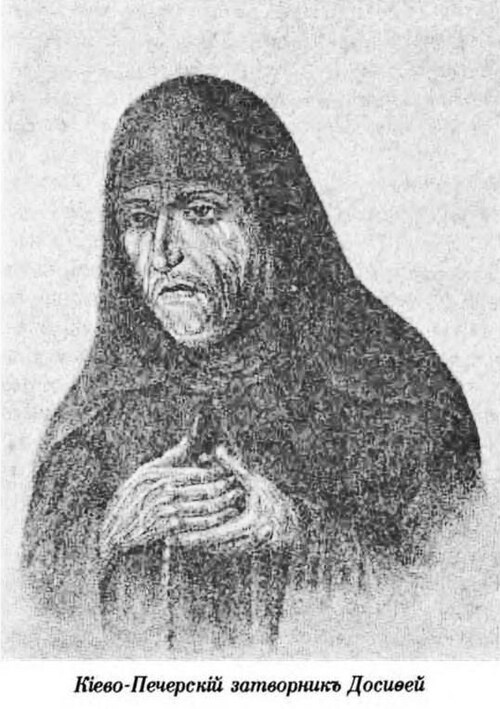
Venerable
Dosifei of Kyiv
Rassophore at the Kiev Caves Lavra
Rassophore ascetic of the Kiev Caves Lavra in the 18th century, traditionally born Darya Tyapkina.
- Feast
- June 10old style June 23
- Reposed
- 177618th century
- Place
- Kyiv
- Order
- Venerables
Life
Venerable Dosithea (Dositheus) of Kyiv, also called Dositheus of Kitaev (1721 to 1776), was, according to her traditional life, a girl from a noble family of Ryazan, Daria Tyapkina, who, dressed in men's clothes, lived as a rassophore monk in the Kyiv Caves Lavra and the Kitaev hermitage. She was a hermit and spiritual elder, known also as a seer. Her secret was discovered only after death. She is venerated as a saint in the Russian Orthodox Church and the Ukrainian Orthodox Church, but historians question her identification with Daria Tyapkina.
Childhood and flight
According to the traditional life, Daria was born in 1721 into the Tyapkin family of Ryazan nobles. When she was two, her parents visited the holy places of the Trinity-Sergius Lavra and stopped at the Ascension Monastery in Moscow, at the home of the nun Porphyria, the child's grandmother, who had recently resolved to devote the rest of her life to God. At Porphyria's insistence Daria stayed with her and remained within the monastery walls until she was nine. Porphyria raised her granddaughter diligently, instilling Christian virtues: humility, non-possession, obedience, love of neighbor. As a result, when her parents took her back into the family, she could not adapt to the ways of noble life. The akathist to the saint says: "Rejoice, you who knew the sweetness of obedience before the temptations of this world". She was not at all glad to move to her parents' house. Until sixteen she kept the spirit of an ascetic in the family: she slept on a board, was a stranger to her relatives' amusements, never went to balls or other social gatherings, did not eat what was offered to her but lived far more simply. In the end, under the threat of being married off, she fled home at sixteen and went to Moscow in search of a monastic refuge. (The Serbian source has her leave "in her fifteenth year" and says she received basic schooling in Moscow; the Ukrainian one says she left at fifteen and that her grandmother was a nun of the Ascension Monastery in Moscow.)
Wandering
In Moscow, after passing through places known from childhood, Daria understood that she would not easily hide from her parents' search. She bought men's clothes at the market and went to the Trinity-Sergius Lavra, presenting herself as the runaway peasant Dosifei. Under the laws of the time, the abbot could receive such a youth into the brotherhood only with the permission of the Holy Synod or the emperor; nonetheless Dosifei was allowed to remain in obedience. The ascetic spent three years in the monastery. Daria's parents, who had searched everywhere, once came to the lavra, saw Dosifei from afar and arranged a meeting with him. Recognizing his waiting relatives, Dosifei did not wait to be exposed and set off at once for Kyiv. The Ukrainian source says she cut her hair before entering the lavra.
In the Kyiv Caves Lavra Dosifei was not received. The Serbian source says the reason was the lack of identity papers, and the Ukrainian one that everyone took him for a fugitive. Then the ascetic went to a suburb called Kitaevo and, digging a cave in the hill, after the example of Saint Anthony, began the work of salvation. He fed on bread, water and what he could find around him (the Ukrainian source adds a gruel of groats), and in the cave cell he never kept a fire. The Serbian source says that his food was left at the entrance by a monk, that in Great Lent he shut himself in and ate only wild grass growing nearby, and that he had the gifts of prophecy and discernment of hearts. The fame of the ascetic began to spread around.
Monasticism and seclusion
He received monastic tonsure unexpectedly. In 1744 Empress Elizabeth visited Kyiv and, learning of the ascetic, wished to see him personally. She came to his cell, spoke with him and, learning that Dosifei had not yet been tonsured, permitted his reception into monasticism by her order and was present at the sacrament. Dosifei became a rassophore monk of the Kyiv Caves Lavra. The Ukrainian source says that after the tonsure of 1744 he did not leave the hermit's way of life and received a cell near the Far Caves of the lavra; in 1766 he was moved again to Kitaev, where he lived in a secluded cell by a pond.
Later, without leaving seclusion, Dosifei took on the labor of spiritual eldership; there are traditions that he also bore the folly for Christ. Guiding those who ran to him for counsel, he raised in the spirit of the highest virtue his cell attendant Theophanes, who later became an ascetic at Solovki. In 1776 he blessed Prokhor Moshnin, then twenty-two (the future Seraphim of Sarov), to take the path of salvation in the Sarov monastery (the Serbian source says that after meeting Seraphim of Sarov, she went to Sarov and then settled in a remote cell of the Kitaev hermitage; the order is not the same in the two sources). The elder labored on Mount Kitaev and in the lavra, at the Far Caves.
Before death the elder came out of seclusion and with tears asked forgiveness of all. After fifty-five years of life, Dosifei reposed in prayer, standing, on 25 September 1776, the day of the memory of Saint Sergius of Radonezh. The Serbian source gives 26 September 1776, and the Ukrainian one writes the year 1776 or 1777; the Ukrainian synodal decision of 1993, quoted by the Russian source, writes 1777.
The secret discovered and the glorification
Dosithea gave up her spirit in prayer, with a note in her left hand: "My body is prepared for the journey to eternal life; I beg you, brothers, to bury it without touching it, in the usual way", which was done exactly. The secret was revealed when Daria's sister looked at the portrait of the elder Dosifei on the gravestone and recognized her missing sister. Then all understood that the elder Dosifei was a maiden, and many inexplicable facts in the saint's life became clear. Nevertheless, three attempts to find the relics of Dosithea failed.
The cultural historian O. O. Krainia has cast doubt on the identity of Dosifei with Daria Tyapkina, since, when the life was compared with archival documents, a number of inconsistencies between the two persons came to light. In the article in volume 16 of the "Orthodox Encyclopedia" (2007) doubt is expressed about the female sex of the saint, and the whole article uses the masculine: "Dosifei of Kitaev (of Kyiv)".
By decision of the Holy Synod of the Ukrainian Orthodox Church (Moscow Patriarchate) of 27 July 1993, the venerable Dosifei of Kyiv, rassophore monk, was canonized together with the venerable Theophilus, Alexis and Parthenius and the fool for Christ Paisius, as a locally venerated saint, with commemoration on 25 September (old style) / 8 October (new style). By decision of the Council of Bishops of the Russian Orthodox Church of 3 February 2016, general-church veneration was established for her under a female name, as Dosithea (Tyapkina), the recluse of Kyiv. The conventional gravestone set up in the early 1990s over the probable burial place, beside the Holy Trinity church, with the inscription "Rassophore monk Dosifei", was replaced earlier by another with a female name. The saint's relics lie under the slab, on the north side of the parish Holy Trinity church in the Kitaev hermitage. In the cave church of the Synaxis of the Mother of God, built on the place of the labors of Dosithea and other ascetics, a so-called "cell of Dosithea" is arranged, where anyone can honor her memory. The Russian source gives as days of commemoration 23 June (Synaxis of the Saints of Ryazan), 27 July and 8 October, and the Ukrainian one 25 September (old style) / 8 October (new style).
Commemorated the same day June 10
 Etheldreda of ElyVenerable · Abbess of ElyJun 10
 Olivia of PalermoMartyrJun 10
 John of TobolskSaint · Metropolitan of TobolskJun 10
 Maximus of AveiaMartyr · Deacon and martyrJun 10
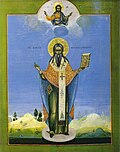 Basil of RyazanSaint · Bishop of Ryazan and MuromJun 10
 Mitrophan Chi SungHieromartyr · First Chinese Orthodox priestJun 10
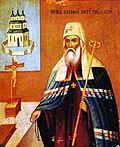 Philotheus of TobolskSaint · Metropolitan of Siberia and TobolskJun 10
 Gerasim DobroserdovSaint · Bishop of AstrakhanJun 10
 Paul of TobolskSaint · Metropolitan of TobolskJun 10
 Schema-abbess Tamar MarjanishviliConfessor · Georgian schema-abbessJun 10
 Dalmat of IsetskVenerable · Founder of Dalmatov MonasteryJun 10
 Antonia and AlexanderHoly MartyrsJun 10