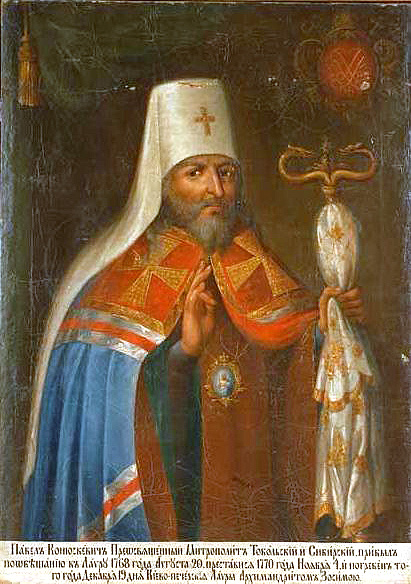
Saint
Paul of Tobolsk
Metropolitan of Tobolsk
Born in Sambir, Metropolitan of Tobolsk and Siberia, who died in Kyiv in 1770; honored in the Synaxis of Siberian Saints.
Life
Saint Paul (in the world Pyotr Konyuskevich, 1705-1770) the hierarch was Metropolitan of Tobolsk and Siberia, born at Sambir in Galicia and died at Kyiv. He is venerated in the Russian Orthodox Church as a holy hierarch, with commemoration on 10 June (in the synaxis of the saints of Siberia) and on 4 November. His veneration was confirmed in stages: in 1984 he was glorified in the Synaxis of the Saints of Siberia, in 2001 entered in the Synaxis of the Saints of Galicia, on 14 May 1999 canonized by the Ukrainian Orthodox Church (Kyiv Patriarchate), and in 2008 canonized also by the Russian Church. He should not be confused with Metropolitan Paul who governed the see in the seventeenth century.
Youth and monasticism
He was born in 1705 at Sambir in Galicia, in a well-off townsman family, who came from the Carpathian village of Koniuski (now Luky near Sambir). He studied at the brotherhood school of Sambir and then at the Kyiv Theological Academy, and after graduating was kept on to teach poetics. He had a gentle but firm character and was very persevering in work. He loved the service and church singing much. At twenty-eight, in 1733, he was tonsured at the Kiev Caves Lavra with the name Paul, and the next year was ordained hierodeacon. He taught a course of poetics at the Kyiv Academy (1738-1740), then, returning to the Lavra, was treasurer of the printing house. As a hieromonk he accompanied the abbot of the Lavra to Saint Petersburg, where he was noticed and sent as preacher to the Slavo-Greek-Latin Academy in Moscow (1741-1743).
In 1744 he was raised to the rank of archimandrite and appointed abbot of the monastery of Saint George (Yuriev) at Novgorod. He served as abbot fifteen years and built several buildings in the monastery (among them the sacristy, preserved to this day, and the fence of the eastern part).
Metropolitan of Tobolsk
On 23 May 1758 he was consecrated at Saint Petersburg bishop of Tobolsk and Siberia, with elevation to metropolitan. He reached Tobolsk only on 20 November. In his rule he renewed the Tobolsk seminary, invited three learned monks from Kyiv to teach there and made it a notable centre of education and culture of Siberia. He took care of church building, giving preference to stone ones (in his time about twenty stone churches and many wooden ones were built in the diocese), and opened many parishes. He restored the church of the Epiphany, burned a month before his arrival, together with the wooden church of Saint Zacharias. In 1761 the stone church of the Exaltation of the Cross was consecrated at Tobolsk, in 1762 the church of the Nativity of the Mother of God at the convent, and a stone bell tower at the church of the Annunciation. At the Znamensky monastery, the Ukrainian Mikhail Mitkevich completed in 1767 the building of a bell tower and a stone church. In 1764, in his time, the relics of Saint Innocent of Irkutsk were found (glorified in 1805). Strict in governing, he was generous to the poor, orphans and widows; he was a leading preacher and theologian, who stubbornly spoke Ukrainian to everyone.
Leaving the see
Metropolitan Paul was dissatisfied with Catherine II's policy of secularizing church property and wrote the Synod a sharp letter. On the other hand, his strictness, bordering on cruelty, drew a flood of complaints. His activity aroused the dissatisfaction of some local priests, who had the support of the chief procurator of the Synod, I. Melissino. The real cause of dissatisfaction "at the top" was that he had consistently opposed the interference of the secular power in church affairs and the intention to secularize its lands; Metropolitan Ilarion (Ohienko) considered him "of one mind with Metropolitan Arsenius (Matsievich) in the defence of the holy Orthodox Church". In 1767 he was summoned to the Synod; because of illness he stayed at Tobolsk until 11 January 1768. Arriving in Moscow in April, before the trial he sent the Holy Synod a request for retirement to the Kiev Caves Lavra, which was granted by the empress's order of 7 May (it is said that he had been condemned to deprivation of episcopal rank, but the empress did not confirm the Synod's decision). On 29 June he arrived at the Caves Lavra, where he stayed until his death. In autumn 1770 he made his will, by which all that he still had he had "in full mind and of his own will" already given to the poor. He died on 4 November 1770, after a long illness, "with every Christian order", as the archimandrite of the Lavra reported to the Synod. He was buried in the crypt under the Dormition cathedral of the Lavra, in the side chapel of Saint Stephen.
Veneration
From 1910 preparation for canonization began, but was never completed. So in 1912 his remains were moved into a new reliquary, of gilded bronze, with scenes from his life. In 1914-1918 the question of canonization was raised, and the Council of 1917-1918 decided to gather further data, but the Bolshevik coup prevented it. After the destruction of the Dormition cathedral in 1941, the relics lay almost sixty years under its ruins; during the archaeological research led by Gleb Ivakin the grave of Metropolitan Paul was found among numerous burials in slate sarcophagi of the fifteenth century. Today the relics rest in the Far Caves of the Lavra, beside the underground church of the Annunciation and near the relics of the hieromartyr Vladimir. On 20 March 1994, on the Sunday of Orthodoxy, the cornerstone of a church in his honour was consecrated at Sambir, today one of the finest Orthodox churches in Ukraine. It is said that after the saint's death many miracles took place at his grave: the sick received healing, as the entries in the Lavra's chronicles show. Since 2013 there has been the Kuzbass Literary Prize of Saint Paul, Metropolitan of Tobolsk.
Commemorated the same day June 10
 Etheldreda of ElyVenerable · Abbess of ElyJun 10
 Olivia of PalermoMartyrJun 10
 John of TobolskSaint · Metropolitan of TobolskJun 10
 Maximus of AveiaMartyr · Deacon and martyrJun 10
 Basil of RyazanSaint · Bishop of Ryazan and MuromJun 10
 Mitrophan Chi SungHieromartyr · First Chinese Orthodox priestJun 10
 Dosifei of KyivVenerable · Rassophore at the Kiev Caves LavraJun 10
 Philotheus of TobolskSaint · Metropolitan of Siberia and TobolskJun 10
 Gerasim DobroserdovSaint · Bishop of AstrakhanJun 10
 Schema-abbess Tamar MarjanishviliConfessor · Georgian schema-abbessJun 10
 Dalmat of IsetskVenerable · Founder of Dalmatov MonasteryJun 10
 Antonia and AlexanderHoly MartyrsJun 10